Archaeological excavations at the Üçağızlı II Cave on Turkey’s Mediterranean coast have revealed that Neanderthals and modern humans shared remarkably similar cultural behaviors and survival strategies. Recent findings published in the journal PNAS indicate that both groups utilized the same local flint sources, hunted identical prey, and collected specific marine shells, suggesting a deep level of cultural interaction rather than distinct, isolated developments.
This discovery at Üçağızlı II, a prehistoric corridor between the Levant and Eurasia, challenges the long-held assumption that Neanderthals and Homo sapiens functioned in entirely separate cultural spheres. By analyzing the internal structures of fossilized teeth and employing optically stimulated luminescence to date sediment layers, researchers have established a timeline of occupation that provides new clarity on how these two groups coexisted in the region.
Evidence of Shared Cultural Behavior
The research, which centers on the Üçağızlı II site, shows that Neanderthals occupied the cave between roughly 77,000 and 59,000 years ago, followed by Homo sapiens from about 59,000 to 47,000 years ago. Despite the chronological separation, the archaeological record demonstrates a striking uniformity in lithic technology and hunting-gathering strategies. Both groups relied on the same local resources to produce stone tools and focused their hunting efforts on species such as wild goats (Capra aegagrus), fallow deer (Dama mesopotamica), roe deer (Capreolus capreolus), and wild boar (Sus scrofa).
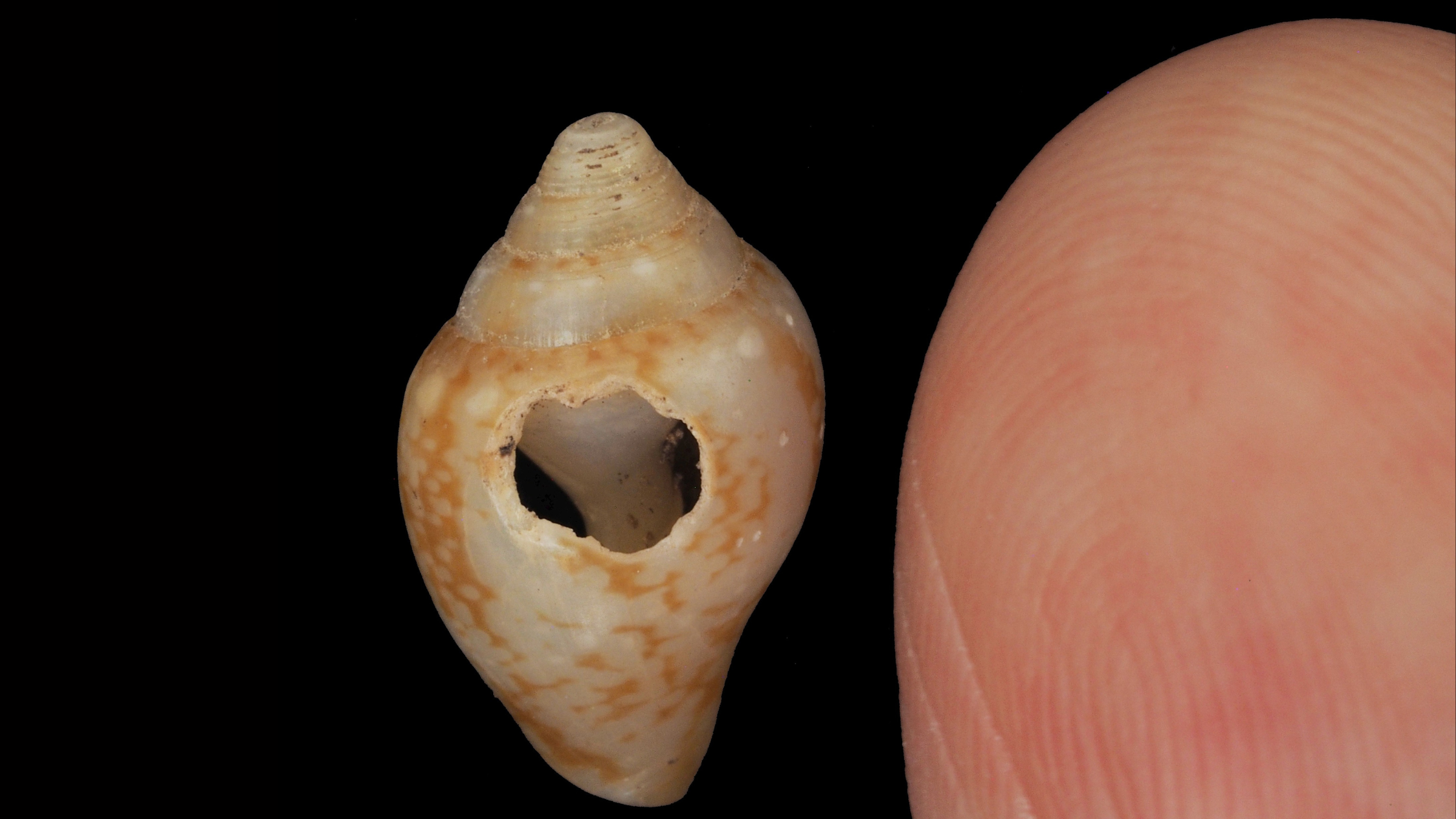
Perhaps most compelling is the discovery of 29 shells of the marine snail Columbella rustica. These shells were transported into the cave, likely for use as personal ornaments rather than as a food source. Some specimens exhibit perforations suggesting they were strung, and one shell from the Neanderthal-occupied layer shows evidence of deliberate heating to alter its color, a practice indicative of symbolic behavior. According to Naoki Morimoto, a paleoanthropologist at Kyoto University and co-author of the study, these findings suggest that the two groups were not merely reacting to the same environment, but were likely sharing symbolic preferences.
The research team performs excavations at the Üçağızlı II cave site in 2024. (Image credit: KyotoU/Naoki Morimoto)
Regional Context and Evolutionary Questions
This evidence of cultural continuity contrasts with findings from other sites, such as Mandrin Cave in France, where Neanderthal and modern human occupations appear as distinct, alternating pulses without clear signs of shared culture. However, the situation at Üçağızlı II mirrors data from Tinshemet Cave in Israel, where researchers have identified similar behavioral overlaps between the two groups dating back to between 130,000 and 80,000 years ago. These findings suggest that while there was a biological turnover as populations shifted, the cultural framework in the region remained largely stable.

April Nowell, a Paleolithic archaeologist at the University of Victoria in Canada who was not involved in the research, noted that sites like Üçağızlı II are forcing a reassessment of the relationship between these human groups. She stated that by demonstrating cultural continuity and elevated levels of interaction, these sites are changing the understanding of how Neanderthals and Homo sapiens interacted during the Late Pleistocene. While Neanderthals eventually went extinct around 40,000 years ago, the degree of overlap in their daily lives raises questions about the nature of their contact, including the possibility of interbreeding or the exchange of information.
A view of Turkey’s Üçağızlı II Cave, which housed Neanderthals and Homo sapiens at different times. (Image credit: KyotoU/Naoki Morimoto)
Future Directions in Evolutionary Research
Despite the insights gained from the Turkish site, many questions remain regarding the exact mechanisms of these shared cultural practices. Researchers are currently looking at whether these similarities were the result of direct contact, shared environmental pressures, or even genetic intermingling. The ongoing excavation and analysis of the Üçağızlı II site continue to provide a more detailed picture of human evolution, moving away from the idea that Neanderthals were inherently less cognitively capable than their modern counterparts.
As scientists continue to analyze the material from this site, the focus remains on clarifying when and where these cultural exchanges occurred. Further updates on the progress of these excavations and new analyses of the recovered fossils will be shared as the research team publishes their findings in peer-reviewed journals. Readers are encouraged to keep an eye on official university press releases and future PNAS publications for the latest developments in this ongoing study of our shared human past.