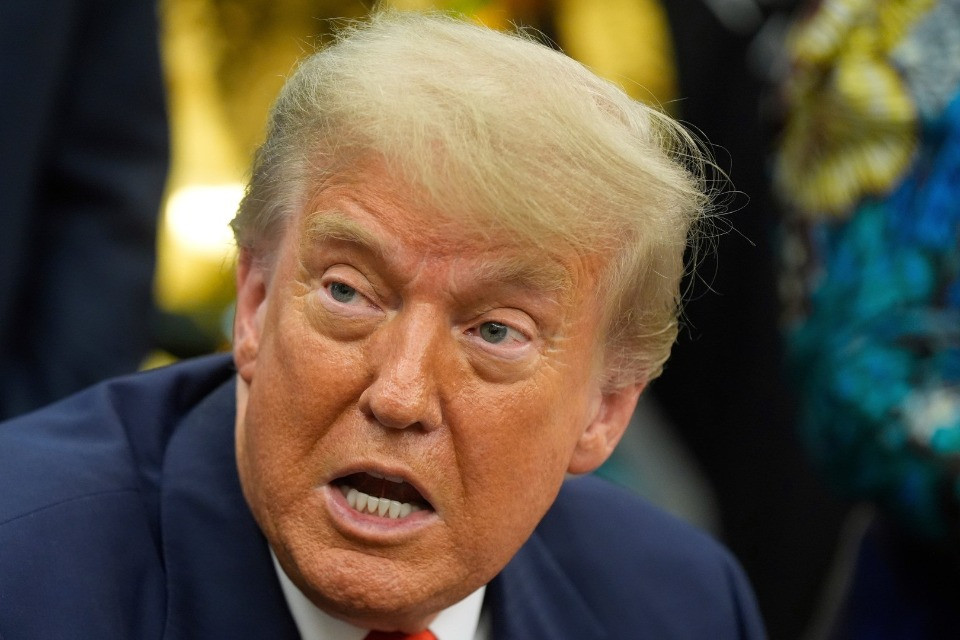
Washington D.C. – Accusations leveled by former U.S. President Donald Trump regarding Iran’s development of long-range missiles capable of reaching the United States and its renewed pursuit of nuclear weapons have sparked a diplomatic firestorm. These claims, made during his State of the Union address on February 25, 2026, have been vehemently denied by Iranian officials, who dismiss them as “grand lies.” The escalating rhetoric comes as indirect talks between the two nations are set to resume in Geneva, adding further complexity to an already fraught geopolitical landscape.
The core of the dispute centers on Iran’s ballistic missile program and its nuclear ambitions. Trump asserted that Iran is actively working to rebuild its nuclear program, which he claimed was “totally obliterated” by U.S. Strikes in June 2025. He likewise warned of potential military action should Iran fail to abandon its nuclear pursuits. But, the extent of the damage inflicted during those strikes – targeting facilities at Fordow, Natanz and Isfahan – remains a point of contention, with varying assessments from U.S. Officials, intelligence reports, and Iranian authorities. The situation is further complicated by the ongoing Iran-Israel conflict, which has seen a series of escalating attacks and counterattacks.
U.S. Strikes on Iranian Nuclear Sites: Conflicting Assessments
On June 22, 2025, the United States Air Force and Navy launched attacks on three Iranian nuclear facilities as part of the broader Iran-Israel war. According to Wikipedia, the strikes targeted Fordow, Natanz, and Isfahan. U.S. Officials initially stated that the sites sustained “extremely severe damage and destruction,” with the Natanz nuclear site reportedly destroyed and Fordow and Isfahan suffering “major damage.” This assessment suggested a setback of approximately two years for Iran’s nuclear program.
However, a leaked Defense Intelligence Agency (DIA) report paints a different picture, indicating that even as the sites were damaged, they were not destroyed, and the Iranian nuclear program was delayed by only a few months. Israeli intelligence reportedly shares this more cautious assessment. Iran, for its part, initially claimed the damage was “quite superficial” and caused no irreversible harm, though later acknowledged “significant and serious damages.” The International Atomic Energy Agency (IAEA) reported that the sites “suffered enormous damage.” This discrepancy in assessments highlights the challenges in independently verifying the extent of the damage and its impact on Iran’s nuclear capabilities.
Trump’s Stance and the Pursuit of Diplomacy
Despite the bellicose rhetoric, Trump stated his “preference” is to resolve tensions with Iran through diplomacy. He emphasized that any potential agreement must include a firm commitment from Iran to never develop a nuclear weapon. As reported by Al Jazeera, Trump’s comments came during his annual State of the Union address, where he accused Iran of being the “world’s number one sponsor of terror.”
The U.S. President’s approach reflects a complex strategy that combines threats of military action with a willingness to engage in negotiations. This strategy is aimed at pressuring Iran to return to the negotiating table and accept terms that are favorable to the United States and its allies. The deployment of U.S. Naval forces and fighter jets to the region, as noted by TIME magazine, underscores the seriousness of the situation and the potential for escalation.
Iran’s Response and Missile Capabilities
The Iranian Foreign Ministry swiftly rejected Trump’s accusations, labeling them as “grand lies.” A spokesperson for the ministry, Esmaeil Baqaei, stated on X (formerly Twitter) that any claims regarding Iran’s nuclear program, ballistic missiles, and the number of casualties during January protests were simply a repetition of falsehoods. This denial underscores Iran’s firm stance against external interference in its internal affairs and its determination to pursue its own strategic interests.
While Iran maintains that its nuclear program is for peaceful purposes, concerns remain about its potential to develop nuclear weapons. The country has made significant advancements in its missile technology, raising concerns among regional and international powers. The range and accuracy of Iran’s ballistic missiles are a key factor in the ongoing tensions, as they could potentially reach targets across the Middle East and even Europe. The development of missiles capable of reaching the U.S. Mainland, as alleged by Trump, would represent a significant escalation in Iran’s capabilities and further heighten concerns about regional stability.
The Question of Long-Range Missile Development
The specific claim that Iran is developing missiles capable of reaching the United States is particularly sensitive. While Iran has demonstrated the capability to launch satellites into orbit using ballistic missile technology, the development of intercontinental ballistic missiles (ICBMs) would represent a significant leap in its capabilities. The technical challenges associated with developing ICBMs are substantial, and it is unclear whether Iran has overcome them. However, the possibility remains a source of concern for U.S. Policymakers.
The Geneva Talks and the Path Forward
As both sides prepare to resume indirect talks in Geneva, the prospects for a breakthrough remain uncertain. Iran’s negotiating delegation, led by Foreign Minister Abbas Araghchi, has already departed Tehran for Switzerland. The talks are expected to focus on a range of issues, including Iran’s nuclear program, its ballistic missile program, and its regional activities. The success of the talks will depend on the willingness of both sides to compromise and address each other’s concerns.
The current situation is highly volatile, and the risk of miscalculation or escalation remains significant. A failure to reach a diplomatic solution could have serious consequences for regional and global security. The international community is closely monitoring the situation and urging both sides to exercise restraint and engage in constructive dialogue. The outcome of the Geneva talks will be a crucial test of whether diplomacy can prevail over confrontation in the Middle East.
Key Takeaways
- Former U.S. President Donald Trump has accused Iran of restarting its nuclear program and developing long-range missiles.
- Iran has vehemently denied these accusations, dismissing them as “grand lies.”
- The U.S. And Iran are set to resume indirect talks in Geneva, but the prospects for a breakthrough are uncertain.
- The situation remains highly volatile, with the risk of escalation a significant concern.
- Conflicting assessments exist regarding the damage inflicted on Iranian nuclear facilities during U.S. Strikes in June 2025.
The next key development to watch will be the outcome of the indirect talks in Geneva, scheduled to continue in the coming days. The international community awaits a resolution that prioritizes stability and prevents further escalation in the region. Readers are encouraged to share their thoughts and perspectives on this critical issue in the comments section below.
Related reading