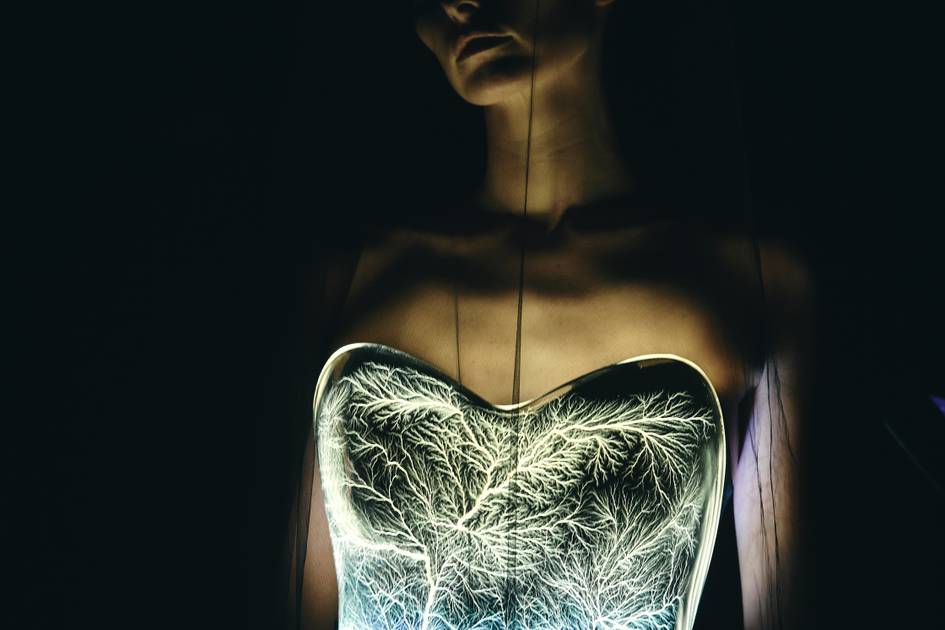
Dutch fashion designer Iris van Herpen has unveiled a pioneering garment dubbed the “plasma” dress, a creation that bridges the gap between haute couture and advanced fluid dynamics. The piece, which debuted as part of her broader exploration into atmospheric and elemental design, utilizes innovative material science to mimic the appearance of ionized gas in motion. According to the designer’s official exhibition archives, the garment integrates complex 3D-printed structures with hand-manipulated textiles to achieve a visual effect that shifts in response to the wearer’s movement.
Van Herpen’s work frequently draws from the intersection of biology, physics, and technology, a methodology she has refined since establishing her eponymous label in 2007. Her design philosophy often involves collaborating with engineers and scientists to push the physical limitations of garment construction. In the case of the plasma-inspired collection, the focus remained on capturing the ephemeral nature of high-energy states, translating the chaotic, glowing patterns of plasma into wearable, sculptural forms.
The Engineering Behind the Silhouette
The construction of the plasma dress relies on a combination of digital fabrication and traditional craftsmanship. As noted in industry reports detailing her recent collections, Van Herpen employs multi-material 3D printing to create lightweight, flexible skeletons that support delicate, translucent fabrics. This structural approach allows the dress to maintain its shape while retaining the fluidity necessary for movement, a hallmark of her design studio’s technical evolution.
The material selection is critical to the “plasma” effect. By layering sheer, iridescent polymers with laser-cut elements, the dress refracts light in a manner that simulates the flickering, unstable energy of plasma. This technique requires precise calibration of the material’s refractive index, ensuring that the light-play appears organic rather than static. The design process involves extensive prototyping, often utilizing computational fluid dynamics software to map how the fabric will drape and react under various lighting conditions.
Why This Matters for Fashion Technology
The significance of the plasma dress lies in its demonstration of how high-tech manufacturing can be integrated into high-end fashion without sacrificing the artistic intent. While 3D printing has been used in fashion for over a decade, Van Herpen’s application is distinct because of its focus on kinetic aesthetics. According to the Metropolitan Museum of Art, which has featured her work in past exhibitions, her ability to marry complex mathematical patterns with human anatomy has established a new precedent for the industry.
.jpg "Why This Matters for Fashion Technology")
This development is part of a broader trend where luxury fashion houses are increasingly investing in proprietary software and robotic assembly to differentiate their products. For the consumer and the fashion industry at large, this signals a shift toward a future where clothing is not merely assembled, but engineered. The plasma dress serves as a prototype for how such technologies could eventually inform more sustainable, durable, or adaptable everyday wear.
The Creative Process and Collaborations
Van Herpen’s studio in Amsterdam functions more like a research laboratory than a traditional atelier. Her creative process involves interdisciplinary teams that include architects, biologists, and software engineers. This collaborative model is essential to achieving the complex geometries seen in the plasma collection. By moving away from conventional sewing techniques, the studio can achieve textures and forms that were previously impossible to execute using needle and thread.
The reliance on these specialized partnerships has allowed the brand to remain at the forefront of the “tech-couture” movement. Each collection, including the one featuring the plasma-inspired pieces, undergoes rigorous testing to ensure the structural integrity of the 3D-printed elements. This technical rigor ensures that the garments are not just display pieces, but functional works of art that can be worn on the runway and in controlled environments.
Looking Ahead at the Future of Couture
As the fashion industry continues to grapple with the integration of digital tools and artificial intelligence, Iris van Herpen’s work provides a clear path forward. Her focus on elemental themes—such as water, electricity, and now plasma—suggests a continued interest in natural phenomena as a source of inspiration. Observers of the industry anticipate that her upcoming projects will further explore the integration of smart materials that can change properties based on environmental stimuli.

The next major public update regarding her collections is expected during the upcoming Paris Haute Couture Week. For those interested in following the technical evolution of these garments, the official brand website provides ongoing documentation of their latest research and exhibition schedules. Readers are encouraged to share their thoughts on the intersection of science and style in the comments below.