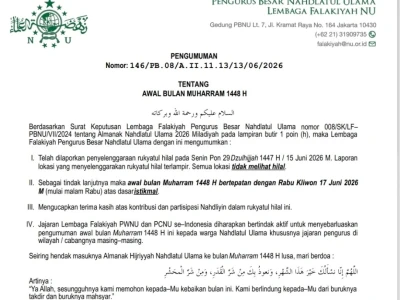
Islamic New Year 1448 H Expected to Begin June 17, 2026, Amidst Calendar Discrepancies
The Islamic New Year 1448 H is projected to begin on Wednesday, June 17, 2026, according to the Nahdlatul Ulama (NU) organization. This determination by the central board of NU (PBNU) may differ from the official calendar established by Indonesia’s Ministry of Religious Affairs, as religious authorities in the country utilize different methodologies for observing the lunar crescent, known as the hilal.
The potential for a one-day discrepancy between the country’s largest Muslim organization and the government has become a recurring theme in the Indonesian religious landscape. While PBNU has announced its calendar based on astronomical calculations, the Ministry of Religious Affairs typically waits for a formal joint determination session, or Sidang Isbat, to finalize religious dates for the nation.
Why do the 1 Muharram 1448 H dates differ?
The variation in dates stems from two distinct approaches to the Hijri calendar: hisab and rukyat. The hisab method relies on precise mathematical and astronomical calculations to predict the position of the moon. PBNU frequently utilizes this method to provide early guidance to its millions of members regarding upcoming religious observances, including the start of Muharram.
:quality(30):format(webp):focal(0.5x0.5:0.5x0.5)/jambi/foto/bank/originals/Kalender-Islam-Global-2026-Berisi-Jadwal-Puasa-Ramadan-1448-H.jpg "Why do the 1 Muharram 1448 H dates differ?")
In contrast, the Ministry of Religious Affairs (Kemenag) prioritizes rukyat, which is the physical sighting of the new moon. Under this method, the government conducts the Sidang Isbat, a meeting that involves astronomers, religious leaders, and government officials to verify whether the hilal is visible to the naked eye or through specialized instruments. If the moon is not sighted on the expected evening, the current month is extended by one day, shifting the New Year accordingly.
This methodological divergence means that while NU members may begin their 1448 H celebrations on Wednesday, June 17, others following the government’s official decree might observe the holiday on Thursday, June 18. This distinction often impacts public holidays, fasting schedules, and communal prayers across the archipelago.
The role of the hilal in Muharram 1448 H
The hilal, or the thin crescent moon, serves as the fundamental marker for the beginning of every month in the Islamic lunar calendar. For the transition into Muharram—the first month of the Islamic year—the position of the moon is critical. Astronomers track the moon’s altitude, azimuth, and elongation to determine if it is high enough above the horizon to be detected after sunset.

As the date for 1 Muharram 1448 H approaches, specialized astronomical observatories across Indonesia will prepare for intensive monitoring. The Ministry of Religious Affairs coordinates these observations through various regional offices to ensure that any potential sighting is documented and verified by multiple parties. The accuracy of these sightings is essential, as the entire liturgical calendar for the year depends on the successful transition between lunar months.
Comparing PBNU and Ministry of Religious Affairs methodologies
The following table outlines the primary differences in how the two major authorities in Indonesia approach the determination of the Islamic New Year.
| Feature | Nahdlatul Ulama (PBNU) | Ministry of Religious Affairs (Kemenag) |
|---|---|---|
| Primary Method | Hisab (Astronomical Calculation) | Rukyat (Visual Sighting) and Hisab |
| Decision Process | Internal PBNU determination | Sidang Isbat (Joint Determination Session) |
| Expected 1448 H Start | Wednesday, June 17, 2026 | To be confirmed via Sidang Isbat |
| Primary Focus | Predictive astronomical accuracy | Empirical observation and consensus |
Impact on the Muslim community and public life
The discrepancy between religious organizations and the state can create logistical challenges for the Muslim population. In Indonesia, where religious observance is deeply integrated into social and professional life, a one-day difference in the Islamic New Year can affect school schedules, workplace holidays, and the timing of religious festivals.

For many communities, the decision is often localized. Families or specific mosques may follow the PBNU calendar, while government employees and state-run institutions adhere to the Ministry of Religious Affairs’ official decree. This dual-track approach to the calendar requires high levels of religious literacy and awareness among the public to ensure that communal activities, such as doa akhir tahun (end-of-year prayers) and doa awal tahun (beginning-of-year prayers), are conducted correctly according to their chosen tradition.
Furthermore, the timing of Muharram is significant because it marks the beginning of a new spiritual cycle. Many Muslims observe the month through increased acts of worship, charity, and reflection. The certainty of the date, whether through calculation or sighting, remains a central point of discussion for religious scholars and astronomers alike.
The Ministry of Religious Affairs is expected to hold its official Sidang Isbat closer to the end of the month of Dhu al-Hijjah 1447 H to finalize the 1448 H calendar. Official announcements regarding the exact date of 1 Muharram 1448 H will be released through Kemenag’s official channels following the conclusion of that session.
Please share this update with your community to help clarify the upcoming calendar changes, and leave a comment below if you have questions regarding the different lunar sighting methods used in Indonesia.
Keep reading