
Researchers have identified a previously unknown sensory pathway linking fine body hairs—similar to human peach fuzz—to chronic itch sensations, offering a potential new target for treatments that currently fail to relieve persistent skin inflammation. The discovery, published in Neuron, reveals how specialized neurons connected to these hairs transmit mechanical itch signals to the brain, a mechanism that may explain why existing therapies often miss the mark for conditions like eczema.
Chronic itch affects millions worldwide, with no universally effective treatments available. Current options—such as antihistamines or topical steroids—primarily target chemical itch triggered by allergens or insect bites, but do little to alleviate the mechanical itch caused by skin inflammation. The new study suggests that targeting the newly identified neuronal pathway could provide relief for patients who scratch relentlessly despite conventional therapies.
Bo Duan, an associate professor in the Department of Molecular, Cellular, and Developmental Biology at the University of Michigan, led the research team behind this breakthrough. “We’ve discovered a pathway that plays a very important role for both acute and chronic itch sensation,” Duan said. “This is a new avenue to explore if we want to treat chronic itch effectively.”
How peach fuzz triggers itch—and why it matters
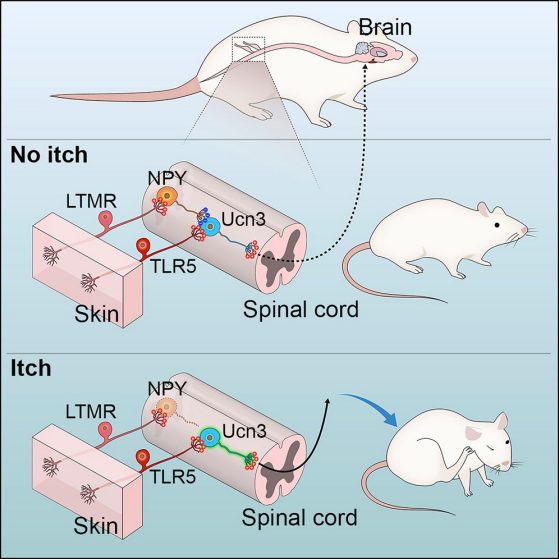
The study focused on mice, where researchers identified a class of fine, touch-sensitive hairs—called vellus-like hairs—that resemble human peach fuzz. These hairs, concentrated around the mouth, ears, and paws in mice, connect to specialized neurons that transmit itch signals to the spinal cord. When the team stimulated these hairs mechanically, mice scratched in response—but when the neurons were deactivated or absent, the itching response vanished.
Human bodies are covered in similar vellus hairs, though we rarely notice them. Yet these hairs may serve as an early warning system, alerting mammals to potential parasites or irritants near sensitive areas like the mouth and ears. The discovery raises intriguing questions about why we don’t scratch constantly if our bodies are wired to detect mechanical itch.
According to Duan, spinal cord “gating” circuits likely suppress these signals under normal conditions, only activating them when necessary. “This suggests the body has a dedicated system for mechanical itch, but it’s tightly regulated,” he explained. The team’s findings align with earlier research showing that human neurons in culture respond to the same proteins that transmit itch signals in mice.
Why current treatments fail—and what this means for patients
Existing therapies for chronic itch primarily target chemical itch pathways, leaving mechanical itch untreated. For example, antihistamines block histamine receptors, which are activated by mosquito bites or poison ivy—but these drugs do little for the itch caused by eczema or psoriasis. The new study suggests that drugs targeting the mechanical itch pathway could offer relief where others fail.

Duan emphasized that while the research was conducted in mice, the presence of the same genes and proteins in human neurons strengthens the case for a shared mechanism. “Our study indicates that humans may have this same kind of mechanism to transmit mechanical itch,” he said. The team is now exploring how to translate these findings into potential therapies.
For patients with chronic skin conditions, the discovery offers hope. Eczema alone affects over 31 million Americans, with many reporting severe, unrelenting itch that disrupts sleep and daily life. Current treatments often provide only temporary relief, leaving patients desperate for better options. This research could pave the way for targeted therapies that finally address the root cause of mechanical itch.
How the study was conducted—and what’s next
The team developed novel methods to study mechanical itch in mice, since no standard procedures existed. They used a fine loop of thread to stimulate the vellus-like hairs and observed scratching behavior. To confirm the role of the specialized neurons, they made the cells sensitive to blue light—shining light on the mice’s skin triggered the same itching response as mechanical stimulation.
Duan noted that the study required creative solutions, from developing new experimental techniques to interpreting mouse behavior. “A mouse can’t tell us it’s itchy, but it will scratch,” he said. “That’s how we knew we were on the right track.”
The research was supported in part by the National Institutes of Health (NIH), underscoring its potential impact on public health. While human trials are still years away, the findings provide a critical foundation for future drug development.
What this means for the future of itch research
Chronic itch remains a significant unmet medical need, with few effective treatments available. The discovery of this mechanical itch pathway could lead to new therapies that address the root cause of persistent scratching, rather than just masking symptoms. For patients with eczema, psoriasis, or other inflammatory skin conditions, this research offers a glimmer of hope.
Duan’s team is already exploring ways to target the identified neurons, with ongoing projects investigating potential drug candidates. If successful, these therapies could transform the lives of millions who suffer from chronic itch every day.
For now, patients should continue working with their healthcare providers to manage symptoms, while staying informed about emerging research. The next steps in this study will likely involve preclinical trials to test the safety and efficacy of targeting the mechanical itch pathway in animals before moving to human studies.
Key takeaways
- New pathway identified: Researchers discovered how fine body hairs (peach fuzz-like) trigger mechanical itch through specialized neurons.
- Potential for new treatments: Current therapies fail to address mechanical itch caused by skin inflammation, but this research could lead to targeted solutions.
- Human relevance confirmed: Human neurons respond to the same proteins as those in mice, suggesting a shared mechanism.
- Chronic itch impact: Conditions like eczema and psoriasis affect millions, with no universally effective treatments available.
- Next steps: The team is exploring drug candidates to target the identified neurons, with preclinical trials expected in the coming years.
For readers interested in staying updated on this research, the University of Michigan and NIH will likely provide official updates as the study progresses. In the meantime, patients with chronic itch should discuss their symptoms with a dermatologist to explore current management options.
Have questions about this research or its potential impact? Share your thoughts in the comments below or on our social media channels.
Keep reading
- Wildfire Risk Threatens Thousands of US Historic Landmarks, Study Finds
- Cyclist Bitten or Struck by Bat Classified as Level 3 Rabies Exposure, Receives 6 Immunoglobulin Injections
- Pan-Mass Challenge Aims for $79 Million to Support Cancer Research at Dana-Farber (news-usa.today)
- Phil Collins Opens Up About Near-Death Alcohol Struggle and Personal Life Challenges (world-today-news.com)