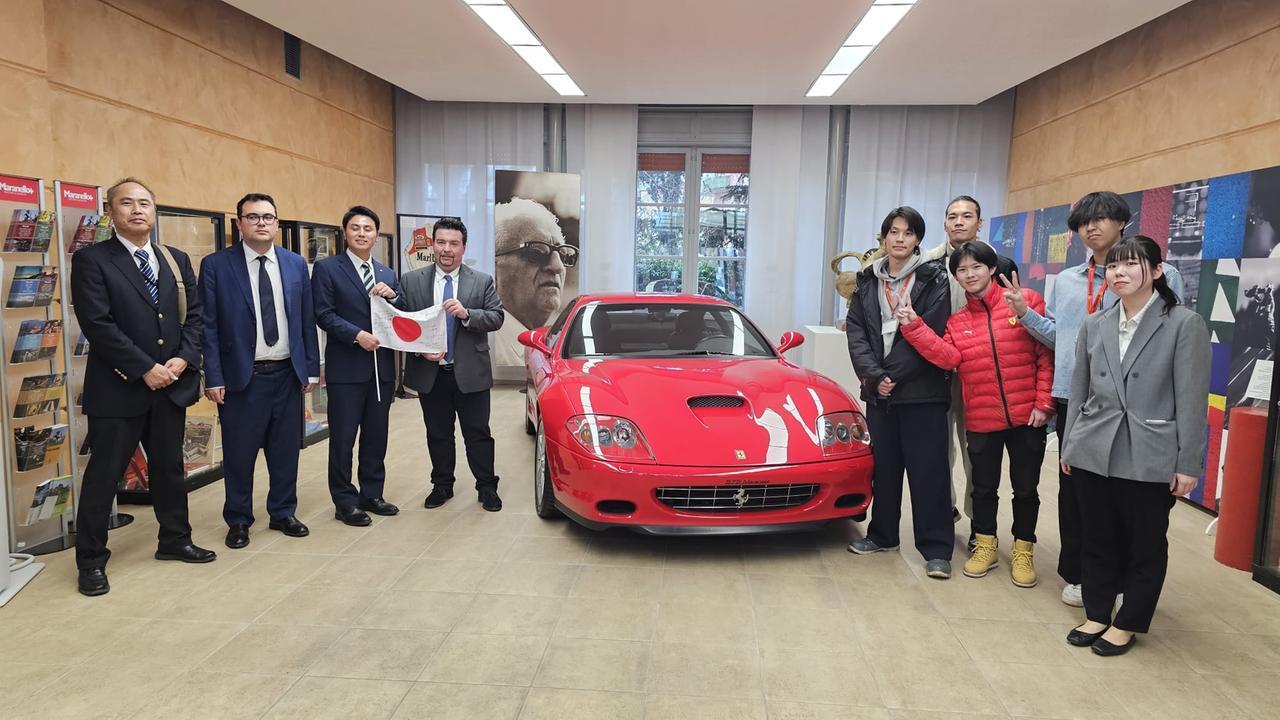
Maranoello, Italy – A decades-long educational partnership between an Italian technical institute and a leading Japanese automotive college continues to foster cross-cultural understanding and provide invaluable hands-on experience for aspiring automotive engineers. The collaboration, initially sparked by a shared passion for mechanics – or “Rikigaku” as it’s known in Japanese – between educators in 1989, remains a vibrant example of international cooperation in technical education. This exchange program, focused on automotive technology, offers students from both institutions a unique opportunity to learn from different approaches to engineering and manufacturing, and to immerse themselves in new cultures.
The Istituto di Istruzione Superiore “A. Ferrari” in Maranello, Italy, and the Nakanihon Automotive College (NAC) in Sakahogi, Japan, formally renewed their partnership in October 2025, according to the Istituto’s website. The Istituto Ferrari, named after the iconic automotive brand, specializes in technical and professional education, preparing students for careers in the automotive industry and beyond. The NAC, as detailed on its English-language website, offers comprehensive automotive engineering programs, including certifications for gasoline and diesel auto mechanics, auto body repair, and even motorsports engineering. The enduring nature of this collaboration, now entering its 26th year, underscores the mutual benefits derived from the exchange of knowledge and expertise.
A Legacy Built on Shared Passion
The origins of the partnership trace back to a connection made between a professor at the Ipsia/Itis A. Ferrari institute and an instructor at the NAC. This initial contact, fueled by a common interest in automotive mechanics, blossomed into a formal gemellaggio – a twinning agreement – in the early 1990s. As reported by Gazzetta di Modena on March 13, 2026, the program has provided opportunities for students for a quarter of a century. Currently, the program involves students completing practical training and academic studies in both Italy and Japan. In February 2026, four Japanese students were in Maranello as part of the exchange, gaining firsthand experience in the heart of Italy’s automotive industry.
Practical Learning and Cultural Immersion
A key component of the NAC curriculum involves practical application of theoretical knowledge. Students participate in projects like building the body of a vehicle for the “Econo Power” competition, which emphasizes energy efficiency rather than speed, as explained by Giacinto Massaro, the project manager at the Istituto Ferrari. This focus on practical skills aligns with the Istituto Ferrari’s emphasis on preparing students for real-world employment. The exchange program isn’t solely focused on technical skills; it also provides a significant cultural experience. Students live alongside their Italian counterparts for four weeks, fostering a deeper understanding of different customs, lifestyles, and perspectives. Leonardo Carnevali and Riccardo Russo, Italian students who participated in the exchange program in October of the previous year, highlighted the welcoming atmosphere and the impressive facilities at the NAC in Japan.
The Econo Power Challenge
The Econo Power competition, a central element of the NAC’s practical training, demonstrates the college’s commitment to sustainable automotive engineering. The competition challenges students to design, build, and operate a vehicle that maximizes fuel efficiency. This hands-on experience provides students with valuable skills in areas such as aerodynamics, engine optimization, and lightweight materials. The focus on energy efficiency reflects a growing global emphasis on sustainable transportation solutions and prepares students for the challenges of the future automotive industry.
A Fan’s Perspective: Connecting Passion with Profession
The program’s appeal extends beyond academic and technical benefits. For students like Takahashi Ryo, the opportunity to study at the NAC and potentially perform closely with companies like Ferrari represents the realization of a lifelong dream. “From a young age, I loved cars and motorcycles, so I thought, ‘why not turn this passion into a job?’” Ryo shared. Similarly, Kohei Aruga, a student from the NAC, expressed his enthusiasm for the program, stating that he specifically chose the college as of its connection to Ferrari. This demonstrates the powerful motivating force of passion in driving students towards careers in the automotive sector.
Ferrari’s Enduring Influence
The Ferrari brand holds a special significance for many aspiring automotive engineers, and the Istituto Ferrari’s location in Maranello provides students with unique access to the company’s expertise and innovation. The opportunity to interact with future Ferrari technicians is particularly valuable for Japanese students, given the brand’s global reputation and influence. The close proximity to Ferrari allows students to observe cutting-edge automotive technology and gain insights into the design, manufacturing, and testing processes used by one of the world’s leading automakers.
Beyond the Exchange: Broader Educational Initiatives
The Istituto di Istruzione Superiore “A. Ferrari” is also involved in several other educational initiatives aimed at improving student outcomes and addressing broader societal challenges. The institute is participating in a project funded by the Italian National Recovery and Resilience Plan (PNRR) to combat school dropout rates and strengthen students’ foundational skills. This initiative includes the creation of connected laboratories aligned with the institute’s academic programs. The school offers Cambridge English certification courses and has undertaken projects focused on historical education, such as an inauguration at the State Archive of Modena in February 2025.
The school is also actively involved in the “Proteo Engineering” project, bringing together students, teachers, and HR managers in a collaborative laboratory setting, launched on March 5, 2026. These broader initiatives demonstrate the Istituto Ferrari’s commitment to providing a well-rounded education and preparing students for success in a rapidly changing world.
The enduring partnership between the Istituto di Istruzione Superiore “A. Ferrari” and the Nakanihon Automotive College stands as a testament to the power of international collaboration in education. By combining practical training, cultural immersion, and a shared passion for automotive engineering, the program equips students with the skills and knowledge they demand to thrive in a globalized industry. As the automotive landscape continues to evolve, such partnerships will become increasingly important in fostering innovation and preparing the next generation of engineers and technicians.
Looking ahead, the Istituto Ferrari will continue to facilitate student exchanges with the NAC, building on the success of the past 25 years. Further details regarding upcoming exchange opportunities and program updates can be found on the Istituto Ferrari’s official website. We encourage readers to share their thoughts on the importance of international collaboration in education in the comments below.
Keep reading