
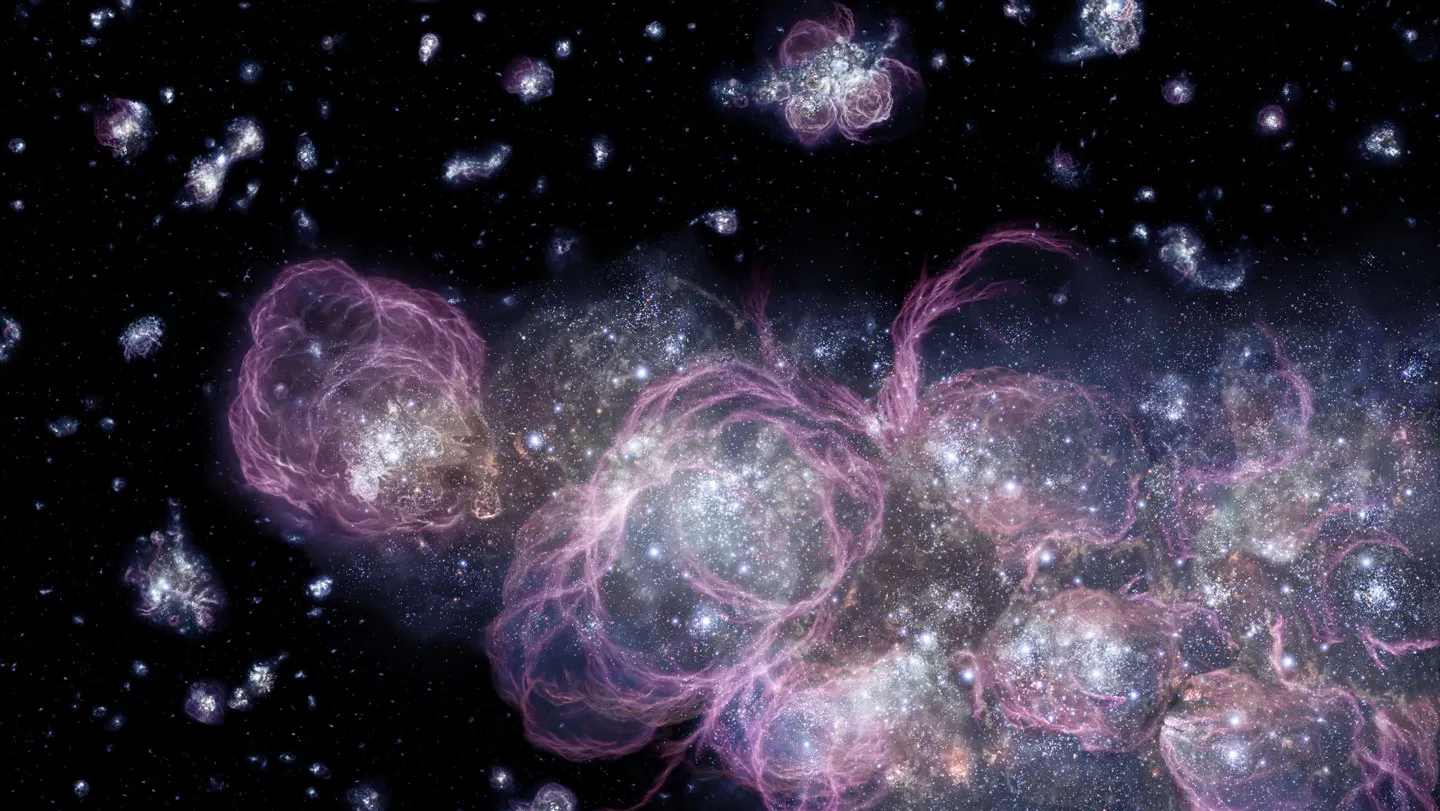
James Webb Space Telescope observations have revealed a distant gas clump that may contain the universe’s first generation of stars, known as Population III stars. This discovery, reported in a trio of papers submitted to arXiv.org on March 20, 2025, pushes back evidence for these primordial stars to approximately 450 million years after the Big Bang.
The gas clump, named Hebe by astronomers, shows chemical signatures consistent with stars formed only from the light elements created in the Big Bang—hydrogen, helium, and a trace of lithium—with no detectable heavier elements. Such pristine composition is a hallmark of Population III stars, which are theorized to have been massive and extremely luminous, potentially up to 1,000 times the mass of the Sun.
Prior to this finding, evidence for Population III stars had only been detected around 1 billion years after the Big Bang. The identification of Hebe significantly narrows the gap between theoretical predictions of when the first stars formed and observational confirmation, increasing confidence that more such systems exist in the early universe.
The James Webb Space Telescope’s advanced infrared capabilities were essential to this discovery, allowing astronomers to detect the faint light from this distant object. Initial observations of Hebe were made in 2024, but higher-resolution data collected in 2025 were necessary to analyze its chemical composition and assess its potential to host primordial stars.
Population III stars are of particular interest to cosmologists because they are believed to have played a crucial role in shaping the early universe. Their intense radiation and eventual supernova explosions would have initiated the process of chemical enrichment, forging the heavier elements necessary for the formation of subsequent generations of stars, planets, and ultimately life.
Astronomer Seiji Fujimoto of the University of Toronto, who was not involved in the research, noted that the discovery of Hebe increases optimism about finding additional Population III star candidates in future James Webb observations. The ability to detect such ancient stellar populations depends on both the telescope’s sensitivity and favorable cosmic alignments, such as gravitational lensing, which can magnify distant objects.
The search for the universe’s first stars remains an active frontier in astrophysics. While the Hebe gas clump represents a promising candidate, further observations will be needed to confirm whether it definitively contains Population III stars or if its properties can be explained by other astrophysical processes.
As the James Webb Space Telescope continues its mission to explore the early universe, scientists anticipate that additional discoveries will refine our understanding of cosmic dawn—the period when the first stars and galaxies emerged from the darkness following the Big Bang.
For ongoing updates on discoveries from the James Webb Space Telescope and developments in cosmology, readers can follow official NASA and ESA communications, as well as peer-reviewed publications in astronomy journals.