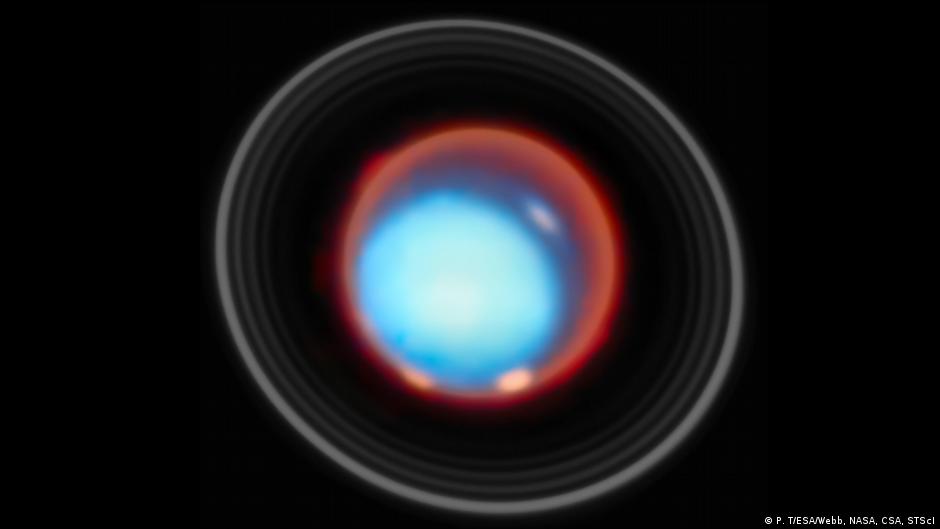
James Webb Telescope Reveals Unprecedented Detail of Uranus’s Mysterious Atmosphere
In a groundbreaking achievement for planetary science, the James Webb Space Telescope (JWST) has delivered the first detailed vertical map of Uranus’s upper atmosphere, offering unprecedented insights into the ice giant’s auroras, temperature variations, and the complex dynamics of its magnetic field. The observations, released on February 19, 2026, are reshaping our understanding of this often-overlooked planet and providing valuable data for characterizing similar ice giants beyond our solar system. Uranus, known for its unusual axial tilt and chaotic magnetic field, presents a unique challenge to astronomers, and JWST’s capabilities are proving crucial in unraveling its mysteries.
For decades, our knowledge of Uranus has been limited by the single flyby conducted by Voyager 2 in 1986. That brief encounter occurred after a solar storm had suppressed the planet’s magnetic field, hindering a full assessment of its characteristics. Now, JWST’s advanced instruments, particularly the Near-Infrared Spectrograph (NIRSpec), are providing a far more comprehensive view, peering through the planet’s atmosphere to reveal details previously hidden from view. This new data is not only illuminating Uranus itself but similarly informing our broader understanding of ice giant planets throughout the universe.
The research, published in the journal Geophysical Research Letters, details how JWST measured the temperature and density of ions – electrically charged particles – up to 5,000 kilometers above the cloud tops, within a region known as the ionosphere. These measurements reveal that ions reach their peak temperature between 4,000 and 5,000 kilometers in altitude, while the highest density is concentrated around 1,000 kilometers. This distribution is directly linked to the planet’s peculiar magnetic field geometry, which is tilted and offset from the planet’s rotational axis.
A Unique Magnetic Field and its Impact on Auroras
Uranus is often described as an “oddball” within our solar system, largely due to its highly unusual magnetosphere. Unlike Earth’s relatively straightforward magnetic field, Uranus’s magnetic field is tilted approximately 60 degrees relative to its axis of rotation and is significantly offset from the planet’s center. This peculiar configuration results in auroras that aren’t confined to the poles, as they are on Earth, but instead appear across the planet’s surface in complex and dynamic patterns. “The magnetosphere of Uranus is one of the strangest in the solar system,” stated Paola Tiranti, lead author of the study and a researcher at the University of Northumbria in the United Kingdom, in a statement released by the European Space Agency (ESA).
The JWST observations have allowed scientists to visualize the vertical structure of Uranus’s atmosphere in three dimensions for the first time. According to ESA, this is a pivotal moment in planetary exploration. “This is the first time we can spot the upper atmosphere of Uranus in three dimensions,” Tiranti explained. “Thanks to Webb’s sensitivity, we can track how energy rises through the planet’s atmosphere and even observe the influence of its unbalanced magnetic field.” The data reveals how the magnetic field shapes the flow of charged particles and influences the formation and behavior of the planet’s auroras.
Cooling Trends and Atmospheric Dynamics
Beyond mapping the atmospheric structure and auroral activity, the JWST data also confirms a long-observed trend: the upper atmosphere of Uranus has been steadily cooling since the early 1990s. The telescope determined that the average temperature in the observed region is around -153 degrees Celsius (-243 degrees Fahrenheit), which is lower than previous measurements obtained from other missions and ground-based observatories. This cooling trend suggests a shift in the planet’s energy balance and provides clues about the processes driving its atmospheric dynamics.
The unique tilt of Uranus – it essentially orbits the sun on its side – results in extreme seasonal variations, with each pole experiencing 42 years of sunlight followed by 42 years of darkness. This extreme tilt, believed to be the result of a massive collision early in the planet’s history, likely plays a significant role in shaping its atmospheric circulation and magnetic field. The JWST observations are helping scientists understand how these factors interact to create the unusual conditions observed on Uranus.
The Role of JWST’s NIRSpec Instrument
The success of these observations is largely attributed to the capabilities of JWST’s NIRSpec instrument. NIRSpec is designed to measure the spectra of light emitted by celestial objects, allowing scientists to determine their composition, temperature, and velocity. By analyzing the faint glow from molecules high above the clouds of Uranus, NIRSpec was able to detect the presence of ions and map their distribution throughout the planet’s upper atmosphere. This level of detail was simply not possible with previous generations of telescopes.
According to NASA, the JWST provided the first vertical view of Uranus’s ionosphere, revealing auroras shaped by its tilted magnetic field. This detailed portrait provides data on how Uranus’s atmosphere has continued to cool since the 1990s. The observations build upon previous studies of Uranus, including the Voyager 2 flyby in 1986, but offer a significantly more comprehensive and detailed picture of the planet’s atmospheric processes.
Implications for Understanding Ice Giants
The findings from the JWST observations have significant implications for our understanding of ice giants, a class of planets that are common throughout the galaxy. Uranus and Neptune are the only ice giants in our solar system, but they are believed to be representative of a large population of similar planets orbiting other stars. By studying Uranus in detail, scientists can gain insights into the formation, evolution, and atmospheric dynamics of these distant worlds.
“By revealing the vertical structure of Uranus with such detail, Webb helps us understand the energy balance of ice giants,” Tiranti concluded. “This is a crucial step in characterizing giant planets beyond our solar system.” The data collected by JWST will be invaluable for future studies of exoplanets, helping astronomers to identify and characterize potentially habitable worlds.
The James Webb Space Telescope continues to push the boundaries of our knowledge of the universe, and its observations of Uranus are just the latest example of its transformative potential. As JWST continues to gather data, we can expect even more groundbreaking discoveries about our solar system and the worlds beyond.
Researchers plan to continue observing Uranus with JWST in the coming months and years, focusing on further refining our understanding of its atmospheric composition, magnetic field, and auroral activity. The next major milestone will be a more detailed analysis of the data collected during the initial observations, which is expected to yield even more insights into the mysteries of this fascinating ice giant.
Key Takeaways:
- The James Webb Space Telescope has provided the first detailed vertical map of Uranus’s upper atmosphere.
- Uranus’s unique tilted magnetic field shapes its auroras and atmospheric dynamics.
- The planet’s upper atmosphere has been steadily cooling since the 1990s.
- These observations provide valuable insights into the characteristics of ice giant planets throughout the galaxy.
Share your thoughts on these incredible new images and discoveries in the comments below. And be sure to share this article with anyone interested in space exploration and the mysteries of our universe!
Related reading