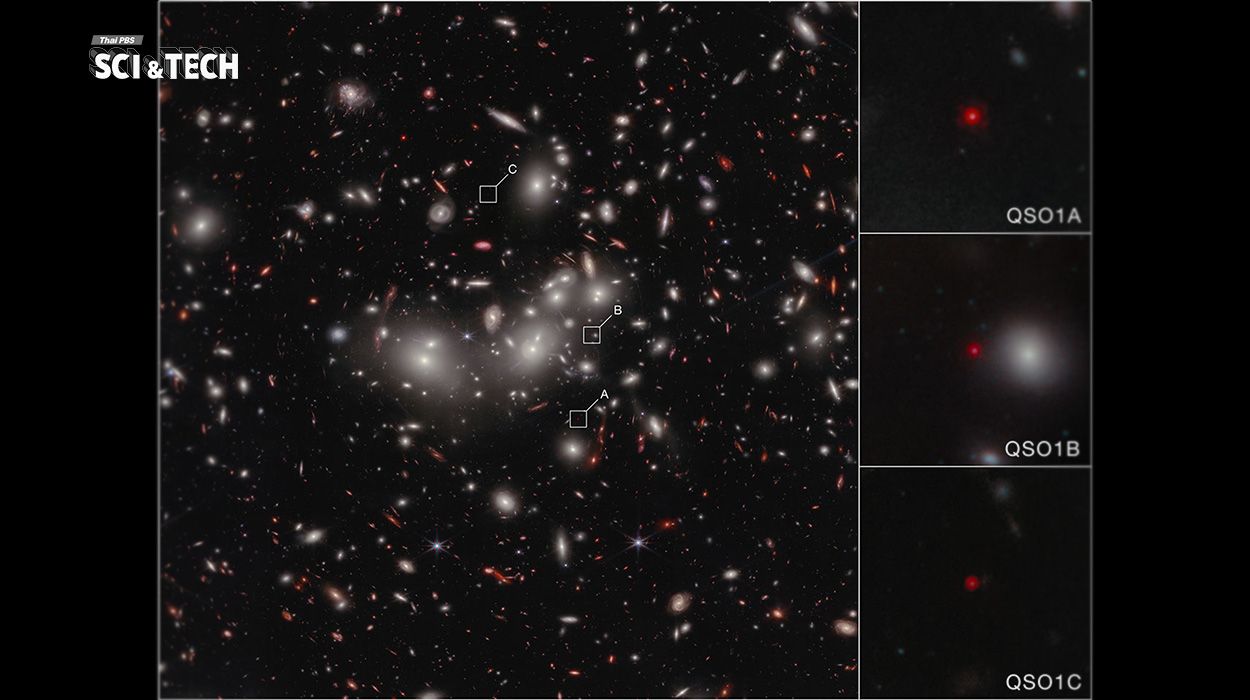
The James Webb Space Telescope (JWST) has identified massive black holes that formed before their galaxies. According to reports, these findings suggest that some black holes may have formed before their galaxies, challenging previous cosmological models.
For decades, astronomers operated under the assumption that supermassive black holes and their host galaxies grew in tandem, maintaining a relatively constant mass ratio. In the local universe, a central black hole typically accounts for a small fraction of the mass of the galaxy’s stellar bulge. However, JWST data has revealed a population of black holes in the early universe that are nearly as massive as the stars surrounding them.
These findings indicate that the early universe was far more active and chaotic than previously modeled. The discovery of these black holes suggests a fundamental shift in the understanding of cosmic evolution, moving away from a galaxy-first model toward one where black hole “seeds” may have acted as the primary anchors for galaxy formation.
Why the mass of these black holes challenges cosmological models
Current scientific consensus generally suggests that black holes form from the remnants of the first generation of stars, which then slowly accrete mass over billions of years. This gradual growth allows the surrounding galaxy to build up its stellar population at a compatible pace. The JWST observations disrupt this timeline by showing black holes that reached millions of solar masses while their host galaxies remained relatively small.
According to data analyzed by international research teams, some of these early black holes possess a mass ratio to their host galaxy that is 10 to 100 times higher than what is observed in the modern universe. This discrepancy implies that these black holes did not grow slowly through the accretion of gas and stars. Instead, they may have started from “heavy seeds.”
The “heavy seed” hypothesis proposes that massive clouds of gas collapsed directly into medium-sized black holes—thousands of times the mass of the sun—without ever becoming stars first. This process, known as direct collapse, would provide a significant “head start,” allowing the black hole to reach supermassive proportions while the surrounding galaxy was still in its infancy.
How the James Webb Space Telescope detected “quiet” black holes
Previously, astronomers primarily found distant black holes by looking for quasars—extremely bright objects created when a black hole actively consumes vast amounts of matter. This created a selection bias, as researchers only saw the most active, “loud” black holes.
The JWST’s ability to detect faint infrared light allows scientists to see the stars of the host galaxy itself, even if the black hole is “quiet.” By measuring the velocity of stars orbiting the center of these galaxies, researchers can calculate the mass of the central black hole regardless of whether it is currently emitting the bright radiation associated with a quasar. This capability has revealed a hidden population of dormant but massive black holes.
These “quiet” black holes provide a more accurate census of the early universe. This expanded dataset shows that overmassive black holes are more common than previously thought, suggesting that the “heavy seed” mechanism might be a standard feature of early cosmic history rather than a rare anomaly.
The role of “Little Red Dots” in early galaxy evolution
Among the most intriguing discoveries made by JWST are objects referred to by astronomers as “little red dots.” These are compact, red-colored objects found in the deep field images that appear to be extremely distant galaxies harboring unexpectedly massive black holes.
Spectral analysis of these dots indicates they are located at high redshifts, meaning they existed when the universe was only a fraction of its current age. The red color is caused by the stretching of light as it travels across the expanding universe, combined with the presence of dust that obscures the center of the galaxy.
Researchers found that these “little red dots” often contain black holes that are far too large for the amount of stars present in the galaxy. This evidence reinforces the theory that the black hole may have formed first, with its gravity then pulling in the gas and dust necessary to eventually build the rest of the galaxy. This reverses the traditional “bottom-up” model of galaxy formation, suggesting a “top-down” approach where the central engine drives the growth of the surrounding system.
What happens next in the study of early black holes
The scientific community is now focused on determining exactly how these heavy seeds formed and whether they are linked to specific conditions in the early universe, such as the presence of intense ultraviolet radiation that could prevent gas clouds from fragmenting into small stars.

Upcoming observation cycles for the JWST are expected to target a larger sample of these overmassive black holes to determine if there is a specific “cutoff” period when the mass ratio began to stabilize. Astronomers are also coordinating with the European Space Agency (ESA) to cross-reference these findings with other deep-space surveys.
Further data releases from the JWST’s MIRI (Mid-Infrared Instrument) and NIRSpec (Near-Infrared Spectrograph) will be critical in mapping the gas dynamics around these early black holes. These measurements will help confirm if the “direct collapse” theory is the primary driver of this phenomenon or if there are other, currently unknown mechanisms at play in the early history of the universe.
Readers can follow official updates via the NASA JWST portal.
Do you believe the “heavy seed” theory changes our understanding of where we come from? Share your thoughts in the comments or share this article with other space enthusiasts.
Related reading