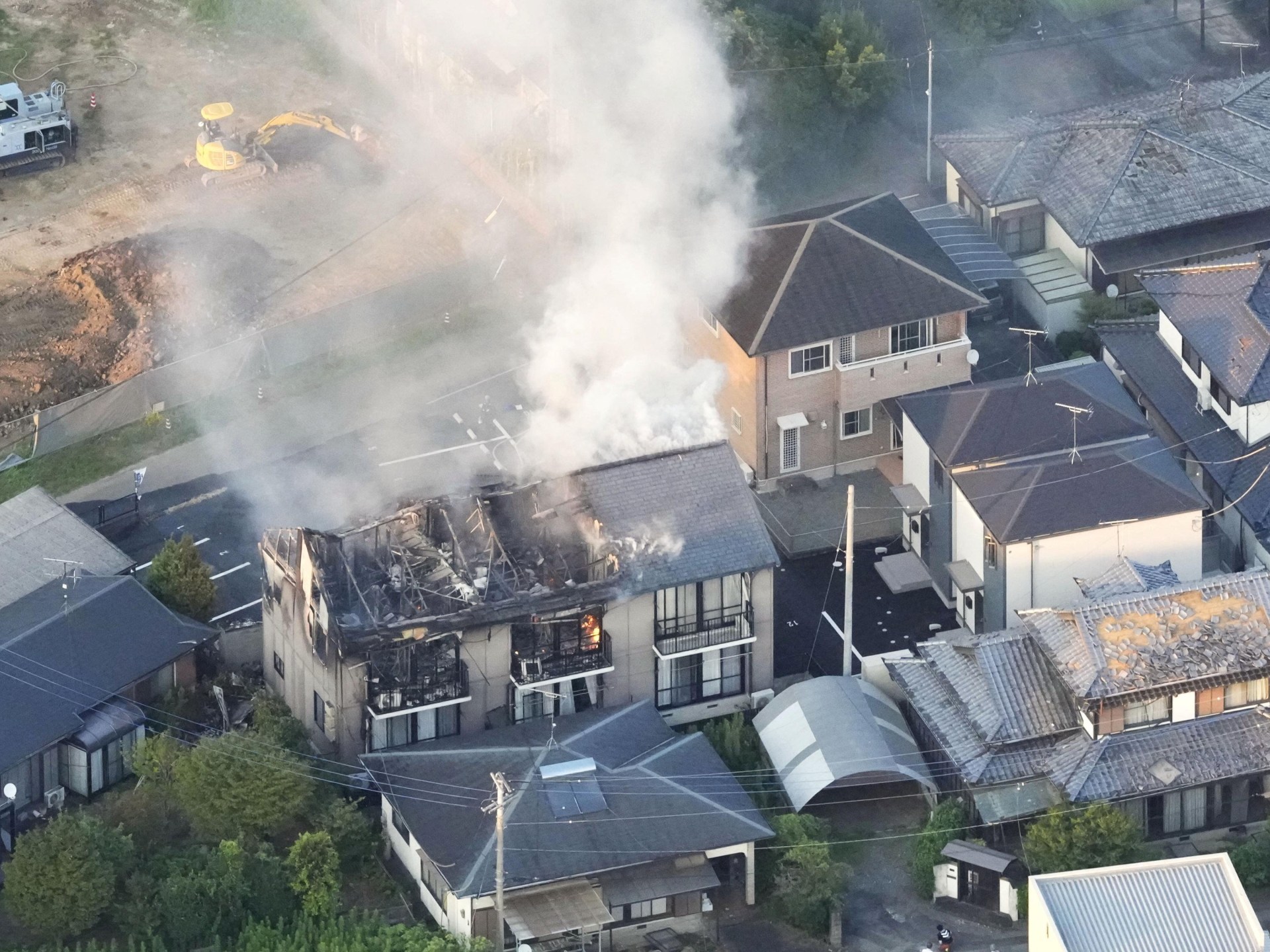
A 7.1 magnitude earthquake struck Japan’s Kyushu island on Tuesday, triggering a partial collapse at a recently reopened shopping mall and a factory chimney collapse in Kumamoto prefecture. Over 260,000 residents faced evacuation advisories, while bullet train lines, local flights, and major manufacturing plants suspended operations amid ongoing aftershocks.
A powerful tremor shook southwestern Japan on Tuesday, leaving roads ruptured, power cut to thousands of homes, and rescue workers racing to reach people trapped under heavy debris. The earthquake struck at an extremely shallow depth of 10 kilometers, according to the Japan Meteorological Agency, registering a preliminary magnitude of 7.1 before the U.S. Geological Survey later revised its estimate to 6.8. The Japan Meteorological Agency estimated the quake’s maximum seismic intensity at 7 on the Japanese scale, a rating denoting violent shaking that makes it impossible for people to stand.
Aeon Mall Disaster and the Post-Quake Explosion in Kashima Town
The most severe structural failure unfolded at the Aeon Mall in Kashima Town, Kumamoto prefecture, where a second-floor collapse was compounded by a powerful explosion about an hour after the initial tremor. Employees had guided approximately 200 shoppers to safety outside before the blast tore through the complex, blowing out exterior walls and leaving the sprawling structure reduced to a skeletal framework and rubble, according to Reuters. Public broadcaster NHK reported that 20 to 30 mall employees remained unaccounted for, while witnesses at the scene reported smelling gas in the area.

It had reopened just last month on June 13 following extensive redevelopment and repairs necessitated by the devastating Kumamoto earthquake in April 2016.
Police and fire services confirmed that two women in their 20s died at the mall site.
Factory Collapse in Yatsushiro and Regional Infrastructure Damage
Emergency response efforts stretched across multiple municipalities as industrial sites and public transportation networks absorbed the impact. At the Nippon Paper Industries Co.’s Yatsushiro factory, a large chimney collapsed and damaged surrounding buildings, trapping 11 workers under the debris, according to AP News. Emergency teams pulled two individuals out without vital signs, while the status of nine others remained unverified.
Transportation and utilities suffered widespread disruption throughout Kyushu. Stone walls at Kumamoto Castle—a landmark heavily damaged during the 2016 disaster—sustained fresh damage, AP News.
Government Response and Business Suspensions Across Kyushu
Prime Minister Sanae Takaichi briefed journalists on widespread infrastructure damage, noting blackouts, structural collapses, and fires across the prefecture.
The Fire and Disaster Management Agency advised more than 260,000 residents to evacuate, primarily within Kumamoto prefecture but extending into neighboring Nagasaki prefecture.
Major industrial operators in the region halted activity to inspect facilities.
Aftershock Warnings and Nuclear Facility Safety
A tsunami advisory was issued for the Ariake and Yatsushiro Seas immediately after the earthquake but was lifted within two hours by the Japan Meteorological Agency. Officials from Japan’s Nuclear Regulation Authority confirmed that no abnormalities were detected at three nearby nuclear power facilities, including the Sendai Nuclear Power Plant in neighboring Kagoshima prefecture.
Rescue operations faced continuous delays as aftershocks rattled the region. The Japan Meteorological Agency recorded more than 60 aftershocks, including a magnitude 4.1 tremor just after midnight.