
On April 20, 2026, a 7.7-magnitude earthquake struck off the coast of Aomori Prefecture in northern Japan, triggering widespread concern across the region and prompting an outpouring of international support. The tremor, which occurred at 4:53 p.m. Local time, was felt across multiple prefectures and led to temporary tsunami advisories in coastal areas. While no major casualties were immediately reported, the event evoked memories of the devastating 2011 Tōhoku earthquake and tsunami, particularly among those who experienced the disaster firsthand.
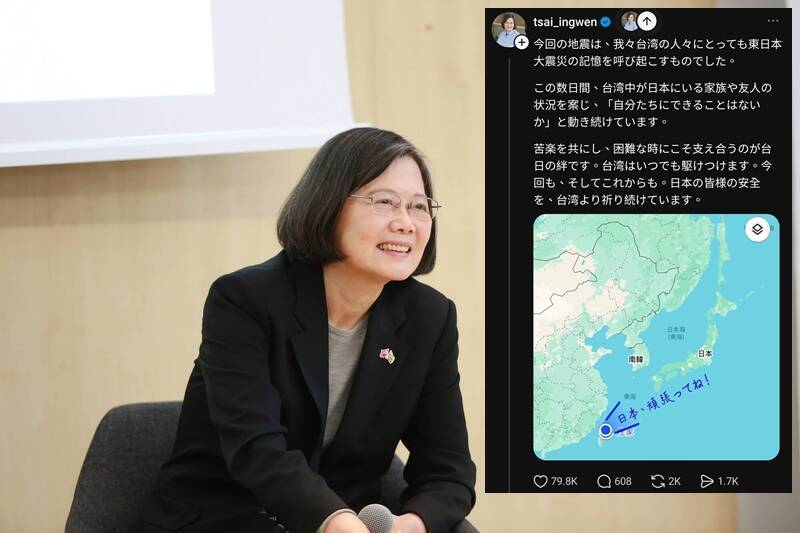
In the aftermath, former Taiwanese President Tsai Ing-wen took to social media to express solidarity with the Japanese people, posting a message entirely in Japanese on the platform Threads. Her message acknowledged the emotional resonance of the quake for many in Taiwan, referencing the shared history of mutual support between the two regions. She wrote that the recent tremor reminded Taiwanese people of the Great East Japan Earthquake of 2011, during which Taiwan provided significant humanitarian assistance to affected communities.
Tsai’s post included a map graphic with the phrase “日本、頑張ってね!” (Hang in there, Japan!) written above Taiwan, a format that has recently gained popularity as a viral trend known as “map shouting” (地圖喊話). This style involves overlaying messages of encouragement onto geographical outlines, often used in social media to show solidarity during crises. The post quickly gained attention, accumulating over 500,000 views and prompting a wave of responses from users in both Taiwan, and Japan.
Among the replies, several individuals identifying themselves as survivors of the 2011 disaster shared personal reflections, expressing gratitude for Taiwan’s assistance during that time. One user recalled losing family members and their home in the 2011 tsunami but emphasized how aid from Taiwan had made a lasting impact, noting that their family had since relocated to Taiwan and now considers it their home. Another respondent, identifying as a Japanese national, conveyed sincere appreciation for Taiwan’s role in the 2011 relief efforts, stating that the support would never be forgotten.
The exchange highlighted the enduring bonds between Taiwan and Japan, particularly in the context of disaster response and recovery. Taiwan was among the first international donors to contribute to relief efforts following the 2011 earthquake and tsunami, providing financial aid, supplies, and volunteer support. Over a decade later, those gestures continue to be remembered and acknowledged by individuals who lived through the catastrophe.
While the recent Aomori earthquake did not result in the same scale of destruction as the 2011 event, its occurrence served as a reminder of the region’s seismic vulnerability and the importance of preparedness. Japanese authorities, including the Cabinet Office and the Japan Meteorological Agency, monitored the situation closely and issued updates regarding seismic activity and potential aftershocks. No tsunami was ultimately generated, and evacuation advisories were later lifted.
As of the latest available reports, there have been no confirmed fatalities or major structural damages linked to the April 20 quake. Emergency response teams conducted safety assessments in affected areas, particularly focusing on infrastructure and coastal communities. The event has since faded from immediate headlines, but the diplomatic and humanitarian resonance of the moment remains notable in public discourse.
The interaction between Tsai Ing-wen’s message and the responses from 2011 survivors underscores how digital platforms can facilitate meaningful cross-border connections, especially when rooted in shared historical experiences. It also illustrates how symbolic gestures—such as posting in another language or using trending formats—can carry significant emotional weight when they reflect genuine empathy and historical awareness.
For those seeking updated information on seismic activity in Japan, the Japan Meteorological Agency provides real-time earthquake data and tsunami warnings through its official website. Similarly, Taiwan’s Central Weather Bureau monitors regional seismic events and issues alerts as needed. Both agencies continue to collaborate on information exchange regarding tectonic activity in the Western Pacific region.
As communities in northern Japan continue to recover and remain vigilant, the expressions of solidarity from Taiwan serve as a testament to the lasting impact of compassion in times of crisis. The exchange also reflects a broader pattern of mutual support between the two regions, one that has been demonstrated repeatedly over the past decade and a half.
We invite our readers to share their thoughts on this story in the comments section below. If you found this article informative, please consider sharing it with others who may be interested in international humanitarian efforts and cross-cultural solidarity.