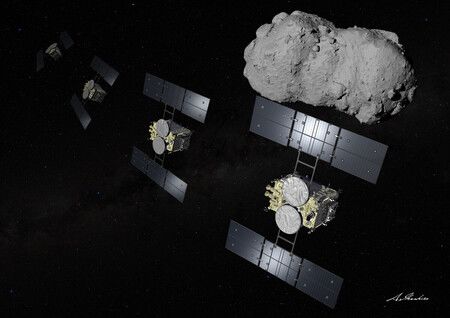
The Japan Aerospace Exploration Agency (JAXA) has scheduled its Hayabusa2 spacecraft to conduct a remote observation of the asteroid 1998 KY26, also known as Torifune, on July 5, 2026. This flyby represents the primary objective of the spacecraft’s ongoing extended mission, which aims to gather data on small, fast-rotating near-Earth objects. According to official JAXA mission documentation, the probe will utilize its onboard optical navigation cameras to capture high-resolution imagery and scientific data as it passes the target.
Following the successful return of samples from the asteroid Ryugu in December 2020, Hayabusa2 was repurposed for an extended mission. The spacecraft is currently traveling through deep space to reach its new destination. The mission team at JAXA confirmed that the encounter with Torifune is a critical test of the probe’s remaining hardware and navigation capabilities. Scientists are particularly interested in this asteroid because of its rapid rotation period—estimated at approximately 10 minutes—which provides a stark contrast to the larger, slower-rotating C-type asteroid Ryugu.
Mission Objectives and Scientific Significance
The observation of Torifune is designed to enhance international understanding of planetary defense and the composition of small celestial bodies. As reported by the National Aeronautics and Space Administration (NASA), objects of this size are frequently classified as potential hazards, making detailed study essential for developing future mitigation strategies. Hayabusa2 will not land on the asteroid; instead, it will perform a high-speed flyby to minimize the risk to the aging spacecraft while maximizing the scientific yield from its sensors.
The data collected during this encounter will allow researchers to refine models regarding the structural integrity of small asteroids. Because Torifune is significantly smaller than Ryugu, scientists hypothesize that its physical properties may be governed by different gravitational and rotational forces. By comparing the two, JAXA aims to build a more comprehensive taxonomy of near-Earth objects, which is a priority for the global space research community.
Technical Challenges of the Extended Mission
Operating a spacecraft years beyond its original design life presents significant engineering hurdles. The Hayabusa2 probe, launched in December 2014, has been in service for over a decade. According to the Institute of Space and Astronautical Science (ISAS), the mission team must carefully manage the craft’s remaining xenon propellant and battery health to ensure the systems remain operational for the July 2026 flyby. The team is currently conducting periodic health checks to calibrate the instruments for the unique lighting and distance conditions expected at Torifune.
The navigation required for this flyby is autonomous. Given the immense distance between Earth and the spacecraft, light-speed delays make manual, real-time control impossible. The spacecraft’s onboard computer will manage the trajectory adjustments needed to ensure a precise pass, relying on the navigation software that successfully guided the craft during the complex sampling operations at Ryugu.
What Happens Next?
Following the observation on July 5, 2026, the mission team will begin the process of transmitting the stored image and sensor data back to Earth via the Deep Space Network. This process is expected to take several weeks due to the bandwidth limitations inherent in deep-space communication. Once the data is received and decoded, JAXA is expected to publish preliminary findings regarding the asteroid’s shape, surface texture, and rotational dynamics.
The success of this flyby will determine the feasibility of future long-duration missions for JAXA. If the hardware performs within expected parameters, the agency may consider further mission extensions. Readers interested in following the mission’s progress can monitor the official JAXA Hayabusa2 portal for updates, press releases, and technical briefings as the encounter date approaches. Feel free to share your thoughts on the future of asteroid exploration in the comments section below.
Related reading