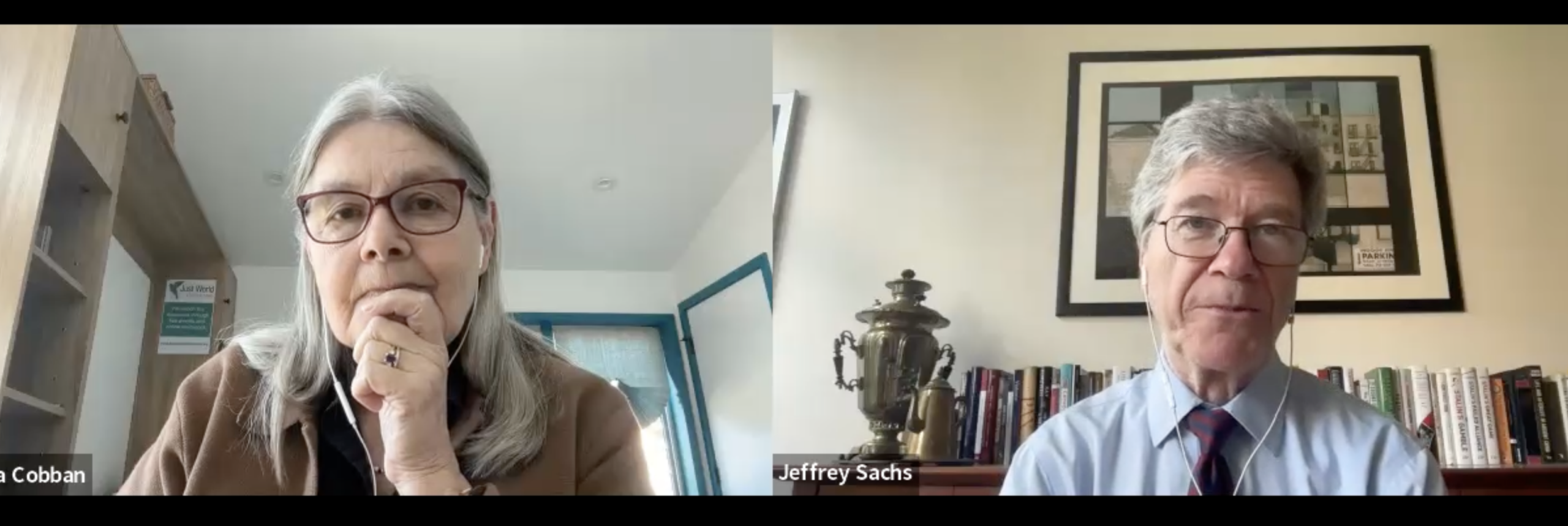
Economist Jeffrey Sachs has characterized the escalating conflict involving Iran as a “war of whim,” warning that the ongoing U.S.-Israeli military strategy lacks a rational foundation and threatens to destabilize global energy and food markets. During a June 5 discussion with Helena Cobban, president of Just World Educational, the long-time United Nations advisor argued that the current trajectory of the conflict is driven by narrow geopolitical interests rather than immediate security imperatives, with consequences that are already impacting vulnerable communities worldwide.
The economic fallout, according to Sachs, is rooted in the volatility of energy prices, which dictate the costs of essential goods, including fertilizer. “The impact is serious and widespread because the rise of energy prices and everything produced with energy, including fertilizer, most importantly, hits the entire world,” Sachs stated. He warned that while the current economic burden is significant, it has the potential to become devastating if the conflict continues to escalate, noting that the ultimate outcome remains uncertain and heavily dependent on future decisions made in Washington.
Sachs assessed that global markets are currently functioning as a “prediction market,” where oil prices reflect the collective expectations of governments and producers regarding the stability of supply lines. He observed that while companies are currently making tactical decisions about whether to release or hold reserves, the current market pricing suggests an underlying hope that energy flows might resume before the situation collapses further. When asked about the logic behind these market maneuvers, Sachs emphasized that the true irrationality lies not in the pricing mechanisms, but in the persistent blockade and the continuation of the war itself.
Critique of Leadership and Strategic Interests
A central theme of the discussion was the role of the United States and its leadership in the current regional crisis. Sachs and Cobban expressed sharp criticism of the current foreign policy approach, which they argued is being driven by figures who disregard the broader regional consequences. Sachs described the decision-making process as reckless, asserting that the U.S. has increasingly become the primary obstacle to achieving a sustainable peace in the Middle East.
Sachs argued that the war is not a byproduct of accidental developments, but rather the result of a long-term strategic vision. He suggested that the conflict serves a narrow set of interests, including energy companies and military contractors, while placing the economic cost of the war on ordinary citizens both in the United States and across the globe. He characterized the current approach to the region as being heavily influenced by lobbying networks, which he believes have played a decisive role in shaping Washington’s stance toward Iran.
Regarding the humanitarian impact, Sachs highlighted that the Global South is bearing the brunt of the instability. He noted that poor nations are already contending with rising food costs and shortages in agricultural inputs. These pressures, he warned, could be further exacerbated by climate-related events, such as a potential severe El Niño phase, which would disproportionately affect populations that rely on subsistence-level income for survival.
The Role of International Institutions
The discussion also addressed the effectiveness of the United Nations and the challenges facing its constituent bodies. Sachs argued that the U.S. is systematically undermining the UN by rejecting international law and failing to fulfill its financial obligations to the organization. He maintained that while the UN is not a world government with enforcement powers, its role as a framework for cooperation among sovereign states is being compromised by the refusal of major powers to participate in good faith.
Sachs specifically pointed to the constraints placed on institutions like the International Court of Justice (ICJ) and the United Nations Relief and Works Agency (UNRWA). Referring to the ICJ’s January 2024 interim ruling, which addressed the plausibility of genocide in Gaza, Sachs remarked that “justice delayed is justice denied.” He argued that political pressure and administrative delays have severely hindered the ability of these bodies to function effectively. Furthermore, he dismissed certain Security Council initiatives, such as the so-called “Board of Peace” for Gaza, as a charade designed to project an appearance of normalcy while the conflict continues.
Domestic Politics and the Path Forward
Shifting to the U.S. domestic landscape, Sachs argued that American democracy has been hollowed out by a security state that has been captured by private interests. He identified the military-industrial complex, major technology firms, and specific lobbying groups as entities that promote a cycle of war-making. He urged the American public to “regain our government” by using the upcoming election as a means to check the power of the executive branch and halt what he termed a culture of “family grift” and personal gain.

The conversation concluded with a call for an immediate shift in U.S. policy. Sachs argued that the most urgent priority is to end the blockade and cease what he described as “stupid things.” He called for the U.S. to withdraw from the current war effort, lift sanctions, and allow for the reopening of the Strait of Hormuz. “I want the U.S. to go home. Just go home,” he stated, a sentiment echoed by Cobban as the necessary foundation for regional de-escalation.
The discussion, which serves as the 24th installment in an ongoing project regarding the Iran crisis, is available for public review through various platforms. Readers interested in the full transcript or video documentation of these remarks can access them through the official archives of the organizing body. Further developments regarding international sanctions and regional energy policy are expected to be addressed in upcoming sessions of the United Nations Security Council, where the adherence to international law remains a point of contention among member states.
Keep reading
- Bronwyn Heslop’s death highlights the urgent need for change in South Africa’s fight against GBV
- Order of the Sinking Star is Ready to Launch on PlayStation 5 and TV
- Data Centers Spur Economic Growth, But Who Reaps the Benefits? (world-today-news.com)
- Israeli settlers set fire to Al-Rahma Mosque in Qusra, West Bank (time.news)