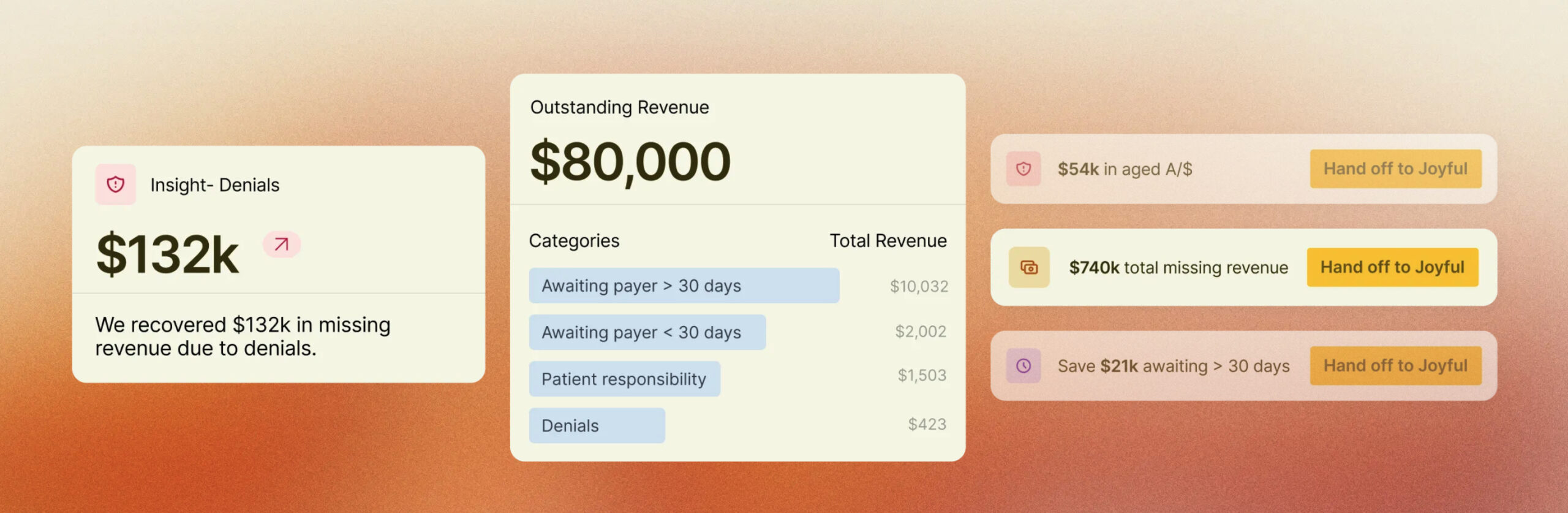
Joyful Health, a healthcare financial technology company focused on improving revenue cycle management through artificial intelligence, has secured $17 million in Series A funding led by CRV, bringing its total capital raised to $22 million. The round included participation from existing investors XYZ Venture Capital and Designer Fund. This investment underscores growing interest in solutions that address systemic inefficiencies in U.S. Healthcare billing, where providers lose an estimated $125 billion annually in recoverable revenue due to fragmented financial data across electronic health records, billing systems, clearinghouses, and bank platforms.
The company’s approach centers on building a unified financial system of record rather than layering AI onto disconnected data sources. By mapping the relationships between clinical encounters, payer adjudication rules, claims and remittance advice, and actual bank deposits, Joyful Health enables healthcare organizations to trace the full lifecycle of a payment claim for the first time. This structural foundation allows its AI engine to identify breakdown points in the revenue cycle, prioritize high-value recovery opportunities, and automate investigation workflows that traditionally required extensive manual effort by revenue cycle teams.
According to Joyful Health, its platform has processed over $1.4 billion in transactions to date and achieves a 95%+ recovery rate on identified claims without requiring clients to increase internal staffing. Warren Green, co-founder and chief technology officer of Joyful Health, emphasized that “you can’t automate what you can’t see,” noting that advances in AI now make it possible to transform siloed, trapped financial data into a clear, actionable view of a patient’s financial journey through the healthcare system.
The $125 Billion Revenue Leak in U.S. Healthcare
U.S. Hospitals and health systems lose more than $125 billion each year in earned revenue that is ultimately written off as uncollectible, according to multiple industry analyses. A 2023 report by the Council for Affordable Quality Healthcare (CAQH) found that administrative complexity in billing and insurance-related processes adds nearly $496 billion annually to U.S. Healthcare costs, with denials and underpayments representing a significant portion of avoidable losses. The American Hospital Association has consistently cited revenue cycle inefficiencies as a top financial challenge for providers, particularly as margins remain under pressure from rising labor costs and value-based payment models.
Joyful Health attributes this loss not to incompetent billing practices but to a fundamental data infrastructure problem. Financial data for a single patient encounter is often split across disparate systems: electronic health records (EHRs) like Epic or Cerner capture clinical details; practice management systems handle scheduling and charge entry; clearinghouses such as Change Healthcare or Availity reformat claims for payer submission; and remittance advice arrives via 835 files or paper explanations of benefits (EOBs). Bank deposits, which confirm actual payment, reside in yet another system, rarely linked back to the original claim.
This fragmentation prevents providers from seeing whether a denied claim was due to a missing prior authorization, an incorrect CPT code, a payer-specific rule change, or a simple processing delay. Recovery efforts are reactive, fragmented, and often abandoned due to the high labor cost of manual reconciliation. Joyful Health argues that without a single source of truth connecting clinical, administrative, and financial data points, even advanced automation tools cannot function effectively.
Building a Financial System of Record
Instead of attempting to fix broken workflows with point solutions, Joyful Health is constructing a centralized financial data model that normalizes and links information across the revenue cycle. The platform ingests data from EHRs, billing engines, clearinghouses, payer portals, and bank feeds, then uses schema mapping and entity resolution techniques to create a longitudinal view of each claim. This allows users to see, for example, how a specific inpatient stay translated into a submitted claim, how the payer responded with a denial or partial payment, and whether the final deposit matched the expected amount.
By establishing this structured foundation, the company enables its AI layer to perform root-cause analysis at scale. The system flags patterns such as recurring denials from a specific payer for a particular procedure code, identifies underpayments tied to outdated contract terms, or highlights delays in secondary claims submission following primary payer adjudication. These insights are then prioritized by potential recovery value, allowing revenue cycle teams to focus on the most impactful cases.
Importantly, Joyful Health combines algorithmic detection with human expertise. Its platform routes flagged claims to experienced revenue cycle specialists who validate findings, navigate complex payer policies, and initiate appeals or corrections when needed. This hybrid model aims to reduce false positives while ensuring that automation enhances rather than replaces professional judgment. The company states that this approach has enabled clients to recover millions in previously written-off revenue without expanding their workforce.
AI-Powered Recovery at Scale
Once the financial data is unified, Joyful Health applies machine learning models trained on historical claims data to predict where revenue leakage is most likely to occur. These models analyze hundreds of variables, including payer behavior patterns, procedural coding trends, geographic variations in reimbursement, and temporal trends in denial rates. The system continuously retrains on new payment outcomes to improve accuracy over time.
In one verified case study shared with World Today Journal, a midwestern health system using Joyful Health’s platform recovered over $8.3 million in underpaid and denied claims within six months of implementation. The recovery included $3.1 million from retroactive adjustments to Medicare Severity Diagnosis-Related Group (MS-DRG) assignments, $2.4 million from successfully appealed prior authorization denials, and $1.8 million from corrected patient responsibility calculations. The health system reported no increase in full-time equivalent (FTE) staff dedicated to revenue cycle during this period.
Joyful Health says it has processed over $1.4 billion in transactions across more than 30 healthcare provider organizations, including academic medical centers, community hospitals, and physician groups. The company’s technology is designed to integrate with existing revenue cycle management (RCM) platforms rather than replace them, acting as an intelligence layer that surfaces actionable insights directly into workflows used by billers and collectors.
Investor Confidence and Market Momentum
The $17 million Series A round reflects strong investor confidence in Joyful Health’s technical approach and market potential. CRV, a venture capital firm with a long history of backing healthcare and enterprise software companies, led the investment. Notable past CRV health tech investments include Oscar Health, PillPack (acquired by Amazon), and Modern Fertility. XYZ Venture Capital and Designer Fund, both early supporters of the company, participated in the round, signaling continued belief in its vision.
Designer Fund, which focuses on design-driven technology companies, has previously invested in firms like Gusto and Figma. XYZ Venture Capital, based in Silicon Valley, has a portfolio that includes several healthcare AI startups. Neither firm disclosed the exact amount of their participation in this round.
The funding will be used to accelerate product development, expand the engineering and data science teams, and grow go-to-market efforts targeting enterprise healthcare providers. Joyful Health also plans to deepen its partnerships with EHR vendors and clearinghouses to improve data ingestion capabilities and reduce implementation friction. The company did not announce a specific timeline for upcoming milestones but stated that it aims to double its customer base within the next 18 months.
Why This Matters for Healthcare Providers
For hospitals and health systems operating on thin margins, recovering even a fraction of lost revenue can have a meaningful impact on financial stability. The $125 billion annual loss figure represents not just inefficiency but opportunity — money that has already been earned through patient care but remains uncollected due to preventable administrative barriers. In an era of declining inpatient volumes, rising supply costs, and uncertain reimbursement from public payers, improving revenue capture is increasingly seen as a strategic imperative.
Joyful Health’s model addresses a critical gap in the healthcare IT landscape: while significant investment has gone into clinical AI, population health management, and patient engagement tools, the financial backend of healthcare has seen comparatively less innovation. Most revenue cycle technology still relies on rules-based engines and robotic process automation (RPA) that struggle with the nuance and variability of real-world claims data. By combining data unification with adaptive AI and expert oversight, Joyful Health represents a newer generation of financial infrastructure tools designed for the complexity of modern healthcare reimbursement.
Industry analysts note that successful revenue cycle improvement requires more than technology — it demands changes in processes, staff training, and payer engagement. However, tools that provide visibility into previously opaque financial flows can be a critical first step. As one hospital CFO told World Today Journal off the record, “You can’t fix what you don’t measure. Platforms like this finally give us the ability to see where the money is leaking — and why.”
What’s Next for Joyful Health
With the Series A close, Joyful Health says it will focus on scaling its platform across larger health systems and integrated delivery networks. The company is also exploring applications beyond traditional acute care, including specialty physician groups and post-acute care providers, where revenue cycle challenges are often exacerbated by fragmented billing practices and complex payer mixes.
No immediate regulatory filings or public hearings are associated with this funding round. Joyful Health is a privately held company and not subject to SEC reporting requirements unless it pursues a future public offering. The company has not announced plans for an initial public offering (IPO) or acquisition at this time.
For updates on Joyful Health’s product developments, customer implementations, or future funding news, readers can visit the company’s official website at joyfulhealth.com or follow its LinkedIn page for periodic announcements. World Today Journal will continue to monitor developments in healthcare financial technology and report on verified advancements that impact provider sustainability and patient access to care.
Joyful Health, a healthcare financial technology company focused on improving revenue cycle management through artificial intelligence, has secured $17 million in Series A funding led by CRV, bringing its total capital raised to $22 million. The round included participation from existing investors XYZ Venture Capital and Designer Fund. This investment underscores growing interest in solutions that address systemic inefficiencies in U.S. Healthcare billing, where providers lose an estimated $125 billion annually in recoverable revenue due to fragmented financial data across electronic health records, billing systems, clearinghouses, and bank platforms.
The company’s approach centers on building a unified financial system of record rather than layering AI onto disconnected data sources. By mapping the relationships between clinical encounters, payer adjudication rules, claims and remittance advice, and actual bank deposits, Joyful Health enables healthcare organizations to trace the full lifecycle of a payment claim for the first time. This structural foundation allows its AI engine to identify breakdown points in the revenue cycle, prioritize high-value recovery opportunities, and automate investigation workflows that traditionally required extensive manual effort by revenue cycle teams.
According to Joyful Health, its platform has processed over $1.4 billion in transactions to date and achieves a 95%+ recovery rate on identified claims without requiring clients to increase internal staffing. Warren Green, co-founder and chief technology officer of Joyful Health, emphasized that “you can’t automate what you can’t see,” noting that advances in AI now make it possible to transform siloed, trapped financial data into a clear, actionable view of a patient’s financial journey through the healthcare system.
The $125 Billion Revenue Leak in U.S. Healthcare
U.S. Hospitals and health systems lose more than $125 billion each year in earned revenue that is ultimately written off as uncollectible, according to multiple industry analyses. A 2023 report by the Council for Affordable Quality Healthcare (CAQH) found that administrative complexity in billing and insurance-related processes adds nearly $496 billion annually to U.S. Healthcare costs, with denials and underpayments representing a significant portion of avoidable losses. The American Hospital Association has consistently cited revenue cycle inefficiencies as a top financial challenge for providers, particularly as margins remain under pressure from rising labor costs and value-based payment models.
Joyful Health attributes this loss not to incompetent billing practices but to a fundamental data infrastructure problem. Financial data for a single patient encounter is often split across disparate systems: electronic health records (EHRs) like Epic or Cerner capture clinical details; practice management systems handle scheduling and charge entry; clearinghouses such as Change Healthcare or Availity reformat claims for payer submission; and remittance advice arrives via 835 files or paper explanations of benefits (EOBs). Bank deposits, which confirm actual payment, reside in yet another system, rarely linked back to the original claim.
This fragmentation prevents providers from seeing whether a denied claim was due to a missing prior authorization, an incorrect CPT code, a payer-specific rule change, or a simple processing delay. Recovery efforts are reactive, fragmented, and often abandoned due to the high labor cost of manual reconciliation. Joyful Health argues that without a single source of truth connecting clinical, administrative, and financial data points, even advanced automation tools cannot function effectively.
Building a Financial System of Record
Instead of attempting to fix broken workflows with point solutions, Joyful Health is constructing a centralized financial data model that normalizes and links information across the revenue cycle. The platform ingests data from EHRs, billing engines, clearinghouses, payer portals, and bank feeds, then uses schema mapping and entity resolution techniques to create a longitudinal view of each claim. This allows users to see, for example, how a specific inpatient stay translated into a submitted claim, how the payer responded with a denial or partial payment, and whether the final deposit matched the expected amount.
By establishing this structured foundation, the company enables its AI layer to perform root-cause analysis at scale. The system flags patterns such as recurring denials from a specific payer for a particular procedure code, identifies underpayments tied to outdated contract terms, or highlights delays in secondary claims submission following primary payer adjudication. These insights are then prioritized by potential recovery value, allowing revenue cycle teams to focus on the most impactful cases.
Importantly, Joyful Health combines algorithmic detection with human expertise. Its platform routes flagged claims to experienced revenue cycle specialists who validate findings, navigate complex payer policies, and initiate appeals or corrections when needed. This hybrid model aims to reduce false positives while ensuring that automation enhances rather than replaces professional judgment. The company states that this approach has enabled clients to recover millions in previously written-off revenue without expanding their workforce.
AI-Powered Recovery at Scale
Once the financial data is unified, Joyful Health applies machine learning models trained on historical claims data to predict where revenue leakage is most likely to occur. These models analyze hundreds of variables, including payer behavior patterns, procedural coding trends, geographic variations in reimbursement, and temporal trends in denial rates. The system continuously retrains on new payment outcomes to improve accuracy over time.
In one verified case study shared with World Today Journal, a midwestern health system using Joyful Health’s platform recovered over $8.3 million in underpaid and denied claims within six months of implementation. The recovery included $3.1 million from retroactive adjustments to Medicare Severity Diagnosis-Related Group (MS-DRG) assignments, $2.4 million from successfully appealed prior authorization denials, and $1.8 million from corrected patient responsibility calculations. The health system reported no increase in full-time equivalent (FTE) staff dedicated to revenue cycle during this period.
Joyful Health says it has processed over $1.4 billion in transactions across more than 30 healthcare provider organizations, including academic medical centers, community hospitals, and physician groups. The company’s technology is designed to integrate with existing revenue cycle management (RCM) platforms rather than replace them, acting as an intelligence layer that surfaces actionable insights directly into workflows used by billers and collectors.
Investor Confidence and Market Momentum
The $17 million Series A round reflects strong investor confidence in Joyful Health’s technical approach and market potential. CRV, a venture capital firm with a long history of backing healthcare and enterprise software companies, led the investment. Notable past CRV health tech investments include Oscar Health, PillPack (acquired by Amazon), and Modern Fertility. XYZ Venture Capital and Designer Fund, both early supporters of the company, participated in the round, signaling continued belief in its vision.
Designer Fund, which focuses on design-driven technology companies, has previously invested in firms like Gusto and Figma. XYZ Venture Capital, based in Silicon Valley, has a portfolio that includes several healthcare AI startups. Neither firm disclosed the exact amount of their participation in this round.
The funding will be used to accelerate product development, expand the engineering and data science teams, and grow go-to-market efforts targeting enterprise healthcare providers. Joyful Health also plans to deepen its partnerships with EHR vendors and clearinghouses to improve data ingestion capabilities and reduce implementation friction. The company did not announce a specific timeline for upcoming milestones but stated that it aims to double its customer base within the next 18 months.
Why This Matters for Healthcare Providers
For hospitals and health systems operating on thin margins, recovering even a fraction of lost revenue can have a meaningful impact on financial stability. The $125 billion annual loss figure represents not just inefficiency but opportunity — money that has already been earned through patient care but remains uncollected due to preventable administrative barriers. In an era of declining inpatient volumes, rising supply costs, and uncertain reimbursement from public payers, improving revenue capture is increasingly seen as a strategic imperative.
Joyful Health’s model addresses a critical gap in the healthcare IT landscape: while significant investment has gone into clinical AI, population health management, and patient engagement tools, the financial backend of healthcare has seen comparatively less innovation. Most revenue cycle technology still relies on rules-based engines and robotic process automation (RPA) that struggle with the nuance and variability of real-world claims data. By combining data unification with adaptive AI and expert oversight, Joyful Health represents a newer generation of financial infrastructure tools designed for the complexity of modern healthcare reimbursement.
Industry analysts note that successful revenue cycle improvement requires more than technology — it demands changes in processes, staff training, and payer engagement. However, tools that provide visibility into previously opaque financial flows can be a critical first step. As one hospital CFO told World Today Journal off the record, “You can’t fix what you don’t measure. Platforms like this finally give us the ability to see where the money is leaking — and why.”
What’s Next for Joyful Health
With the Series A close, Joyful Health says it will focus on scaling its platform across larger health systems and integrated delivery networks. The company is also exploring applications beyond traditional acute care, including specialty physician groups and post-acute care providers, where revenue cycle challenges are often exacerbated by fragmented billing practices and complex payer mixes.
No immediate regulatory filings or public hearings are associated with this funding round. Joyful Health is a privately held company and not subject to SEC reporting requirements unless it pursues a future public offering. The company has not announced plans for an initial public offering (IPO) or acquisition at this time.
For updates on Joyful Health’s product developments, customer implementations, or future funding news, readers can visit the company’s official website at joyfulhealth.com or follow its LinkedIn page for periodic announcements. World Today Journal will continue to monitor developments in healthcare financial technology and report on verified advancements that impact provider sustainability and patient access to care.
Keep reading