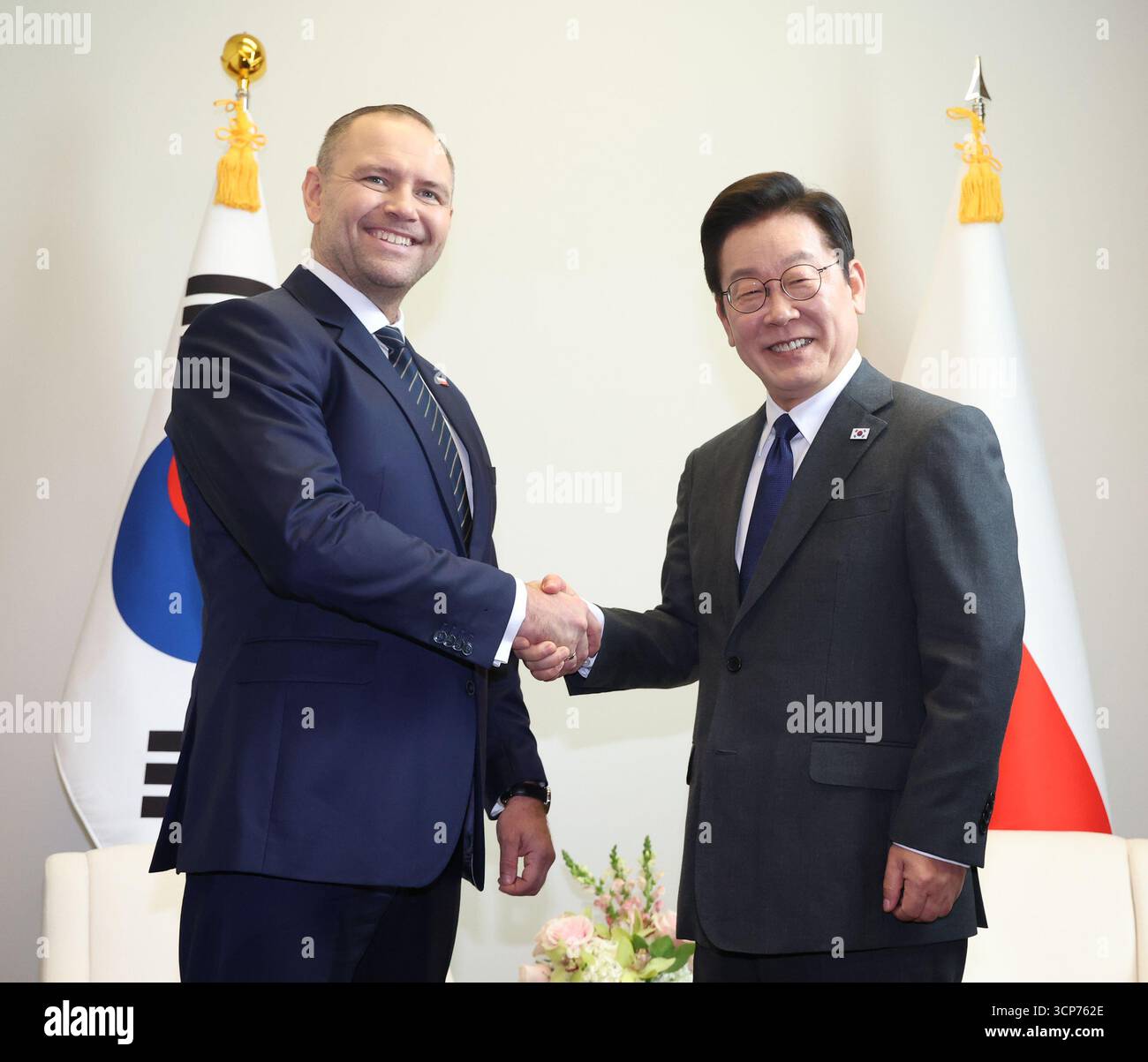
South Korean President Lee Jae-myung and Polish Prime Minister Donald Tusk met at the Blue House on Monday, April 13, 2026, to solidify a strategic partnership amid a volatile global landscape. The two leaders announced the elevation of their bilateral ties to a “Comprehensive Strategic Partnership,” signaling a deeper commitment to cooperation across defense, technology, and energy sectors.
The summit comes at a critical juncture, with both nations navigating the fallout of the Middle East crisis and broader shifts in international order. President Lee emphasized the need for strengthened supply chain cooperation to mitigate the risks posed by these regional instabilities, although Prime Minister Tusk stressed the importance of joint efforts to maintain global peace.
A central pillar of the discussions focused on the existing defense industry cooperation, which has seen significant growth since 2022. The leaders reaffirmed their commitment to the stable implementation of a framework agreement valued at approximately $44.2 billion, signed in 2022 according to official reports.
Expanding the Horizon: From Defense to High-Tech Innovation
While defense has long been the primary engine of the South Korea-Poland relationship, the new “Comprehensive Strategic Partnership” aims to diversify this cooperation. President Lee detailed a joint statement that outlines a future-oriented approach, expanding the scope of collaboration into several critical fields.

The expanded cooperation will target advanced industries, science and technology, space exploration, energy, and infrastructure. This shift reflects a strategic desire to move beyond transactional arms deals toward a holistic technological and economic alliance that can withstand global economic uncertainties.
Prime Minister Tusk acknowledged that while defense remains a core driver, Poland is keen to accelerate technology transfers and the localization of production. This includes the potential relocation of production bases to Poland, which would integrate South Korean industrial expertise directly into the European market.
Addressing Global Instability and Supply Chain Risks
The geopolitical context of the meeting was dominated by the ongoing conflict in the Middle East and its ripple effects on global trade. President Lee specifically highlighted “supply chain cooperation” as a vital tool for resilience, suggesting that the two nations must coordinate more closely to ensure the flow of essential materials and energy.
The leaders discussed the increasing unpredictability of the global security environment. By enhancing communication and strategic alignment, South Korea and Poland intend to create a more stable corridor for trade and security, bridging the gap between East Asia and Central Europe.
The commitment to “stable implementation” of previous contracts was a key point of the dialogue. President Lee urged the Polish administration to ensure that the massive defense contracts signed in previous years continue to be executed without delay, ensuring that Poland’s security needs are met while South Korean industries maintain their export momentum.
Key Outcomes of the Korea-Poland Summit
| Area of Cooperation | Key Objective/Detail |
|---|---|
| Diplomatic Status | Elevated to “Comprehensive Strategic Partnership” |
| Defense Industry | Stable execution of $44.2 billion framework agreement (2022) |
| Industrial Strategy | Technology transfer and localization of production in Poland |
| Future Sectors | Collaboration in Space, Energy, and Advanced Science/Tech |
| Global Security | Joint response to Middle East crisis and supply chain stabilization |
The Strategic Significance of the Partnership
The elevation of ties to a Comprehensive Strategic Partnership is not merely a symbolic gesture. For South Korea, Poland serves as a critical gateway to the European Union and a primary customer for its high-end defense exports. For Poland, South Korea provides a reliable source of advanced military hardware and a partner in high-tech industrial modernization.
The focus on “localization” mentioned by Prime Minister Tusk suggests a shift toward a more sustainable industrial ecosystem. Rather than simply importing finished goods, Poland seeks to build its own capacity through South Korean technology, which would enhance its domestic employment and industrial capabilities.
the mention of “human exchange” and “communication” indicates that both governments recognize the need for deeper cultural and professional ties to support these high-level political and economic agreements. By expanding personnel exchanges, the two nations hope to create a foundation of trust that transcends individual administrations.
As the international community continues to grapple with the “격변” (upheaval) of the international order, the South Korea-Poland axis represents a pragmatic alignment of two nations that prioritize security and technological sovereignty in an era of great-power competition.
The next phase of this partnership will likely involve the detailed mapping of the “future-oriented” cooperation in space and energy, with further diplomatic follow-ups expected to finalize the specifics of the technology transfer agreements.
We invite our readers to share their perspectives on the growing strategic ties between East Asia and Central Europe in the comments section below.