
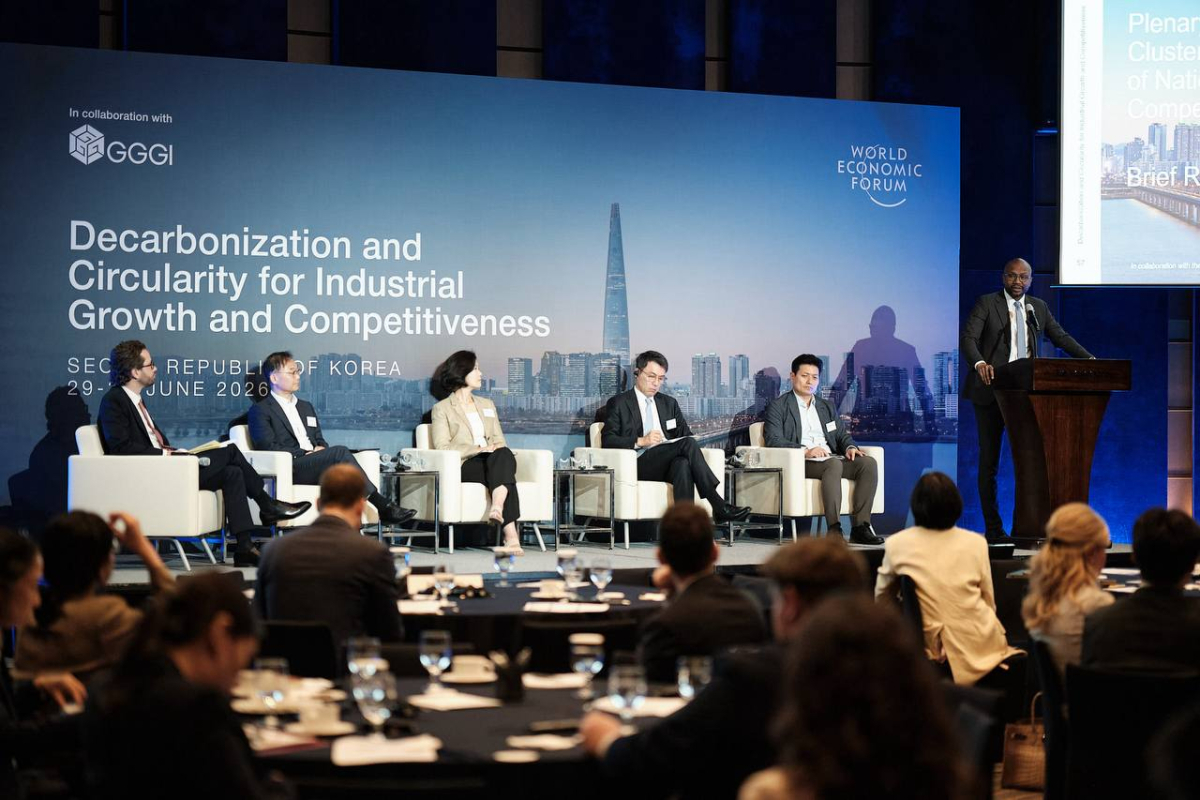
Korea Zinc participated in the World Economic Forum (WEF) forum on “Decarbonization and Circularity for Industrial Competitiveness” to align its industrial strategies with global net-zero goals. The event brought together Asia-Pacific governments, international organizations, and industry representatives to address the balance between economic growth and carbon reduction.
The company used the forum to discuss the integration of circular economy principles into heavy industry, specifically focusing on how non-ferrous metal smelting can transition to sustainable models without losing market competitiveness. This participation follows Korea Zinc’s broader strategic pivot toward green energy and resource recycling.
The forum focused on the Asia-Pacific region, where industrial emissions remain high but the potential for circularity—the process of eliminating waste and the continual use of resources—is significant. According to the World Economic Forum, accelerating the transition to a circular economy could reduce greenhouse gas emissions by billions of tonnes by 2050.
How Korea Zinc is Integrating Circularity into Smelting
Korea Zinc is currently implementing its “Troika Drive” growth strategy, which focuses on three core pillars: renewable energy, secondary battery materials, and resource recycling. This strategy aims to transform the company from a traditional smelter into a sustainable materials provider.

The resource recycling component of this strategy focuses on “urban mining,” the process of recovering precious and base metals from electronic waste and industrial scrap. By increasing the ratio of recycled materials in its production process, the company reduces the energy-intensive need for primary mining and refining.
The company’s efforts are part of a broader industry shift toward “green smelting.” Traditional smelting relies heavily on fossil fuels for heat and chemical reduction. Korea Zinc is exploring the use of hydrogen as a reductant to replace carbon-heavy sources, a move that would significantly lower the carbon footprint of zinc and lead production.
The Role of the Asia-Pacific Region in Industrial Decarbonization
The WEF forum highlighted that the Asia-Pacific region faces unique challenges in decarbonization due to its high density of energy-intensive industries. Government representatives at the forum discussed the necessity of policy frameworks that incentivize companies to adopt circularity without compromising their global export competitiveness.

Industry leaders argued that decarbonization cannot be achieved through regulation alone but requires technological breakthroughs in energy storage and carbon capture. Korea Zinc’s participation underscores the role of private sector leadership in developing the technical infrastructure needed for these transitions.
The forum emphasized that circularity in the Asia-Pacific region requires cross-border cooperation to establish standards for recycled materials. This ensures that recovered metals meet the quality requirements for high-tech applications, such as electric vehicle (EV) batteries and semiconductor components.
What the Troika Drive Means for Global Supply Chains
The “Troika Drive” is designed to secure Korea Zinc’s position in the global energy transition. By expanding into battery materials, the company is diversifying its revenue streams beyond traditional metals like zinc and lead.

The company is focusing on the production of precursors and cathode materials, which are essential components of lithium-ion batteries. According to Korea Zinc’s official corporate disclosures, this expansion is intended to create a closed-loop system where battery materials are produced, used, and eventually recycled back into the production cycle.
This closed-loop approach addresses two critical supply chain vulnerabilities: the volatility of raw material prices and the environmental impact of mining. By recovering nickel, cobalt, and manganese from spent batteries, the company reduces reliance on imports from politically unstable regions.
The Financial and Economic Impact of Green Transition
The transition to decarbonized industrial processes requires significant capital expenditure. However, the WEF forum participants noted that companies failing to adapt risk facing “carbon borders”—tariffs on imports from countries with laxer environmental standards, such as the European Union’s Carbon Border Adjustment Mechanism (CBAM).

For a global exporter like Korea Zinc, reducing carbon intensity is not only an environmental goal but a financial necessity to maintain access to European and North American markets. The shift toward renewables and hydrogen-based production is intended to hedge against these future regulatory costs.
Economic analysis suggests that the circular economy could generate trillions of dollars in economic output by 2030 globally. By positioning itself as a leader in resource recovery, Korea Zinc is attempting to capture a larger share of this emerging “green” metal market.
The company’s next scheduled milestones include the expansion of its renewable energy capacity and the scaling of its battery material production facilities, with further updates expected in its upcoming quarterly earnings and sustainability reports.
Readers interested in the transition of heavy industry can monitor official WEF updates on industrial decarbonization or review Korea Zinc’s investor relations filings for specific project timelines.
Do you believe heavy industry can realistically achieve net-zero without government subsidies? Share your thoughts in the comments below.