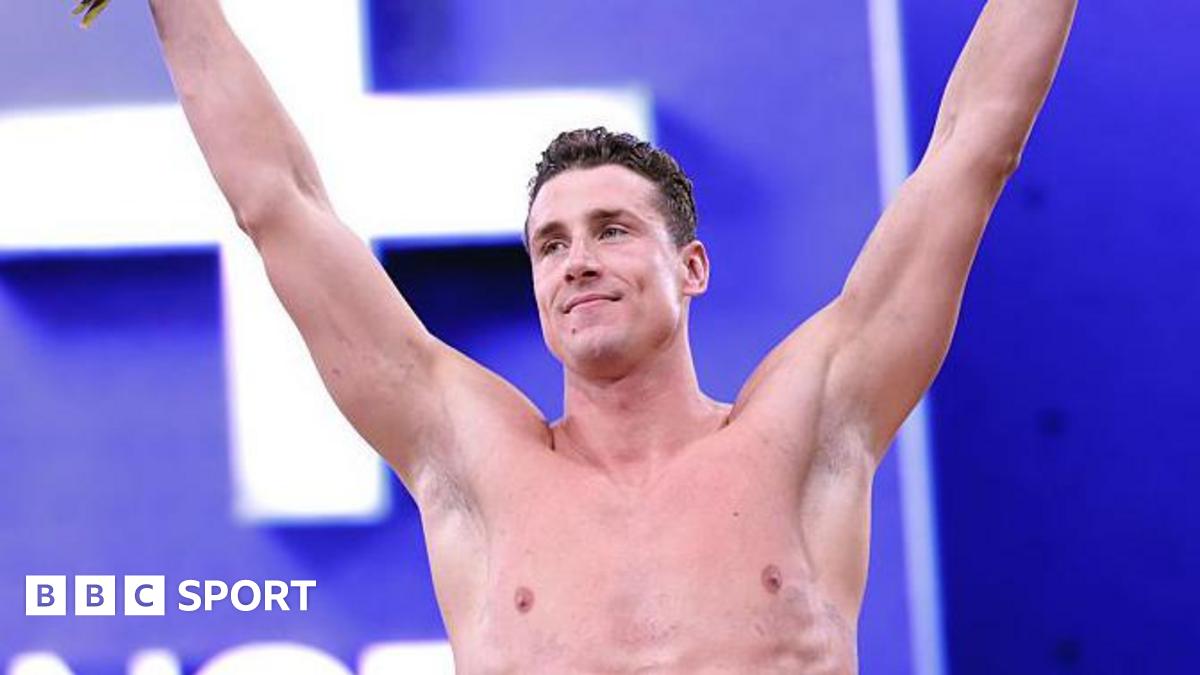
Las Vegas, May 21, 2025 — The world of competitive swimming was turned on its head today as Greek Olympic swimmer Kristian Gkolomeev shattered the long-standing 50-meter freestyle world record during a high-profile event tied to the controversial Enhanced Games, a new sports movement blending elite athletics with scientific performance enhancements. The announcement, made at Resorts World Las Vegas, not only revealed the inaugural Enhanced Games will take place in Las Vegas over Memorial Day Weekend 2026 but also marked the first time a swimmer has broken the 50m freestyle record in a setting explicitly designed to test the boundaries of human performance through cutting-edge technology and athlete incentives.
Gkolomeev’s record-setting swim—clocking 20.89 seconds—surpassed the 2009 benchmark of 21.04 seconds set by Brazilian legend Cesar Cielo. But the achievement went further: he also became the fastest man in history to swim the 50m freestyle in jammers (competitive swimsuits), recording a time of 21.03 seconds, edging out the previous record of 21.04 seconds held by American Caeleb Dressel. For his groundbreaking performance, Gkolomeev was awarded a $1 million prize, the first payout under the Enhanced Games’ new athlete incentive model—a bold step into uncharted territory where science, sport, and financial motivation collide.
The Enhanced Games, founded by Dr. Aron D’Souza, President and Founder of the organization, position themselves as a movement rather than a traditional competition. Their mission, as D’Souza articulated during the announcement, is to “embrace the full spectrum of human potential” through transparency, science, and athlete choice. The event’s timing—just months before the 2026 Games—raises questions about the future of doping regulations, fair play, and the ethical boundaries of performance enhancement in sport. While the International Olympic Committee (IOC) has not yet commented on the Enhanced Games’ approach, the initiative has sparked debate among athletes, governing bodies, and anti-doping advocates worldwide.
What Are the Enhanced Games?
The Enhanced Games represent a radical departure from traditional sports competitions. Unlike the Olympics or World Championships, which adhere to strict anti-doping protocols enforced by World Anti-Doping Agency (WADA), the Enhanced Games explicitly embrace scientific performance enhancements—a term that includes everything from advanced training methodologies and nutritional optimization to cutting-edge biomechanics and, in some interpretations, legal pharmacological aids. The movement’s founders argue that such approaches are the natural evolution of human progress in sport, while critics warn of a slippery slope toward unregulated competition and a potential erosion of fair play.
According to the organization’s press release, the Enhanced Games will feature events across multiple disciplines, with swimming serving as the inaugural showcase. The inaugural event in 2026 will include:
- A multi-day competition over Memorial Day Weekend (May 26–29, 2026),
- Cash prizes for top performers, including the $1 million awarded to Gkolomeev,
- A focus on transparency, with athletes required to disclose any performance-enhancing methods used, and
- Partnerships with scientific institutions to validate and monitor enhancements.
The choice of Las Vegas as the host city is symbolic. Known for its association with innovation, risk-taking, and spectacle, the city aligns with the Enhanced Games’ ethos of pushing boundaries. However, the decision has also drawn scrutiny from sports purists and anti-doping advocates who question whether such a platform could normalize the use of performance-enhancing drugs (PEDs) in mainstream sport.
Kristian Gkolomeev: The Swimmer Who Broke the Mold
Kristian Gkolomeev, a two-time Olympic medalist in swimming, has long been a figure at the intersection of tradition and innovation. Born in Athens, Greece, Gkolomeev rose to prominence as a teenager, winning gold in the 2020 Tokyo Olympics in the 50m freestyle—a race he completed in 21.44 seconds. His decision to participate in the Enhanced Games announcement signals a shift in his career, one that prioritizes performance over conventional anti-doping restrictions.
In a post-announcement interview, Gkolomeev reflected on the significance of his record-breaking swim:
“This isn’t just about breaking records. It’s about breaking limits. The Enhanced Games gave me the resources and the team to unlock a new level of performance—and now the whole world can see what’s possible.”
Gkolomeev’s comments highlight a central tension in the debate surrounding the Enhanced Games: Is this the future of sport, or a dangerous experiment? While proponents argue that scientific advancements should be celebrated rather than suppressed, critics point to the potential for a two-tiered system where elite athletes gain unfair advantages through access to cutting-edge (and potentially unregulated) enhancements.
The Controversy: Science vs. Fair Play
The Enhanced Games have ignited a global conversation about the ethics of performance enhancement in sport. Key stakeholders are divided:
- Supporters: Argue that the movement democratizes access to performance science, allowing athletes to compete at their biological peak without the stigma of doping. They also point to the financial incentives as a way to attract top talent to disciplines that often struggle with funding.
- Critics: Warn that the Enhanced Games could undermine the integrity of traditional sports by creating a parallel system where anti-doping rules are optional. They also raise concerns about the safety of untested enhancements and the potential for a rich-get-richer dynamic in sport.
- Regulators: Organizations like WADA and the IOC have not yet issued official statements, but leaks suggest internal debates are underway. Some officials are reportedly exploring whether the Enhanced Games could be classified as a non-sanctioned event, effectively barring its athletes from future Olympic qualification.
One of the most contentious aspects of the Enhanced Games is their athlete incentive model. The $1 million prize awarded to Gkolomeev is unprecedented in swimming and sets a benchmark for future competitions. While the Enhanced Games frame this as a reward for innovation, critics argue it could incentivize athletes to take risks with their health in pursuit of financial gain.
What Happens Next?
The Enhanced Games are still in their infancy, but their rapid rise has forced the sports world to confront uncomfortable questions. Here’s what to watch for in the coming months:
- Regulatory Response: Will WADA or the IOC issue a formal statement on the Enhanced Games? Rumors suggest a working group may be formed to assess the movement’s impact on anti-doping standards.
- Athlete Participation: Will other Olympic champions follow Gkolomeev’s lead and compete in the Enhanced Games? Names like Sarah Sjöström (Sweden) and Caeleb Dressel (USA) have been speculated to be watching closely.
- Scientific Oversight: How will the Enhanced Games ensure the safety of athletes using performance enhancements? Will they partner with medical institutions to monitor side effects?
- Broadcast and Sponsorship Deals: The financial viability of the Enhanced Games hinges on securing major media rights and sponsors. If broadcasters like ESPN or Eurosport sign on, it could legitimize the movement.
- Legal Challenges: Could athletes who compete in the Enhanced Games face disqualification from future Olympic events? This remains an untested legal gray area.
Key Takeaways
- The Enhanced Games announced their inaugural event in Las Vegas (May 26–29, 2026), marking a new era where science and sport collide.
- Kristian Gkolomeev broke the 50m freestyle world record (20.89s) and the jammers record (21.03s), earning a $1 million prize—the first of its kind in swimming.
- The movement challenges traditional anti-doping norms, raising questions about fair play, safety, and the future of elite sport.
- Supporters see it as progress. critics fear it could erode doping regulations and create an unequal playing field.
- The next 12 months will be critical in determining whether the Enhanced Games become a legitimate competition or a controversial sideshow.
The Enhanced Games’ announcement has sent shockwaves through the sports world, but one thing is clear: the debate over performance enhancement is no longer theoretical. It’s here, it’s happening, and the stakes could not be higher. As the countdown to Las Vegas begins, athletes, regulators, and fans alike are left with a single question: Are we ready to redefine the limits of human achievement?
What are your thoughts on the Enhanced Games? Should science and sport merge, or does this cross an ethical line? Share your views in the comments below—or tag @worldtodayjournal to join the conversation on X.
Keep reading