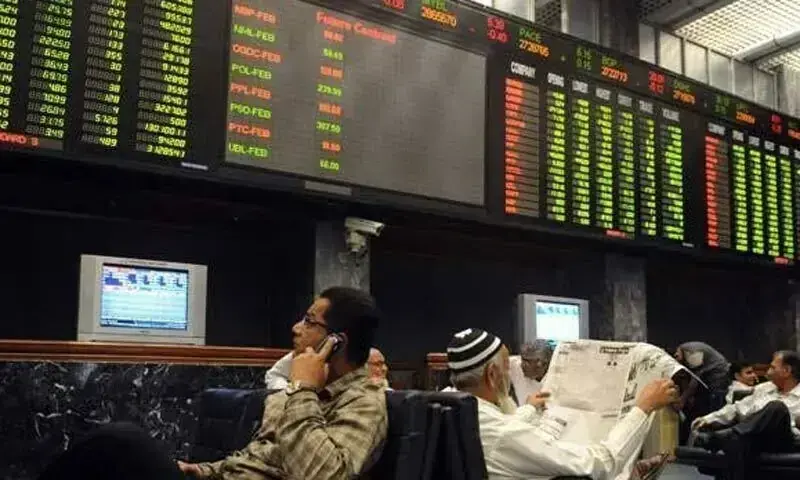
Karachi, Pakistan – Pakistan’s benchmark KSE-100 index is demonstrating resilience, extending its recovery from a dramatic downturn earlier this week. As of 10:30 am local time on Wednesday, the index was trading 381.98 points higher, building on the substantial gains seen on Tuesday. This rebound, however, is occurring against a backdrop of continued volatility and escalating geopolitical tensions in the Middle East, creating a complex environment for investors.
The KSE-100’s current upward trajectory represents a 0.24 percent increase from its previous close of 157,132.09 points. Even as investor confidence appears to be stabilizing, it remains cautious following a turbulent start to the week marked by significant market fluctuations. Tuesday witnessed a remarkable turnaround, with the index surging 5,159.10 points to close at 157,132.09, effectively recouping a substantial portion of the losses incurred during Monday’s historic sell-off. Monday’s decline, the largest single-session drop in the Pakistan Stock Exchange’s history, saw the index plummet by over 16,000 points, according to reports from Dawn.
Early Volatility and Geopolitical Concerns
Despite the overall positive trend, Wednesday’s trading session has been far from smooth. The index experienced a sharp dip in early trading, briefly falling by more than 2,300 points around 9:20 am, reaching an intraday low of 154,790.73 before regaining lost ground. This fluctuation, with the day’s trading range spanning from 154,790.73 to 157,962.47, underscores the fragile sentiment currently prevailing in the market. The underlying cause of this volatility is largely attributed to external factors, particularly the escalating tensions between the United States and Israel with Iran.
The conflict in the Middle East has sent shockwaves through global markets, driving up oil prices to a 19-month high and creating uncertainty across international equities. Brent crude oil, a key benchmark, has seen significant price increases in recent days, impacting energy-importing nations like Pakistan. The potential for a prolonged conflict adds another layer of complexity, prompting investors to reassess risk and adjust their portfolios accordingly. According to reports, the situation is being closely monitored by financial institutions worldwide, with contingency plans being prepared for various scenarios.
Tuesday’s Dramatic Rebound
Tuesday’s impressive rally offered a much-needed respite after Monday’s devastating losses. The KSE-100’s 5,159.10 point gain was a significant reversal, demonstrating the market’s capacity for resilience. A total of 429.9 million shares were traded during the session, with the total market value reaching approximately Rs. 38 billion at closing, as reported by TechJuice. Top volume leaders included KEL (Karachi Electric Limited), WTL (Worldcall Telecom Limited), and PAEL (Pakistan Aeronautical Engineering Limited).
The surge in trading volume suggests a renewed interest from investors, potentially driven by bargain-hunting following Monday’s steep decline. However, analysts caution that the recovery is not yet fully established and remains vulnerable to external shocks. The market’s sensitivity to geopolitical events and global commodity prices will likely continue to be a key factor in the coming days.
Key Volume Leaders on Tuesday
- KEL: 74,401,539 shares traded, closing at Rs. 7.29
- WTL: 50,045,665 shares traded, closing at Rs. 1.21
- PAEL: 38,234,339 shares traded, closing at Rs. 39.33
- UNITY: 29,974,829 shares traded, closing at Rs. 8.60
- BOP: 28,091,733 shares traded, closing at Rs. 28.64
- CNERGY: 25,439,509 shares traded, closing at Rs. 6.33
- TELE: 25,103,572 shares traded, closing at Rs. 6.66
Broader Economic Context and Outlook
The performance of the KSE-100 is intrinsically linked to the broader economic health of Pakistan. Recent economic indicators have presented a mixed picture, with concerns surrounding inflation, foreign exchange reserves, and the country’s debt burden. The Pakistani Rupee (PKR) has shown remarkable stability against the US Dollar, maintaining an upward trend for 111 consecutive sessions as of Tuesday, defying broader global trends, according to TechJuice. However, this positive trend could be threatened by the escalating geopolitical risks and their potential impact on the country’s import bill.
The sustained recovery of the KSE-100 will likely depend on a number of factors, including the resolution of the conflict in the Middle East, the stabilization of global commodity prices, and the implementation of sound economic policies by the Pakistani government. Investors will be closely watching for any developments that could impact the country’s economic outlook and corporate earnings. The Pakistan Stock Exchange (PSX) provides real-time market data and analysis on its website, offering investors valuable insights into market trends and performance. You can track the KSE100 index and related information at Sarmaaya and TradingView.
Key Takeaways
- The KSE-100 index is currently experiencing a recovery following a historic single-session decline on Monday.
- Geopolitical tensions in the Middle East are contributing to market volatility.
- Tuesday’s rally demonstrated the market’s resilience, with significant trading volume.
- The sustained recovery of the KSE-100 will depend on external factors and domestic economic policies.
Looking ahead, the market is expected to remain sensitive to global developments and economic indicators. Investors are advised to exercise caution and conduct thorough research before making any investment decisions. The next key event to watch will be the release of the State Bank of Pakistan’s monetary policy statement later this month, which is expected to provide further clarity on the country’s economic outlook.
We encourage our readers to share their perspectives on the KSE-100’s performance and the broader economic challenges facing Pakistan in the comments section below. Your insights are valuable as we continue to monitor and report on these important developments.
Worth a look
- Former Anthropic Engineer Accuses Company of Lowering AI Safety Standards for Big Clients
- Hidden Defects Lawyer in Toulon: Protect Your Real Estate Rights
- Wet-Bulb Temperature vs. Heat Index: What Actually Predicts Danger (daybreakwire.com)
- Gold Price Outlook: Fed Rates, Geopolitical Tensions, and Market Trends (world-today-news.com)