
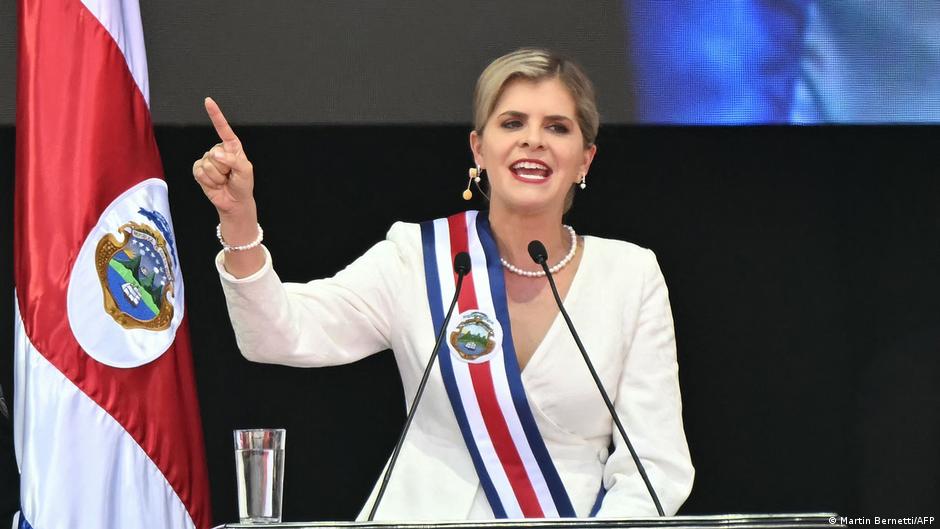
Right-wing political scientist Laura Fernández officially assumed the presidency of Costa Rica on Friday, May 8, 2026, during a massive ceremony at the Estadio Nacional in San José. In a speech delivered before a crowd of supporters, the 39-year-old leader signaled a sharp shift in national security priority, pledging a “firm hand” response to the escalating threats of organized crime and drug trafficking within the country.
Fernández, who won the February 1 elections with a comfortable margin, ascended to power largely fueled by the popularity of her mentor, outgoing president Rodrigo Chaves. Her inauguration marks a new chapter for the Central American nation, as she seeks to implement a security apparatus designed to close systemic vulnerabilities that have allowed narcotics trafficking to penetrate the state.
The investiture was historically significant, marking the first time two women headlined the ceremony. Following Fernández’s oath, Yara Jiménez, the head of the Legislative Assembly, placed the presidential sash upon her, symbolizing a transition of power characterized by a strong alignment between the executive and legislative branches.
A Mandate for “Mano Dura”
Central to Fernández’s platform is the concept of mano dura (firm hand), a governance style emphasizing strict law enforcement and zero tolerance for criminal activity. During her address, Fernández was explicit about her resolve, stating, “My hand will not tremble to face organized crime.”
The new president argued that Costa Rica has reached a critical juncture where it “cannot accept that drug trafficking finds cracks in the system.” This rhetoric suggests a move toward more aggressive policing and judicial strategies to dismantle the networks that facilitate the movement of illicit goods through the region. For a country historically known for its stability and peaceful diplomacy, this shift toward a security-first approach represents a significant evolution in domestic policy.
The Bukele Model and the Megaprison Project
Perhaps the most provocative element of Fernández’s immediate agenda is the planned construction of a massive correctional facility. The president announced plans to inaugurate a megaprison capable of holding 5,000 prisoners, a project explicitly inspired by the controversial security model implemented by Salvadoran President Nayib Bukele.

The Bukele model in El Salvador is characterized by mass arrests and the construction of high-capacity, high-security prisons to isolate gang members from the general population. By adopting a similar approach, Fernández aims to neutralize the influence of organized crime leaders who often continue to operate from within traditional prison systems. The scale of the proposed 5,000-prisoner facility indicates a projected surge in incarcerations as the government cracks down on trafficking rings.
This policy direction is likely to draw scrutiny from human rights organizations, given the international debate surrounding the legal safeguards and due process associated with the Salvadoran model. However, for Fernández and her supporters, the priority remains the restoration of order and the eradication of the “cracks” in the system that have emboldened criminal syndicates.
Political Lineage and the Chaves Influence
The rise of Laura Fernández cannot be decoupled from the influence of Rodrigo Chaves. As a protégé of the outgoing president, Fernández inherits a political machinery built on populist appeal and a critique of the traditional political establishment. Her victory on February 1 was seen as a validation of the Chaves administration’s direction, providing Fernández with a strong mandate to expand upon his policies.
As a political scientist, Fernández brings a technical background to the presidency, though her governing philosophy is firmly rooted in the right-wing tradition. Her ability to consolidate power quickly—evidenced by the seamless transition with Legislative Assembly head Yara Jiménez—suggests that she will have the political capital necessary to push through her ambitious security legislation and infrastructure projects.
Key Takeaways of the Fernández Administration’s Launch
- Security Priority: Implementation of a “mano dura” (firm hand) policy against drug trafficking and organized crime.
- Infrastructure: The planned construction of a megaprison for 5,000 inmates, modeled after Nayib Bukele’s approach in El Salvador.
- Political Alignment: Strong continuity from the Rodrigo Chaves administration and close coordination with the Legislative Assembly.
- Historical Milestone: A landmark investiture featuring two women in the primary leadership roles of the ceremony.
As President Fernández begins her four-year term, the international community will be watching closely to see how the “Bukele-inspired” security measures are integrated into Costa Rica’s democratic framework. The immediate focus remains the operationalization of the new prison system and the first wave of enforcement actions against organized crime.

The next official checkpoint for the administration will be the introduction of the first legislative package aimed at restructuring prison benefits and enhancing police powers, expected in the coming weeks.
World Today Journal encourages readers to share this report and join the conversation in the comments section below regarding the shift in Central American security policies.