Revolutionizing Infrared Imaging: Lensless Technology Promises Affordable, High-Performance Vision
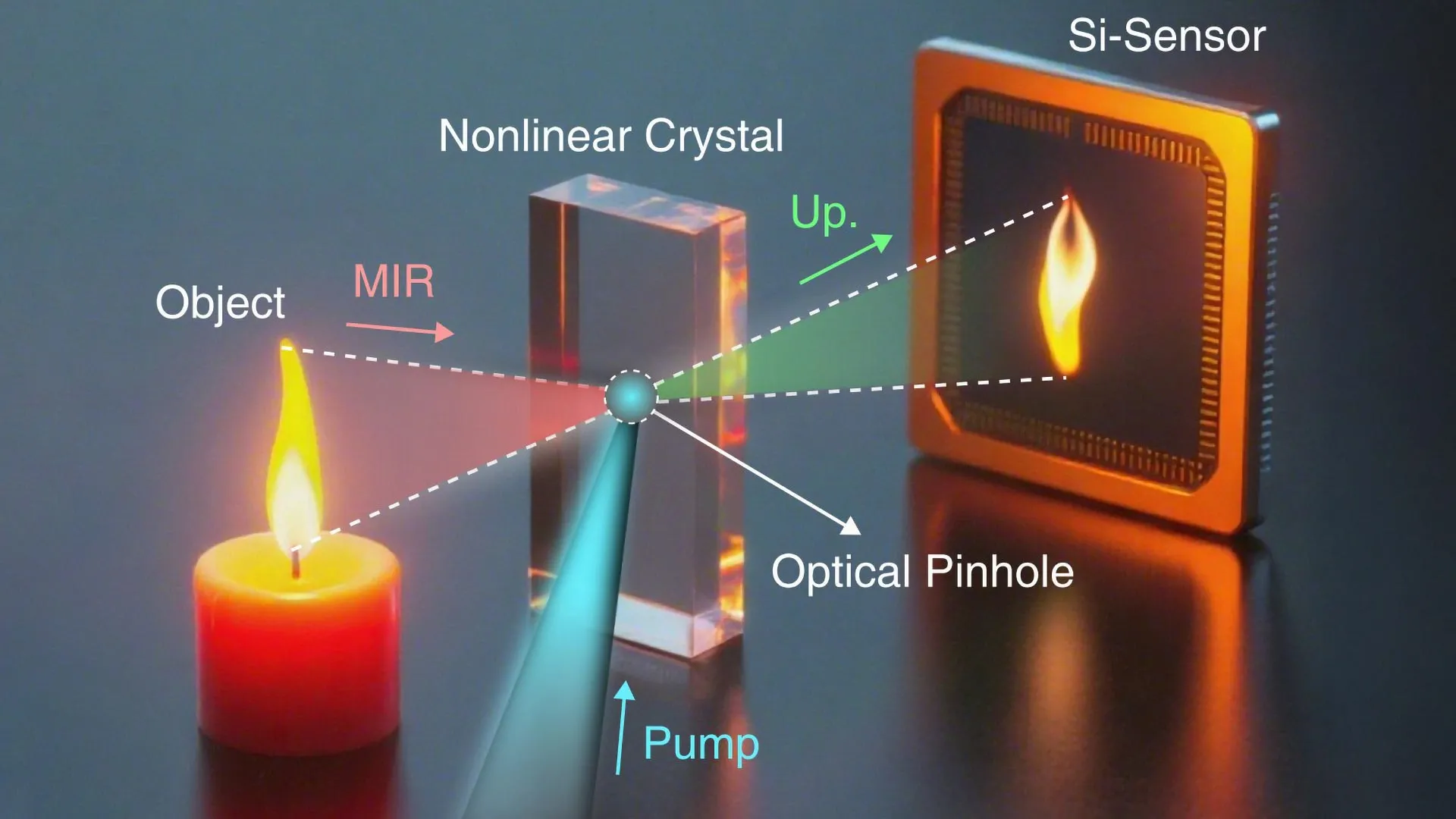
Infrared (IR) imaging is a powerful tool with applications spanning night vision, industrial inspection, environmental monitoring, and more. However, traditional IR systems often rely on expensive, bulky, and specialized lenses. Now,a groundbreaking advancement published in Optica is poised to disrupt this landscape. Researchers have demonstrated a novel lensless infrared imaging technique utilizing a tiny “optical pinhole” created within a nonlinear crystal, offering a pathway to more affordable, portable, and energy-efficient IR vision – and even enabling 3D imaging without lenses.
A Return to First Principles: The Power of pinhole Imaging
The core concept behind this innovation isn’t new. pinhole imaging,documented as early as the 4th century BC by Chinese philosopher Mozi,is one of the oldest image-forming methods.A simple pinhole camera projects an image by allowing light to pass through a minuscule aperture, creating an inverted image on the opposite surface. This method boasts inherent advantages: it avoids optical distortion, possesses an infinite depth of field, and functions effectively across a broad spectrum of wavelengths. Though,traditional pinhole imaging suffers from low light gathering ability,limiting its practical applications.
This research team, led by Kun Huang from East China Normal University, has ingeniously overcome this limitation. instead of a physical pinhole, they leverage the unique properties of nonlinear crystals and intense laser light to create an optical pinhole – an artificial aperture – within the crystal itself. Crucially, this crystal together converts the invisible infrared image into visible light, allowing it to be captured by standard, readily available silicon sensors.
Key Innovations: Large Field of view, High Sensitivity, and 3D Capabilities
This isn’t simply a revival of an old technique. Several key innovations distinguish this approach:
* Expanded Field of View: The researchers employed a specially engineered crystal with a “chirped-period structure.” This design allows the crystal to accept light rays from a wider range of angles, resulting in a significantly larger field of view – exceeding 6 cm in their experiments. this is a major advancement over traditional pinhole systems.
* enhanced Sensitivity & Noise Reduction: The upconversion process inherent in the crystal’s function naturally suppresses noise, enabling clear imaging even in extremely low-light conditions. This is critical for applications like nighttime surveillance and remote sensing.
* Depth of Field Breakthrough: The system achieved a remarkable depth of field exceeding 35 cm, allowing for sharp imaging of objects at varying distances. This eliminates the need for constant refocusing, a common challenge in conventional IR imaging.
* 3D Imaging Without lenses: Perhaps the moast exciting aspect of this research is its ability to generate 3D images without the need for lenses. Two distinct 3D imaging techniques where successfully demonstrated:
* Time-of-Flight Imaging: Utilizing synchronized ultrafast laser pulses as an optical gate, the system reconstructed a 3D model of a ceramic rabbit with micron-level precision, even with incredibly low light levels (as low as 1.5 photons per pulse).
* Two-Snapshot Depth Imaging: By capturing two images at slightly different distances, the system accurately calculated object depths over a 6 cm range, bypassing the need for complex pulsed timing.
Implications and Future Directions
The potential impact of this technology is significant. Huang emphasizes its potential to “enhance night-time safety,industrial quality control and environmental monitoring.” The use of simpler optics and standard silicon sensors promises to dramatically reduce the cost and complexity of IR imaging systems, making them accessible to a wider range of users. Furthermore, the technique isn’t limited to mid-infrared wavelengths; it can be adapted for far-infrared and terahertz imaging, where traditional lenses are tough to manufacture or perform poorly.
While currently a proof-of-concept requiring a relatively complex laser setup,the researchers are actively working to address these limitations. Future development efforts are focused on:
* Increasing Conversion Efficiency: Improving the efficiency of the infrared-to-visible light conversion process.
* Dynamic pinhole Control: Developing methods to dynamically reshape the optical pinhole to optimize imaging for different scenes.
* Expanding Spectral Range: Extending the system’s operation across a wider range of mid-infrared wavelengths.
* Miniaturization: Integrating new nonlinear materials and light sources to create more compact and portable devices.
This research represents a significant leap forward in infrared imaging technology. By reimagining a centuries-old principle, these researchers have opened the door to a future where high-performance, affordable, and versatile IR vision is within reach. this innovation promises to reshape industries and enhance our ability to “see” the world around us in new
Keep reading