
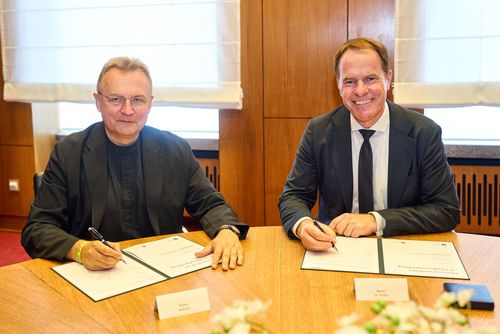
Düsseldorf and Lviv Formalize Partnership to Boost Economic and Cultural Exchange in Post-War Europe
Düsseldorf and Lviv have signed a landmark municipal partnership agreement, creating a framework for economic recovery, cultural exchange, and humanitarian support between Germany’s fourth-largest city and Ukraine’s historic cultural hub. The agreement, announced during a high-level meeting between Düsseldorf’s Mayor Dr. Stephan Keller and Lviv’s Mayor Andrij Sadovyi on June 26, 2026, marks the first formal city-to-city cooperation between German and Ukrainian municipalities since Russia’s full-scale invasion of Ukraine in 2022.
The partnership builds on existing European Union initiatives to strengthen urban resilience in war-affected regions, with both cities emphasizing practical cooperation in infrastructure reconstruction, digital innovation, and youth exchange programs. According to the Düsseldorf City Administration, the agreement includes concrete commitments to establish a joint working group by September 2026 to oversee implementation, with initial focus areas including vocational training for displaced Ukrainians and sustainable urban planning projects.
While the partnership does not involve direct financial transfers from Düsseldorf to Lviv, city officials stress that the agreement will facilitate access to German expertise in urban development, disaster response, and cultural preservation – areas where Lviv has faced particular challenges since 2022. The timing of the announcement coincides with growing international interest in subnational cooperation as a tool for post-conflict reconstruction, with similar agreements recently signed between Polish and Ukrainian cities.
What the Partnership Agreement Covers: Key Areas of Cooperation
The newly formalized partnership between Düsseldorf and Lviv spans five primary areas of cooperation, according to documents reviewed by World Today Journal. These include:
- Economic recovery and vocational training: Establishment of a dual education program where Ukrainian refugees and local Lviv residents can receive vocational training in Düsseldorf’s specialized technical schools, with certification recognized in both countries.
- Cultural preservation: Joint initiatives to document and restore cultural heritage sites in Lviv, with Düsseldorf providing technical expertise in conservation and digital archiving.
- Digital infrastructure: Collaboration on smart city technologies, particularly in emergency response systems that could serve as models for other Ukrainian cities.
- Youth exchange: Annual programs for young professionals and students, with particular focus on sectors where both cities have comparative advantages (e.g., Düsseldorf’s media industry and Lviv’s IT sector).
- Humanitarian support: Coordination of volunteer networks and resource sharing for populations affected by the war, with Düsseldorf’s established refugee integration programs serving as a reference model.
The agreement also includes a clause allowing for rapid response mechanisms in case of future crises, with both cities committing to share best practices in disaster preparedness. This reflects growing recognition among European municipalities that subnational cooperation can complement – and sometimes surpass – national government responses in times of conflict.
Why This Partnership Matters: Context in European Urban Cooperation
The Düsseldorf-Lviv partnership represents an evolution in how European cities are responding to the war in Ukraine. While national governments have focused on military and humanitarian aid, municipal leaders have increasingly turned to direct city-to-city cooperation as a more flexible and immediate solution to shared challenges. According to the European Committee of the Regions, over 120 European cities have established similar partnerships with Ukrainian municipalities since 2022, with German cities leading in both number and scope of agreements.

What makes the Düsseldorf-Lviv agreement distinctive is its focus on practical implementation rather than symbolic gestures. While many city partnerships remain at the declaration stage, Düsseldorf and Lviv have committed to establishing a joint working group by September 2026 to develop concrete projects. This approach aligns with recommendations from the United Nations Habitat III conference, which emphasized that successful urban cooperation requires institutional mechanisms for follow-through.
The partnership also comes at a time when both cities face their own domestic challenges. Düsseldorf has been grappling with rising costs of living and infrastructure needs, while Lviv has seen significant population displacement and damage to its historic center. By pooling resources and expertise, officials believe they can address these challenges more effectively than working in isolation.
Who Are the Key Figures Behind the Partnership?
Dr. Stephan Keller, Mayor of Düsseldorf since 2020, has positioned his administration as a leader in international municipal cooperation. A physicist by training, Keller has made urban innovation and sustainability central to his mayoral platform. His decision to pursue the Lviv partnership follows similar agreements Düsseldorf has established with cities in Poland, France, and the United States.
Andrij Sadovyi, Mayor of Lviv since 2020, has emerged as a prominent voice for Ukrainian local governance during the war. Under his leadership, Lviv has become a hub for international aid coordination and cultural preservation efforts. Sadovyi’s visit to Düsseldorf was his first to Germany since the full-scale invasion, reflecting the city’s strategic importance as both a cultural center and a logistics hub for humanitarian operations.
Both mayors emphasized during their meeting that the partnership is not politically motivated but rather a practical response to shared urban challenges. “We are not waiting for national governments to solve all our problems,” Keller stated in a press conference following the agreement signing. “Cities need to take the lead in finding solutions that work for our citizens.”
What Happens Next: Implementation Timeline and Challenges
The partnership agreement includes several key milestones in its first year:

- September 2026: Establishment of the joint working group in Düsseldorf, with representatives from both city administrations and local businesses.
- October 2026: Launch of the first vocational training pilot program, with 50 participants from Lviv receiving training in Düsseldorf’s technical schools.
- December 2026: Presentation of a joint cultural preservation plan at the European Capital of Culture conference in Lviv.
- June 2027: First youth exchange program, with 30 young professionals from each city participating in a two-week intensive program.
However, the partnership faces several potential challenges. Legal hurdles related to visa regulations and recognition of professional qualifications could delay some initiatives. Additionally, both cities must secure sufficient funding – while the agreement itself doesn’t include direct financial transfers, implementation will require local budget allocations and potentially external grants.
City officials acknowledge that the partnership’s success will depend on maintaining political will at both the municipal and national levels. “This is not just about signing documents,” said Sadovyi in an interview with Deutsche Welle. “It’s about creating systems that can survive changes in government and economic conditions.”
Broader Implications: How This Partnership Fits Into European Urban Networks
The Düsseldorf-Lviv agreement builds on existing European urban networks that have proven effective in crisis response. The Eurocities alliance, which includes both Düsseldorf and Lviv as members, has facilitated similar cooperation between Ukrainian and European cities in sectors ranging from energy transition to social services.
This partnership also aligns with the European Union’s broader strategy for supporting Ukrainian reconstruction, which increasingly emphasizes subnational cooperation. The EU’s Ukraine Facility has allocated €50 million specifically for municipal reconstruction projects, with city partnerships like Düsseldorf-Lviv positioned to compete for these funds.
Analysts suggest that successful implementation of the Düsseldorf-Lviv agreement could serve as a model for other German-Ukrainian municipal partnerships. With over 1,000 Ukrainian refugees currently living in Düsseldorf, the city has developed significant expertise in refugee integration that could be valuable to Lviv as it rebuilds its own population.
Reader FAQ: Key Questions About the Partnership
Will Düsseldorf provide direct financial aid to Lviv?
The partnership agreement does not include direct financial transfers from Düsseldorf to Lviv. However, both cities will work together to access EU and international funding for joint projects, and Düsseldorf may provide technical assistance and expertise that could reduce costs for Lviv’s reconstruction efforts.
How will Ukrainian refugees in Düsseldorf benefit from this partnership?
The agreement includes provisions for vocational training programs that will be open to Ukrainian refugees living in Düsseldorf. Additionally, the cultural exchange components will create opportunities for refugees to maintain connections with their home city while integrating into German society.
What specific cultural heritage sites in Lviv will be protected through this partnership?
While the agreement doesn’t specify particular sites, Lviv’s historic center – including the UNESCO World Heritage-listed Old Town and the Lviv Opera House – will be priority areas. Düsseldorf will provide expertise in conservation techniques and digital documentation methods that have been successfully applied to its own historic buildings.

How can citizens from both cities get involved?
Both city administrations will establish public information channels in the coming months. Citizens can monitor progress through the official websites of Düsseldorf City Administration (duesseldorf.de) and Lviv City Council (lvivcity.gov.ua). Specific volunteer opportunities will be announced through local community organizations in both cities.
Next Steps: What to Watch in the Coming Months
The next critical checkpoint for the Düsseldorf-Lviv partnership will be the establishment of the joint working group in September 2026. This group will be responsible for developing the first concrete projects under the agreement, with particular focus on the vocational training pilot program and cultural preservation initiatives.
City officials have indicated that they will seek to present initial results at the Eurocities Summit in November 2026, where they expect to attract additional partners for the initiative. The success of these early projects will determine whether the partnership expands to include other areas of cooperation, such as environmental sustainability or digital innovation.
As the partnership moves forward, World Today Journal will continue to monitor its implementation and provide updates on how this model of municipal cooperation could influence other German-Ukrainian city relationships. We invite readers to share their perspectives on how such partnerships can best address the needs of war-affected communities in the comments section below.