
In the high-stakes environment of aerospace engineering and advanced optical systems, the integrity of every component is paramount. As industries push the boundaries of performance in space exploration, satellite deployment, and semiconductor manufacturing, engineers face a persistent challenge: outgassing. This phenomenon, which involves the release of volatile substances from materials like adhesives, can jeopardize the functionality of sensitive hardware by depositing contaminants onto critical surfaces. Understanding how to meet NASA low outgassing standards with adhesives for aerospace and optical systems is not merely a technical requirement—it is a fundamental necessity for mission success.
Outgassing occurs when an adhesive, after being cured, continues to emit volatile compounds such as residual solvents or unreacted monomers. In the vacuum of space or the high-vacuum chambers used in industrial manufacturing, these materials evaporate and migrate, ultimately condensing on optical lenses, sensors, or electronic circuits. This process can lead to the “fogging” of optics, the degradation of signal clarity, and the failure of delicate electronic assemblies. To mitigate these risks, engineers rely on rigorous testing protocols established by the National Aeronautics and Space Administration (NASA).
Understanding the Industry Benchmark: ASTM E595
The global benchmark for evaluating the outgassing potential of materials is the ASTM E595 standard, a test method originally developed by NASA to ensure the reliability of spacecraft materials. According to the NASA Technical Standards System, the ASTM E595 testing procedure exposes a cured material sample to a temperature of 125 °C in a high-vacuum environment (typically between 10⁻⁵ and 10⁻⁶ torr) for a duration of 24 hours. The primary objective is to measure two critical parameters: Total Mass Loss (TML) and Collected Volatile Condensable Materials (CVCM).
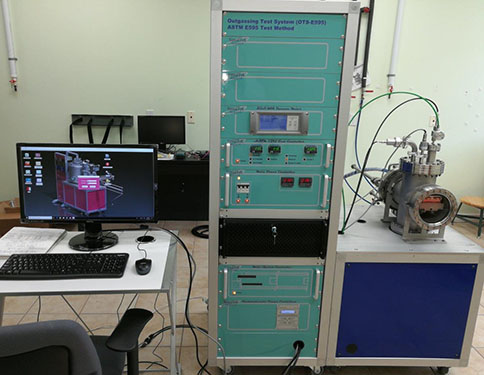
To be considered compliant with NASA’s stringent low outgassing requirements, a material must demonstrate a TML of less than 1.0 percent and a CVCM of less than 0.1 percent. These thresholds are designed to ensure that the amount of material likely to condense on sensitive surfaces remains within acceptable limits for long-term space flight and high-precision scientific applications. For engineers, selecting materials that meet these criteria is the first step toward preventing the degradation of hardware before it even leaves the ground.
Applications Across Demanding Industries
The need for low outgassing materials extends far beyond the vacuum of space. In the semiconductor industry, manufacturing tools operate under extreme conditions where even microscopic contamination can lead to significant yield loss. Similarly, in the development of advanced optical assemblies—ranging from high-resolution cameras and telescopes to sophisticated laser systems—maintaining absolute clarity is essential. When adhesives are used to bond components in these systems, they must be chemically stable enough to resist the environmental stresses of their operating conditions.
Even in terrestrial applications, such as high-vacuum scientific instruments or specialized original equipment manufacturer (OEM) electronic devices, the use of low outgassing adhesives enhances long-term reliability. By minimizing the release of volatile species, manufacturers can ensure that their products maintain peak performance over extended service lives, reducing the need for maintenance and preventing premature failure due to chemical contamination.
Ensuring Performance Through Proper Handling
Selecting a material that meets ASTM E595 standards is only part of the solution; the performance of an adhesive is heavily dependent on the quality of its application. Achieving the manufacturer’s specified outgassing results requires meticulous attention to the storage, mixing, and curing processes. For two-part adhesive systems, engineers must strictly adhere to the recommended mix ratio. Incomplete mixing often leaves unreacted monomers within the matrix, which significantly increases the potential for future outgassing.
Curing schedules also play a decisive role in the final chemical stability of the bond. While many adhesives will harden at room temperature, applying heat—often within the range of 150 °F to 200 °F—can significantly improve the degree of cross-linking. A more complete cross-linked structure locks the molecular components into place, effectively trapping substances that might otherwise become volatile. For systems that utilize UV-curable adhesives, it is critical to ensure that the curing process is uniform. This requires using the correct lamp wavelength—typically around 365 nm—and ensuring that the entire bond line receives adequate light intensity, as shadowed areas can remain uncured and prone to outgassing.
Troubleshooting and Material Selection
If testing reveals that outgassing levels are higher than anticipated, or if contamination is observed on optical surfaces, the root cause is frequently an incomplete cure. When troubleshooting, the first step should be to verify that the adhesive has reached its specified Shore hardness. If the hardness is lower than expected, the adhesive has not fully polymerized. In such cases, extending the heat cure or increasing the curing temperature can often resolve the issue by forcing the reaction to completion.
Engineers seeking materials for vacuum-sensitive applications should look for documentation verifying that the adhesive has successfully passed ASTM E595 testing. Advanced epoxy systems and specialty UV-curable formulations are now available that are specifically engineered to meet these rigorous criteria. For complex geometries where UV light cannot reach every bond line, dual-cure systems—which initiate with light and complete the process with a secondary heat cure—offer a robust solution, ensuring that no uncured material remains to compromise the integrity of the assembly.
As aerospace and optical technologies continue to advance, the role of material science in ensuring reliability will only grow more vital. By strictly following established testing protocols and mastering the handling of low outgassing adhesives, engineers can protect the performance of the world’s most sophisticated technology, from the surface of Earth to the depths of orbit.
For further information on space material standards and testing, industry professionals are encouraged to consult the official NASA Technical Reports Server, which provides ongoing updates regarding material performance and spacecraft environment requirements. We welcome your questions and feedback—please share your thoughts in the comments section below.
Worth a look
- Google Pixel vs. Samsung: Which Smartphone Upgrade Is Right for You?
- EU Commission Finds TikTok Minor Profiles Fail to Meet Safety Standards
- NASA Highlights July 2026 Celestial Events and Freedom 250 Initiative (archyworldys.com)
- Best Business and Personal Credit Cards: Travel, Cash Back & No Annual Fee Options (world-today-news.com)