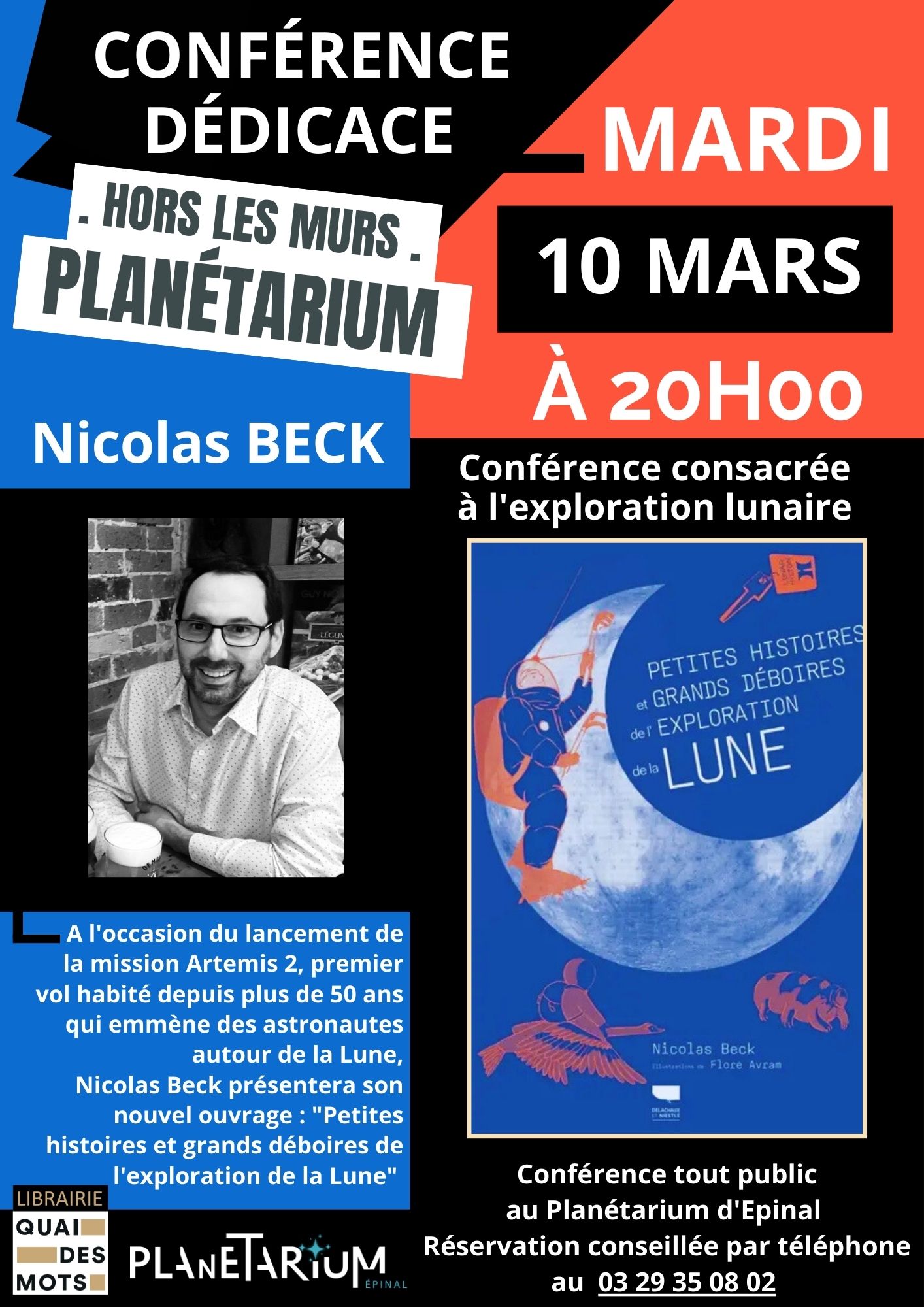
Lunar Exploration and a New Book Launch Converge at Épinal Planetarium
As NASA prepares for the highly anticipated Artemis II mission – the first crewed flight to orbit the Moon in over 50 years – a unique event is taking place in Épinal, France. On Tuesday, March 10th, at 8:00 PM local time, the Épinal Planetarium will host a conference dedicated to lunar exploration, coinciding with the release of a new book by Nicolas Beck, published on March 6th. This event offers a compelling opportunity to delve into the history, challenges, and enduring fascination with Earth’s celestial neighbor.
The upcoming Artemis II mission represents a pivotal moment in space exploration, building upon the success of the uncrewed Artemis I mission in 2022. NASA’s Artemis program aims to establish a sustainable human presence on the Moon, paving the way for future missions to Mars. The Artemis II flight will test critical systems, including the Space Launch System (SLS) rocket and the Orion spacecraft, with a crew of four astronauts: Reid Wiseman, Victor Glover, Christina Koch, and Jeremy Hansen. The ten-day mission will send the crew on a trajectory around the Moon and back to Earth, reaching speeds of approximately 25,000 miles per hour during reentry.
The conference at the Épinal Planetarium will feature Nicolas Beck, a specialist in Earth and Universe sciences, who will discuss the intricacies of lunar exploration. Beck’s new book, “Petites histoires et grands déboires de l’exploration de la Lune” (Modest Stories and Great Mishaps of Lunar Exploration), illustrated by Flore Avram, promises a captivating journey through the scientific anecdotes and historical challenges that have defined humanity’s quest to understand the Moon. The book explores lesser-known facts about our lunar companion, such as the existence of lunar “Alps” with a peak reaching 3,600 meters, abandoned plans for lunar hotels, and the extreme temperature fluctuations ranging from -180°C to +140°C. It also highlights the historical success rate of lunar missions, which stands at approximately 60 percent.
Nicolas Beck: Bridging Science and Society
Nicolas Beck’s background lies in Earth and Universe sciences, and he currently serves as the Deputy Regional Academic Delegate for Research and Innovation in the Grand Est region of France. His commitment extends beyond research to actively engaging the public in scientific discourse. Beck is a prolific science communicator, having authored several popular science books focusing on Mars and the Moon, including “Max à la conquête de Mars!” (Max Conquers Mars!), published by Delachaux et Niestlé. Flore Avram, the illustrator, brings a sensitive and artistic touch to the scientific themes, enhancing the book’s accessibility and appeal.
The Enduring Allure of Lunar Exploration
The renewed interest in the Moon, fueled by missions like Artemis II, underscores the continuing human fascination with our closest celestial neighbor. The Moon has captivated scientists and dreamers for centuries, driving advancements in astronomy, geology, and space technology. The Apollo program, which last landed humans on the Moon in 1972 with Apollo 17, remains a landmark achievement in human history. Artemis II aims to build upon this legacy, not only by returning humans to the lunar vicinity but also by establishing a long-term presence that will enable further scientific discovery and resource utilization.
The challenges of lunar exploration are significant. Beyond the technical hurdles of spacecraft design and propulsion, protecting astronauts from radiation exposure and ensuring life support systems function reliably in the harsh lunar environment are paramount concerns. The extreme temperature variations on the Moon, as highlighted in Beck’s book, pose a substantial engineering challenge. The logistical complexities of establishing a sustainable lunar base, including providing power, water, and food, require innovative solutions.
What’s Next for Artemis and Lunar Science?
Following Artemis II, NASA plans to launch Artemis III, currently scheduled for no earlier than 2026, which will attempt to land astronauts on the lunar surface near the Moon’s South Pole. This region is of particular interest due to the presence of water ice, which could be used as a resource for propellant, life support, and other purposes. The Artemis program envisions a sustained lunar presence, including the construction of a lunar base camp and a lunar orbiting station called Gateway.
The scientific benefits of a return to the Moon are substantial. Lunar samples can provide insights into the early history of the solar system, while studying the lunar environment can help us understand the effects of space radiation on human health. The Moon also serves as a proving ground for technologies that will be essential for future missions to Mars and beyond. The event at the Épinal Planetarium offers a timely opportunity to reflect on these advancements and the exciting future of lunar exploration.
The conference on March 10th provides a unique opportunity for the public in the Vosges region to engage with the science and history of lunar exploration. It’s a chance to learn from an expert in the field and to celebrate the ongoing human endeavor to reach for the stars. The event is particularly relevant given the imminent launch of Artemis II and the renewed global focus on returning to the Moon.
The next major milestone for the Artemis program is the launch of Artemis II, currently scheduled for April 1, 2026. Further updates on the mission, including launch schedules and crew activities, can be found on NASA’s official Artemis website. We encourage readers to share their thoughts on the future of space exploration in the comments below.