
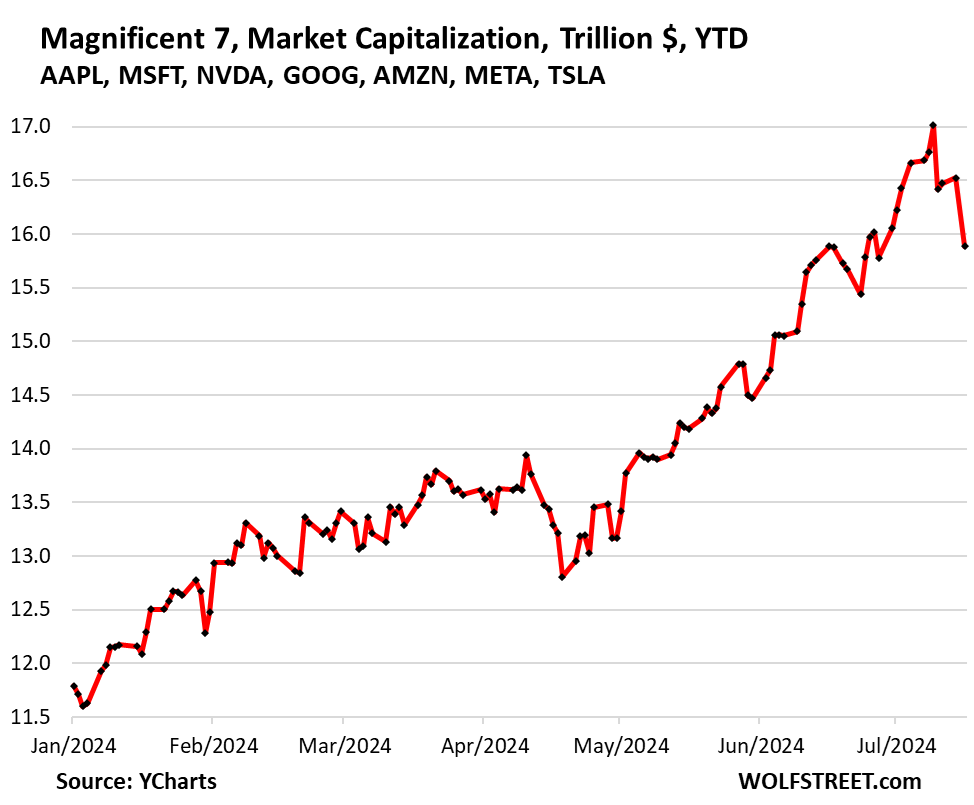
The “Magnificent Seven”—a group of major U.S. technology companies including Apple, Microsoft, Alphabet, Amazon, Nvidia, Meta, and Tesla—saw approximately $2 trillion in market capitalization evaporate during the month of July, according to market data analyzed by financial observers. This sharp contraction reflects investor anxiety regarding the massive capital expenditures required for artificial intelligence infrastructure and whether these investments will yield short-term profitability.
As a physician and health journalist, I often observe how technology and infrastructure investments dictate the pace of medical innovation. In the financial sector, a similar principle applies: the sustainability of growth depends heavily on the efficiency of resource allocation. The recent volatility in the tech-heavy Nasdaq Composite serves as a reminder that even the most dominant market leaders face significant pressure when the timeline for “AI-driven” returns remains speculative.
Market Volatility and the AI Investment Cycle
The decline in market value was largely driven by a broader rotation out of high-growth technology stocks as investors sought lower valuations elsewhere. According to reports from Reuters, the selloff intensified throughout July as market participants reacted to earnings reports that highlighted the immense costs of building data centers and developing large language models. While companies like Alphabet and Microsoft have committed billions to AI, the immediate impact on their bottom lines has been obscured by the sheer scale of the required infrastructure spending.

This “AI investment burden” has created a disconnect between corporate spending and investor expectations. While these companies maintain strong balance sheets, the market has begun to price in the risk that the competitive race for AI supremacy may weigh on profit margins for several quarters to come. The Nasdaq Composite experienced its worst monthly performance of the year in July, signaling a shift in sentiment that impacted all seven members of the tech cohort to varying degrees.
Defining the Magnificent Seven’s Financial Pressure
The term “Magnificent Seven” refers to the seven companies that have been the primary engines of the U.S. stock market’s growth over the past 18 months. Their combined market value had reached unprecedented highs, largely fueled by optimism surrounding generative AI. However, July’s retracement highlights the vulnerability of these valuations to shifts in macroeconomic data, such as interest rate expectations and unemployment figures.

The financial pressure is not merely about the cost of hardware; it involves a complex ecosystem of energy requirements, specialized labor, and software development. As noted by analysts at Barron’s, the market is currently grappling with a “show me the money” phase. Investors are no longer satisfied with projections of future utility; they are looking for concrete evidence that AI integration is driving operational efficiencies or new revenue streams that justify the multi-billion dollar capital expenditure budgets.
What Lies Ahead for Tech Investors
Looking forward, the next major checkpoint for these firms will be the subsequent round of quarterly earnings calls and guidance updates provided to the Securities and Exchange Commission (SEC). Investors are closely monitoring these official corporate filings for any signs that companies might be tempering their capital expenditure plans or providing a clearer roadmap for monetization.
For the average investor, this period of volatility underscores the importance of portfolio diversification. While the “Magnificent Seven” remain foundational to the modern digital economy, their price movements are increasingly sensitive to the high-stakes gamble on AI. Market participants should remain attentive to upcoming economic data releases, including the next U.S. Bureau of Labor Statistics employment report and Federal Open Market Committee (FOMC) meeting minutes, which will likely influence the broader market trajectory.
The intersection of rapid technological advancement and fiscal reality is rarely smooth. Whether these firms can balance their ambitious AI agendas with the need for sustained shareholder value will define the performance of the U.S. equity markets for the remainder of the year. Please share your thoughts on the current state of tech valuations in the comments below.