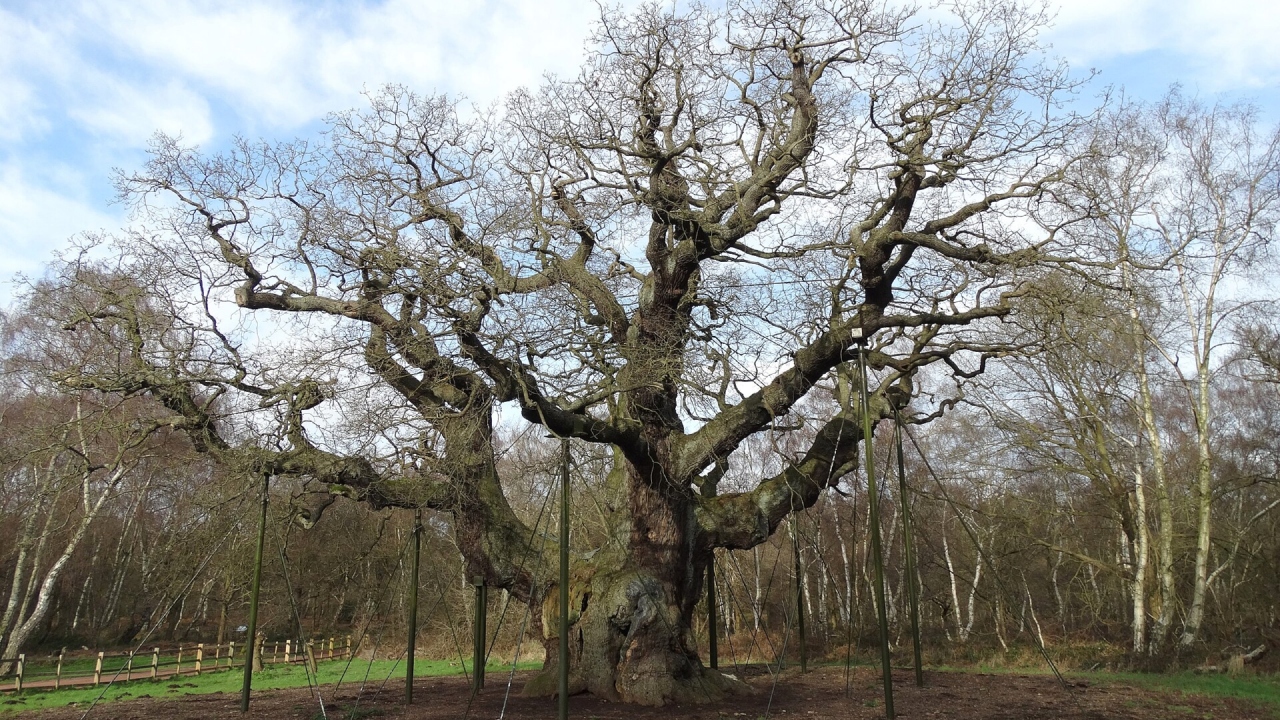
The Major Oak, a towering English oak tree located in Sherwood Forest, Nottinghamshire, has entered a state of significant decline, according to recent assessments by conservation officials. While often associated with the legend of Robin Hood, the tree is now managed as a delicate ecological relic, with park authorities confirming that its structural integrity has reached a critical stage after approximately 1,000 years of growth. The tree, which stands as a prominent landmark in the United Kingdom, remains standing but requires intensive monitoring to manage the risks posed by its advanced age.
The Sherwood Forest National Nature Reserve, managed by the Royal Society for the Protection of Birds (RSPB) in partnership with Nottinghamshire County Council, has reported that the tree’s health is in a state of natural, albeit rapid, deterioration. As detailed by the RSPB official reserve portal, the Major Oak is currently supported by a system of steel poles and cables, a conservation measure that has been in place for decades to prevent the heavy, ancient limbs from collapsing under their own weight. This physical intervention reflects the ongoing effort to preserve a biological specimen that has survived through centuries of environmental change.
The Ecological Significance of the Major Oak
Standing at the heart of Sherwood Forest, the Major Oak is not merely a cultural icon but a vital habitat for a diverse range of species. According to Forestry England, ancient trees like the Major Oak provide essential micro-habitats for rare saproxylic invertebrates—insects that rely on decaying wood for their lifecycle. The tree’s immense trunk, which has a circumference of approximately 10 meters, serves as a complex ecosystem that supports fungi, lichen, and various bird species.
.jpg "The Ecological Significance of the Major Oak")
The decline of the tree is a natural biological process rather than a sudden event. As trees reach the “ancient” stage of their lifecycle, their internal structure becomes increasingly hollow, which is a standard feature of longevity in the Quercus robur species. Conservationists have noted that while the tree is showing clear signs of “dieback”—a condition where branches lose their leaves and eventually perish—this is an expected outcome for a tree that has survived since the medieval period. The focus of the current management strategy is to extend the life of the tree while prioritizing public safety and the protection of the surrounding soil, which is frequently compacted by thousands of visitors.
Separating Folklore from Botanical Reality
The persistent connection between the Major Oak and the outlaw Robin Hood is a matter of cultural history rather than verified historical fact. While local tradition has long claimed the tree served as a hiding place for the legendary figure and his band of merry men, historical analysis by the Nottinghamshire County Council clarifies that the tree likely did not exist in its current form during the 12th or 13th centuries, the period commonly associated with the Robin Hood ballads. The name “Major Oak” itself was only attributed to the tree in the late 18th century, named after Major Hayman Rooke, a local antiquarian who included the tree in his 1790 publication on the ancient oaks of Sherwood.

This distinction between legend and reality is important for researchers who study the evolution of folklore in the British Isles. The mythos surrounding the tree has acted as a catalyst for its preservation, drawing generations of tourists to the site. However, the botanical reality is that the tree is an extraordinarily resilient member of the oak family, whose survival is a testament to the specific environmental conditions of the Edwinstowe region. The ongoing decline is being documented by arborists who track the movement of the tree’s crown and the health of its root system through periodic structural surveys.
Future Management of Sherwood Forest
The management of the Major Oak is currently governed by strict environmental guidelines designed to protect the root zone from human interference. Visitors are restricted by wooden fencing that encircles the tree, a measure that has been essential for preventing soil compaction. According to the Nottinghamshire County Council official newsroom, these protective measures are reviewed annually to balance the public’s desire to view the landmark with the biological necessity of maintaining the tree’s remaining root health.

Looking ahead, the reserve authorities have emphasized that they do not intend to “save” the tree in the sense of preventing its eventual death, as decay is a natural part of the lifecycle of an ancient oak. Instead, the objective is to allow the tree to undergo its natural senescence while documenting its final stages. This approach provides valuable data for foresters managing other ancient woodlands across the UK. The reserve remains open to the public, and visitors are encouraged to consult the official Sherwood Forest visitor website for real-time updates regarding trail access and any temporary closures that may occur due to high wind warnings, which pose a greater risk to the tree’s fragile structure.
As the Major Oak continues to age, the site serves as a reminder of the fragility of natural landmarks. For those interested in the ongoing conservation efforts, the RSPB and Nottinghamshire County Council provide regular updates on their respective digital platforms. We invite readers to share their thoughts or personal experiences with the Major Oak in the comments section below.
Keep reading