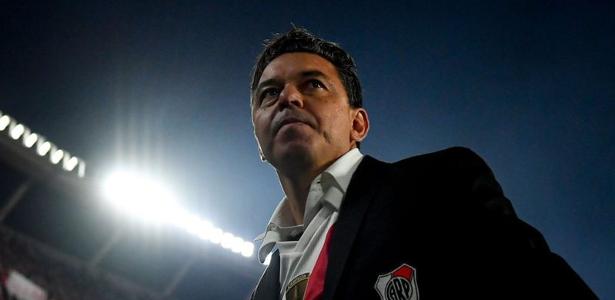
The recent departure of Marcelo Gallardo from River Plate marks not just the finish of a coaching tenure, but potentially the closing of a significant chapter in South American football. Gallardo, a name synonymous with success at the Buenos Aires club, has seen his second stint at the helm falter, prompting a painful reflection on a career trajectory that once seemed destined for perpetual glory. The circumstances surrounding his exit, coupled with a substantial investment in players that yielded limited results, raise questions about the future for both Gallardo and River Plate.
Gallardo’s connection with River Plate is deeply ingrained in the club’s history. His first spell as manager, from mid-2014 to the end of 2022, delivered an unprecedented 14 titles, cementing his status as a River Plate legend. This included two Copa Libertadores triumphs in 2015 and 2018, the latter a particularly memorable victory against arch-rivals Boca Juniors, and the Copa Sudamericana in 2014. As reported by BatiTimes, this period established a “golden era” for the club, transforming it into a continental powerhouse.
A Rocky Return and Unfulfilled Expectations
Following a year away from coaching, Gallardo took the reins at Al-Ittihad in Saudi Arabia, but his tenure was short-lived, ending in mid-2024 due to disappointing performances. His return to River Plate in August 2024, succeeding Martín Demichelis, was met with immense fanfare, fueled by the hope of recapturing past glories. Although, this second chapter has proven to be markedly different. According to the Associated Press, Gallardo announced his departure on Monday, February 24, 2026, after a meeting with club officials, acknowledging his inability to meet the club’s objectives.
The club’s new president, Stefano Di Carlo, extended Gallardo’s contract to December 2026, even after River failed to qualify for the Copa Libertadores. This decision, while demonstrating faith in the manager, ultimately couldn’t alter the team’s downward trajectory. Despite significant investment – reportedly exceeding US$70 million on 16 players in a year and a half – the results have been consistently underwhelming. The team has struggled to secure titles, and the style of play has fallen short of the standards set during Gallardo’s first era.
Recent Struggles and Statistical Decline
The recent form of River Plate under Gallardo has been particularly concerning. The team suffered three consecutive league defeats, placing his position under intense scrutiny. BatiTimes details a recent run of poor results, including elimination from the Copa Argentina by Independiente Rivadavia and a defeat to Platense, the eventual Apertura champions. These losses were described as “humiliating” for a club of River Plate’s stature.
Looking at the statistics, the decline is evident. In the last 30 official matches, River Plate recorded only 10 wins, 9 draws, and 11 losses – a negative goal difference of 3, with 32 goals scored and 35 conceded. Their recent five matches yielded only one victory, a 1-0 win against Ciudad de Bolívar, a team recently promoted to the second division. The other results were a 1-0 defeat to Vélez Sarsfield, a 1-4 loss to Tigre, a 0-0 draw with Rosario Central, and a 1-0 defeat to Argentinos Juniors.
Financial Investment and Lack of Return
The financial backing provided to Gallardo during his second spell at River Plate has been substantial. Estimates suggest that over US$72.6 million (approximately R$375.5 million) was invested in new players within a year and a half. Gallardo is reported to have earned over US$10 million (R$51,730 million) in salary during this period. However, this significant expenditure has failed to translate into on-field success, raising questions about the effectiveness of the club’s recruitment strategy and the team’s overall performance.
The Broader Context: A Shifting Landscape in South American Football
Gallardo’s struggles at River Plate reflect a broader trend in South American football, where financial pressures and increased competition are making it increasingly tricky for even the most established clubs to maintain dominance. The influx of players to European leagues, coupled with the growing financial power of clubs in other regions, has created a more level playing field. River Plate, despite its rich history and passionate fanbase, has found itself struggling to compete with rivals who are also investing heavily in talent.
The Question of Gallardo’s Future
The end of Gallardo’s second spell at River Plate inevitably leads to speculation about his future. Having experienced a challenging period in Saudi Arabia and now a disappointing return to his beloved River, the question arises: what’s next for the Argentine manager? His legacy at River Plate remains secure, but his recent setbacks may impact his future opportunities. Whether he seeks another managerial role in South America, explores options in Europe, or takes a break from coaching remains to be seen.
The circumstances surrounding his departure are particularly poignant, as Gallardo expressed “emotion and pain” at not being able to achieve the club’s objectives. His message, shared through River Plate’s social media channels, underscored his deep connection with the club and his disappointment at the outcome of his second tenure. The timing of his announcement, just before the match against Banfield, adds to the sense of finality and closure.
The future of River Plate is now uncertain. The club will need to identify a new manager who can restore the team’s winning mentality and navigate the challenges of the modern South American football landscape. The search for a successor will be a crucial period for the club, as it seeks to rebuild and reclaim its position as one of the continent’s leading forces.
The next immediate step for River Plate is the match against Banfield on Thursday, February 27, 2026, which will now be Gallardo’s farewell appearance. The club will undoubtedly be looking to provide a fitting send-off for a manager who has given so much to the institution. Following the match, the focus will shift to identifying a new coach and charting a course for the future.
What are your thoughts on Gallardo’s departure and the future of River Plate? Share your opinions in the comments below, and be sure to share this article with fellow football enthusiasts.
Worth a look