
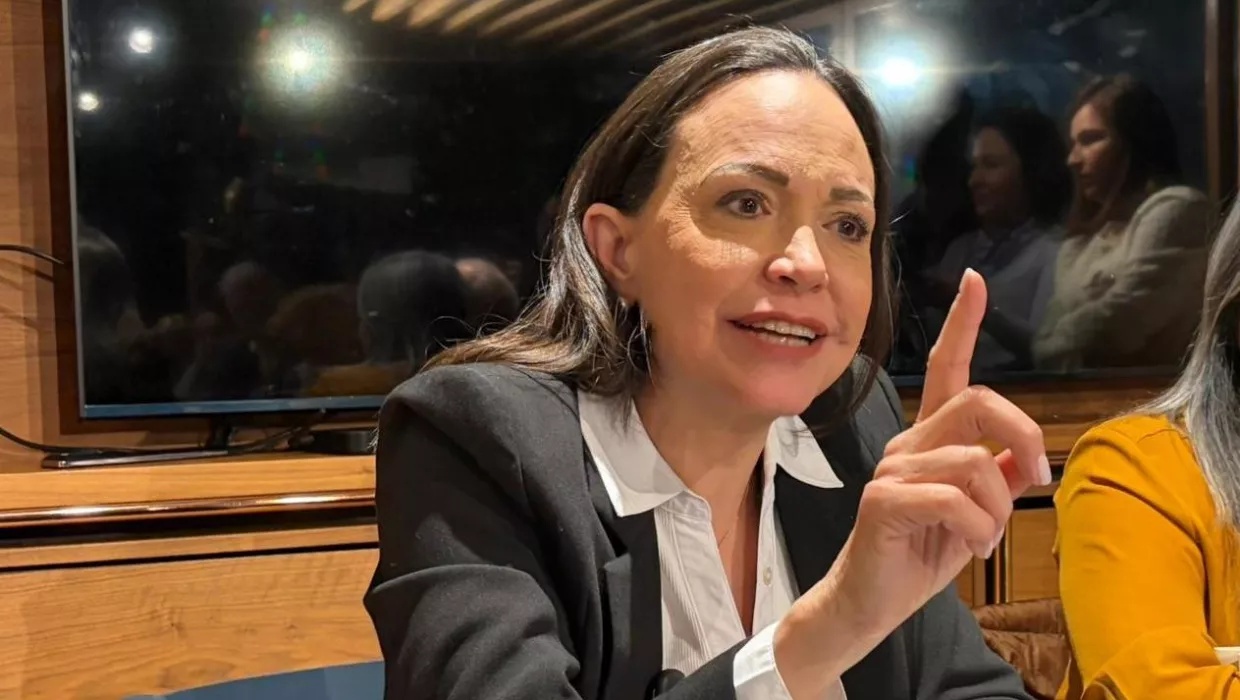
Venezuelan opposition leader María Corina Machado publicly condemned racist chants directed at Venezuela’s Vice President Delcy Rodríguez during a political event in Madrid, stating that such expressions have no place in democratic discourse. The incident occurred on April 12, 2024, during Machado’s appearance at a gathering organized by Venezuelan diaspora groups in the Spanish capital, where Rodríguez was present as part of her official European tour. Video footage shared on social media showed some attendees directing the phrase “¡Fuera la mona!” (“Get out, monkey!”) toward Rodríguez, a remark widely recognized as a racist slur with historical roots in dehumanizing rhetoric against people of African descent.
Machado addressed the incident in a statement posted on her official X account the following day, emphasizing that while she opposes Rodríguez’s political role in Nicolás Maduro’s government, she rejects any form of discrimination or hate speech. “I do not share Delcy Rodríguez’s political vision, nor do I recognize the legitimacy of the regime she represents,” Machado wrote. “But I will never tolerate racist insults, no matter who the target is. Our struggle is for dignity, freedom, and justice — not to replicate the hatred we claim to oppose.” Her remarks were later echoed by several Spanish political figures, including representatives from Más Madrid and Podemos, who called on regional President Isabel Díaz Ayuso to publicly denounce the chants.
The Venezuelan Embassy in Madrid also issued a rare public apology, characterizing the incident as “unacceptable and contrary to the values of respect and dialogue” that should govern political expression, even in exile. The embassy’s statement, released on April 13, urged Venezuelans abroad to uphold democratic principles and avoid actions that undermine the moral authority of their cause. While the embassy did not name Machado directly, it referenced the event where the chants occurred, implicitly linking the condemnation to the gathering she headlined.
Independent verification of the event and Machado’s response comes from multiple credible sources. Footage of the chant was confirmed by EL PAÍS, which reported on April 13 that Más Madrid and Podemos had formally requested Ayuso condemn the incident. The Venezuelan Embassy’s statement was published via its official website and shared through its verified X account (@VenEmbMadrid). Machado’s April 13 post on X (@MariaCorinaYA) remains accessible and was cited by Infobae in its coverage of her rejection of the racist rhetoric.
The phrase “¡Fuera la mona!” has been documented by anti-racism organizations in Spain as a derogatory expression targeting individuals based on race, particularly those perceived as having Afro-Latin American or Afro-Caribbean heritage. According to the Spanish Observatory on Racism and Xenophobia (OBERAXE), such language contributes to hostile environments and violates principles of equal treatment under Spanish and international human rights law. While freedom of expression protects political dissent, Spanish law prohibits hate speech that incites discrimination or violence based on race, ethnicity, or national origin under Article 510 of the Penal Code.
Machado’s stance reflects a broader tension within the Venezuelan opposition between condemning the Maduro regime’s authoritarianism and maintaining ethical boundaries in political protest. Analysts note that while exile groups often express frustration with regime figures traveling abroad, the leverage of racist tropes risks delegitimizing their movement in the eyes of democratic partners in Europe and Latin America. The incident has prompted renewed debate among Venezuelan civil society groups about the importance of upholding human rights consistently, even when criticizing those who violate them.
Context: Delcy Rodríguez’s European Tour and Diplomatic Reactions
Delcy Rodríguez, who serves as Venezuela’s Vice President and Minister of Electricity, began a European tour in early April 2024, visiting Italy, Portugal, and Spain. Her presence in Madrid coincided with increased scrutiny from European Union officials over Venezuela’s ongoing humanitarian crisis, electoral irregularities, and human rights violations. The EU has maintained sanctions on over 50 Venezuelan officials since 2017, including Rodríguez, for undermining democracy and the rule of law.
During her stop in Madrid, Rodríguez attended a private meeting with members of the Venezuelan community and participated in a cultural event at the Ateneo de Madrid on April 11. Her public appearances were met with both support from Chavista sympathizers and protests from opposition demonstrators. The chant targeting her occurred outside the venue where Machado spoke later that day, suggesting a spillover of tensions between rival factions of the Venezuelan diaspora.
The Venezuelan Embassy’s decision to apologize marked an unusual departure from its typical defensive posture toward criticism of regime officials. Diplomatic analysts interpret the move as an attempt to distance the Maduro government from extremist behavior among its supporters abroad, while also signaling sensitivity to Spain’s strict anti-discrimination laws. Spain has prosecuted individuals for racist chants in public spaces, including during football matches and political rallies, under its comprehensive hate crime legislation.
Reactions from Spanish Political Leaders
In the aftermath of the incident, leaders from Más Madrid and Podemos urged Ayuso, the President of the Community of Madrid, to issue a clear condemnation. Manuela Bergerot, spokesperson for Más Madrid in the regional assembly, stated that “allowing racist expressions to go unchallenged, even at events opposing authoritarian regimes, normalizes hatred and weakens our democratic values.” Similarly, Isa Serra of Podemos emphasized that “anti-racism must be unconditional — we cannot pick and choose when to defend dignity based on political convenience.”
As of April 15, 2024, Ayuso had not released a public statement specifically addressing the chants. Her office did not respond to requests for comment from Europa Press regarding whether internal discussions were underway. The lack of a direct response has drawn criticism from anti-racism NGOs in Madrid, who argue that political leaders have a duty to set clear boundaries against hate speech, regardless of the political context.
Machado’s condemnation, while praised by human rights advocates, has also drawn scrutiny from hardline factions within the Venezuelan opposition who view any engagement with regime figures — even in the form of rejecting racism — as a form of legitimization. She has previously faced criticism for refusing to call for international military intervention and for advocating a negotiated transition, positions that contrast with more hardline exile groups.
Implications for the Venezuelan Diaspora and Democratic Norms
The incident underscores the challenges faced by diaspora communities in balancing political activism with adherence to democratic and human rights principles. Venezuelans abroad have played a crucial role in documenting abuses, lobbying for sanctions, and preserving independent media outlets like El Nacional and La Patilla. Although, episodes like the one in Madrid raise concerns about whether frustration with the Maduro regime could erode the moral foundation of the opposition movement.
Experts from the Brookings Institution and the Wilson Center have warned that authoritarian regimes often benefit when their opponents adopt similar tactics of dehumanization, even if directed at different targets. “When opposition movements mirror the rhetoric of the regimes they oppose,” noted a 2023 report from the Carnegie Endowment for International Peace, “they risk losing the support of democratic governments and international organizations that are essential to long-term change.”
Moving forward, Venezuelan civil society leaders inside and outside the country continue to advocate for a clear separation between criticizing policies and attacking individuals based on identity. Organizations such as Súmate and Venezuelan Awareness have issued guidelines for peaceful protest that explicitly prohibit hate speech, harassment, and symbols associated with racism or xenophobia.
Next Steps and Ongoing Developments
As of April 16, 2024, no formal investigations have been announced by Spanish authorities into whether the chants constituted a prosecutable offense under hate crime statutes. The Madrid Prosecutor’s Office for Hate Crimes and Discrimination has not issued a public statement on the matter, and no complaints have been filed through official channels, according to a spokesperson consulted by RTVE on April 15.
María Corina Machado has not indicated plans to revisit the incident in future public appearances. Her focus remains on coordinating with opposition figures inside Venezuela and building international support for a free and fair electoral process. The next major opportunity for such engagement is expected during the Summit of the Americas in June 2024, where regional leaders will discuss democratic governance in the hemisphere — though Venezuela’s participation remains uncertain due to its suspension from the Organization of American States (OAS) in 2017.
Delcy Rodríguez concluded her European tour on April 18, 2024, and returned to Caracas. The Venezuelan government has not commented on the Madrid incident, though state media outlets highlighted her meetings with European business leaders and framed the trip as efforts to attract investment amid ongoing sanctions.
For readers seeking to follow developments related to Venezuelan democratic efforts, human rights advocacy, or diaspora engagement, official updates are available through the Venezuelan opposition’s unified platform (venezuelawithoutdictatorship.org), the Office of the Prosecutor of the International Criminal Court (which maintains an open preliminary examination into Venezuela), and the UN Human Rights Office’s country-specific reports.
If you found this analysis informative, consider sharing it to help foster informed dialogue about the intersection of political dissent and human rights. Comments are welcome below — we encourage respectful, evidence-based discussion.