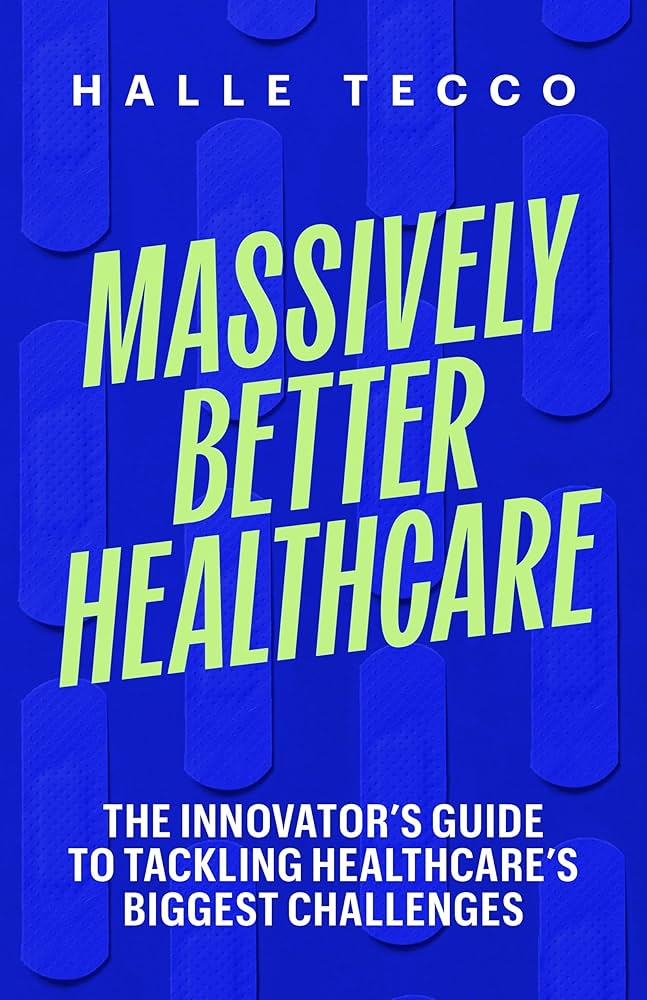
The global healthcare landscape is currently defined by a paradox: we possess unprecedented technological capabilities, yet we are plagued by staggering costs, inadequate patient outcomes and pervasive inequities. For those of us in the medical community, these are not mere statistics but daily realities. As a physician and journalist, I have long sought a blueprint that bridges the gap between the sterile efficiency of Silicon Valley and the rigorous, evidence-based requirements of clinical medicine.
Enter Halle Tecco. In her new book, Massively Better Healthcare: The Innovator’s Guide to Tackling Healthcare’s Biggest Challenges, Tecco attempts to provide exactly that blueprint. What we have is not a theoretical treatise on policy, but rather a practical roadmap for the next generation of leaders aiming to dismantle the barriers that keep healthcare broken. Published in February 2026 by Columbia University Press ([1]), the work serves as a guide for entrepreneurs and clinicians alike who are determined to align profit with purpose.
Tecco is uniquely positioned to write this guide. As the founder of the venture fund Rock Health and an investor in more than 50 digital health companies ([1]), she has spent over a decade at the intersection of capital and care. Her credentials extend beyond the boardroom; she is an Adjunct Professor at Columbia Business School and a Course Director at Harvard Medical School ([3]). This duality—understanding both the “margin” of venture capital and the “mission” of medical education—is the heartbeat of the book.
A Three-Part Framework for Healthcare Entrepreneurship
The book is structured as a comprehensive onboarding process for those entering the complex world of healthcare entrepreneurship. We see designed to move the reader from a state of awareness to a state of action through three distinct phases.
The first section provides a critical assessment of the current U.S. Healthcare system. While the focus is primarily American, the themes of misaligned incentives and regulatory hurdles are universal challenges in healthcare policy. Tecco does not shy away from the “mess” of the system, using this section to warn newcomers about the friction they will encounter when trying to implement change. For the seasoned clinician, this part may feel like a summary of known grievances, but for the tech entrepreneur, it is an essential reality check.
The second and perhaps most valuable section is a deep dive into the mechanics of innovation and company building. Tecco leverages her experience stewarding dozens of startups to offer “nuggets” of wisdom on how to scale solutions without sacrificing clinical integrity. She explores how to navigate the tension between the “move fast and break things” ethos of tech and the “first, do no harm” mandate of medicine. This section transforms the book from a critique into a toolkit, offering actionable frameworks for building sustainable business models.
The final section distills these lessons into four core rules for what works and what does not in the digital health space. Tecco concludes with a call to action, encouraging innovators to take what she describes as “Smart Shots”—targeted efforts to solve specific, individual problems within the system rather than attempting to boil the ocean. This approach suggests that while the system is too large to be fixed by a single entity, it can be improved through a series of strategic, evidence-based victories.
The Philosophy of ‘Mission and Margin’
At the core of Massively Better Healthcare is a simple but profound premise: healthcare will not improve at scale unless mission and margin are aligned ([2]). In many traditional models, these two forces compete; the drive for profit often undermines patient outcomes, while purely mission-driven projects often fail due to a lack of durable funding.
Tecco argues that good intentions, rapid growth, and clinical evidence are each necessary, but none are sufficient on their own. Lasting change requires the convergence of all three. By aligning the financial incentives of the business with the health outcomes of the patient, entrepreneurs can create “durable business models” that reinforce better care rather than competing with it ([2]).
This philosophy is particularly relevant in the current era of digital health, where we observe a proliferation of “pill mills” or virtual-only startups. Tecco’s insistence on evidence-based approaches serves as a necessary guardrail, ensuring that innovation does not come at the cost of patient safety or medical rigor.
Key Takeaways for Health Tech Innovators
- Avoid the ‘Growth-Only’ Trap: Scaling a flawed product only scales the flaw. Growth must be paired with evidence of improved outcomes.
- Navigate the ‘Old Guard’: Resistance to change is a feature of the system, not a bug. Successful innovators turn these regulatory and cultural hurdles into competitive advantages.
- Focus on ‘Smart Shots’: Instead of attempting to replace entire hospital systems, identify specific friction points where a targeted solution can create immediate, scalable value.
- Align Incentives: Build models where the provider, the payer, and the patient all benefit from the same positive health outcome.
Bridging the Gap: From Silicon Valley to the Clinic
One of the most compelling aspects of Tecco’s work is her effort to bridge the cultural divide between the dynamism of venture capital and the caution of clinical practice. As someone who holds an MPH from Johns Hopkins and an MBA from Harvard ([3]), she speaks both languages fluently. She understands that while the speed of Silicon Valley is necessary for innovation, the evidence-based approach of medicine is non-negotiable for safety.

The book is a 304-page guide ([1]) that manages to be both realistic and optimistic. It acknowledges that the “old guard”—those within massive hospital systems and health plans—often feel that change is impossible from within. However, Tecco suggests that by working on the periphery and proving value through “Smart Shots,” innovators can eventually force the center to shift.
For readers looking to extend their learning beyond the book, Tecco has built a comprehensive ecosystem of resources. This includes “The Heart of Healthcare” podcast, which explores the mission of improving digital health for all, as well as a blog and specific teaching tools, including case studies and lesson plans designed for the classroom ([2]), ([3]).
Final Verdict: Incremental or Massive Change?
Is it possible to “massively” improve healthcare, or are we destined for incremental gains? Tecco’s book leans toward a hopeful synthesis. While some critics might find her appeal to newcomers overly optimistic given the sheer power of established healthcare monopolies, her method is the only pragmatic path forward. We cannot wait for a systemic “extinction event” to clear the way for innovation; we must build the future in the margins of the present.
Massively Better Healthcare is an essential read for anyone entering the health tech space with the intention to fix the system. It provides the necessary warnings, the required tools, and the philosophical grounding to ensure that the next wave of digital health startups focuses on outcomes rather than just exits. Whether you are a physician looking to launch a startup or an investor seeking to understand the nuances of medical innovation, this book provides a vital starting point.
The book is available in hardcover for $32.00 and as an e-book for $31.99 ([1]).
As we look toward the remainder of 2026, the digital health sector continues to evolve, particularly with the ongoing scrutiny of virtual GLP-1 startups and the shifting landscape of healthcare acquisitions and IPOs. Keeping a pulse on these trends through resources like Tecco’s “Digital Health IPO Watchlist 2026” will be crucial for any innovator navigating this space ([2]).
Do you believe the current healthcare system can be fixed from the outside, or is internal reform the only way? Share your thoughts in the comments below.
Worth a look
- PRP Treatment and Anti-Inflammatories: Why You Must Avoid Them
- New Breathalyzer-Style Device Accurately Measures Fat Burning Through Exhaled Air
- New Study Links GLP-1 Medications Like Wegovy and Ozempic to Health Risks (archyde.com)
- California Billionaire Tax Proposal: Debate Over $100B Healthcare Fund (archynewsy.com)