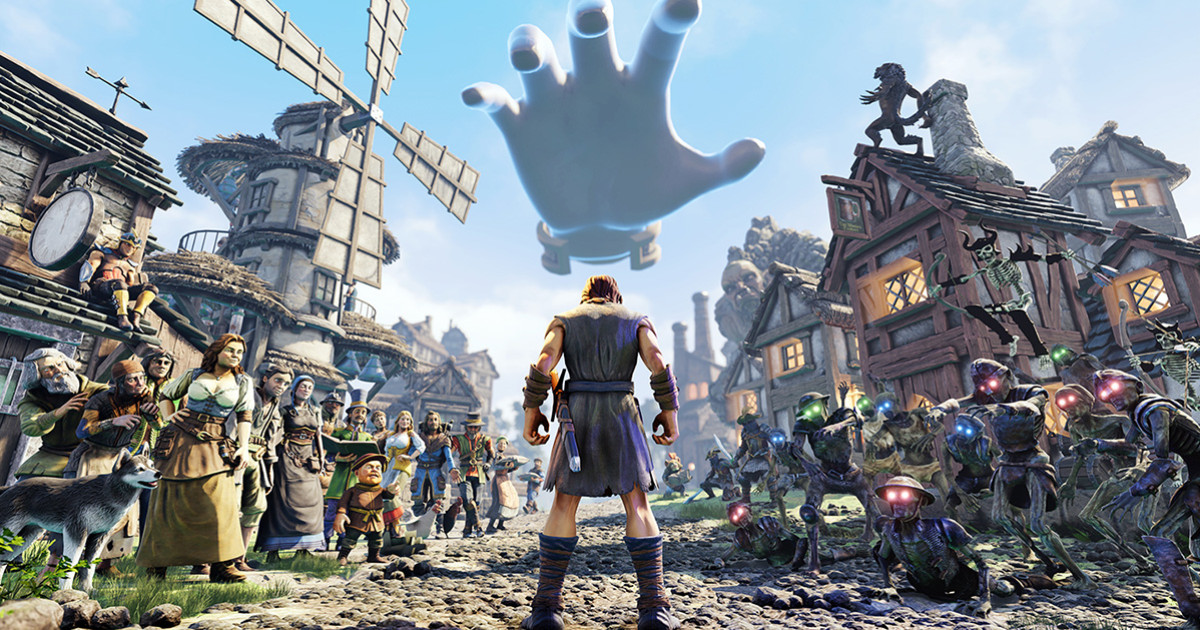
Peter Molyneux, the British video game designer best known for creating the Fable series and Populous, has returned to the spotlight with a latest project titled Masters of Albion. Announced through his studio 22cans, the game is positioned as a spiritual successor to his earlier god-simulation titles, promising players divine control over a evolving civilization. The announcement has reignited long-standing debates within the gaming community about Molyneux’s legacy — celebrated for his visionary ambition but frequently scrutinized for overpromising and underdelivering on features.
First revealed in a developer update posted to the 22cans website in early 2024, Masters of Albion is described as a “living world” simulation where players shape geography, influence societal development, and intervene in the lives of digital inhabitants through god-like powers. The game builds on mechanics pioneered in Populous (1989) and Black & White (2001), blending terraforming, resource management, and emergent AI-driven narratives. According to the studio, the project leverages modern procedural generation and machine learning techniques to create unpredictable yet coherent civilizational trajectories.
The return of Molyneux to game development comes after a period of relative quiet following the mixed reception of Godus, a 2013 Kickstarter-funded project that faced criticism for delayed delivery and unmet stretch goals. While Godus eventually launched in 2014, many backers expressed disappointment over its simplified mechanics compared to initial promises. This history has led to cautious optimism — and in some cases, skepticism — regarding Masters of Albion’s ability to fulfill its ambitious vision.
Industry analysts note that the current climate for simulation and strategy games is favorable, with titles like Civilization VI, Crusader Kings III, and Banished demonstrating sustained player interest in deep, systems-driven experiences. However, the bar for innovation in the genre has risen significantly since Molyneux’s peak years, raising questions about whether Masters of Albion can offer something genuinely new rather than a nostalgic reprise.
What Is Masters of Albion and How Does It Work?
Masters of Albion centers on the player’s role as a deity guiding the fate of a fictional island civilization. Drawing inspiration from real-world anthropological and geological processes, the game simulates how environmental factors — such as climate shifts, natural disasters, and resource availability — interact with cultural evolution. Players can raise or lower terrain, redirect rivers, summon storms, or bless crops, with each action potentially triggering cascading effects across generations.
The game’s AI-driven populace is designed to exhibit emergent behaviors, forming societies with distinct beliefs, economies, and conflict patterns based on player intervention and environmental conditions. Rather than following scripted paths, civilizations adapt dynamically, meaning two playthroughs could yield vastly different outcomes — one might develop into a theocratic maritime power, another into a fragmented network of agrarian clans.
22cans has emphasized that Masters of Albion avoids traditional win/lose conditions. Instead, success is measured through the player’s influence on long-term societal metrics such as technological advancement, cultural cohesion, and environmental sustainability. This open-ended approach aligns with Molyneux’s longstanding interest in games as tools for exploring complex systems, a philosophy he outlined in a 2001 Game Developers Conference talk archived by the GDC Vault.
Technically, the game is being developed using Unity, with custom extensions for procedural terrain generation and neural network-based behavior modeling for non-player characters. While the studio has not disclosed specific partnerships, job listings from late 2023 indicated collaboration with researchers specializing in evolutionary computation and agent-based modeling — fields increasingly used in academic simulations of societal development.
Why Does Molyneux’s Return Spark Debate?
Peter Molyneux’s career has been defined by bold ideas and charismatic presentations, often showcased during high-profile demonstrations at events like E3 and GDC. His 1997 demo of Black & White, where he demonstrated creature training through gesture-based AI, became legendary for its ambition — though the final product, while critically acclaimed, did not fully realize the real-time learning capabilities hinted at in early previews.
This pattern of visionary pitches followed by scaled-back releases has led to a reputation for “overpromising.” Critics point to Fable’s missing multiplayer and morality depth, Black & White 2’s simplified creature AI, and Godus’s departure from its original god-game vision as examples. In a 2014 post-mortem interview with Eurogamer, Molyneux acknowledged that development pressures and publisher constraints often forced compromises on initial designs.
Supporters, however, argue that his willingness to take creative risks has pushed the medium forward. Titles like Populous helped define the god-game genre, while Fable introduced early experiments in morality systems and player-driven storytelling that influenced later RPGs such as Fable II and even The Witcher series. In a 2021 retrospective, Rock Paper Shotgun described him as “a designer who dreams in systems, even when the technology struggles to keep up.”
The announcement of Masters of Albion has thus prompted a familiar dialogue: Can a designer known for grandiose visions deliver a coherent, polished experience in an era where players expect both innovation and reliability? Or will the project fall into the same cycle of anticipation and disappointment that has marked some of his recent work?
Development Timeline and Studio Context
22cans, founded by Molyneux in 2012 after leaving Lionhead Studios (which he co-founded in 1996), has operated as a tiny, independent team focused on experimental projects. Prior to Masters of Albion, the studio released Godus, the mobile puzzle game The Trail (2016), and several VR prototypes. Despite limited commercial breakthroughs, 22cans has maintained a reputation for technical curiosity, often exploring emerging technologies like augmented reality and AI-driven interaction.
According to LinkedIn data and company filings accessed via the UK’s Companies House portal, 22cans employed between 10 and 15 full-time staff as of late 2023. The studio has not disclosed funding sources for Masters of Albion, though it previously relied on a mix of private investment, crowdfunding (Godus raised over £450,000 on Kickstarter), and revenue from earlier titles.
Development on Masters of Albion appears to have begun in earnest around 2022, based on timeline references in developer blogs and concept art shared during private showcases. A playable demo was reportedly shown to select press and influencers at Gamescom 2023, though no public build has been released as of mid-2024. The studio has stated that a public beta or early access launch is planned for late 2024 or early 2025, contingent on milestone completion — though no exact date has been confirmed.
In a May 2024 update on the 22cans website, Molyneux wrote that the team was focusing on “polishing the core simulation loop” and ensuring that “emergent stories feel meaningful, not random.” He emphasized that player agency and consequence would be central to the experience, with interventions carrying long-term weight — a direct response to criticisms that earlier god games lacked lasting impact.
What Players and Critics Are Saying
Early reactions to Masters of Albion have been mixed but intrigued. On forums like Reddit’s r/gaming and ResetEra, users have expressed excitement about the return to deep simulation mechanics, with many citing Black & White as a formative influence. One recurring theme in discussions is cautious hope: players want to believe in the vision but remain wary of unmet expectations.
Some critics have noted that the trailer and screenshots released so far show promising environmental detail and fluid terraforming mechanics, suggesting technical progress since Godus. However, others have questioned whether the demonstrated AI behaviors represent true emergence or sophisticated scripting — a distinction that could determine the game’s long-term replay value.
Industry commentators have highlighted the importance of managing expectations. In a June 2024 analysis, PC Gamer observed that while the game’s foundations appear solid, its success will depend on how well it balances player freedom with coherent narrative feedback — a challenge that has tripped up many ambitious simulations.
Molyneux himself has acknowledged past shortcomings. In a rare candid moment during a 2023 interview with YouTube (archived via transcript), he stated: “I’ve learned that ambition without execution is just frustration. With Masters of Albion, we’re trying to build something that doesn’t just impress in a demo — it holds up over hundreds of hours.”
Where to Follow Official Updates
For those interested in tracking the game’s progress, 22cans maintains an official website at 22cans.com, where developer blogs, concept art, and update logs are posted regularly. The studio also uses Twitter/X (@22cans) and a public Discord server to share milestones and gather community feedback.
Unlike some crowdfunded projects, Masters of Albion is not currently being financed through public crowdfunding campaigns. Instead, the studio has indicated it is pursuing a traditional independent release model, potentially through digital storefronts like Steam or the Epic Games Store. No publisher has been announced as of mid-2024.
Prospective players wishing to stay informed are encouraged to follow these channels directly, as third-party reporting — while enthusiastic — can sometimes amplify rumors or misinterpret early builds. The studio has committed to transparency, promising regular development updates leading up to any public release.
As of now, the next confirmed milestone is the anticipated release of a playable demo or early access build in late 2024, though this remains subject to change based on development progress. No official date has been locked in, and the studio has emphasized quality over schedule.
Whether Masters of Albion will stand as a triumphant return or another cautionary tale remains to be seen. What is clear, however, is that Peter Molyneux continues to provoke conversation — and in an industry often driven by iteration, that willingness to dream big still carries weight.
If you’ve followed the game’s development or have thoughts on Molyneux’s legacy, share your perspective in the comments below. And if you found this overview helpful, consider passing it along to others interested in the evolving intersection of game design, simulation, and creative ambition.
Worth a look