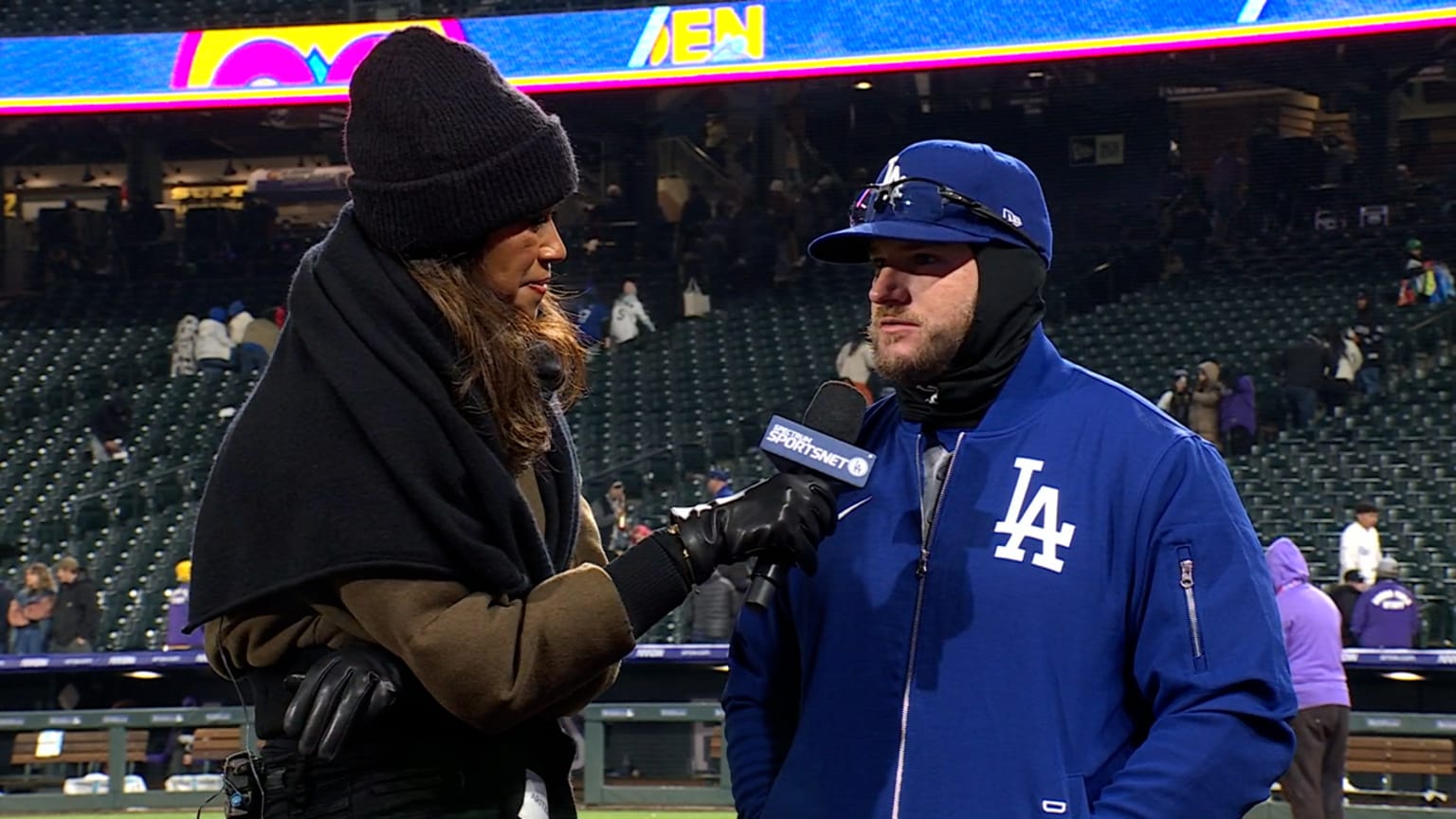
Los Angeles Dodgers slugger Max Muncy delivered a standout performance on April 17, 2026, launching two solo home runs in a victory over the Colorado Rockies at Coors Field. The offensive outburst came during a tightly contested National League West matchup, where Muncy’s power helped the Dodgers secure a 5-2 win despite challenging weather conditions that included gusty winds and temperatures hovering near freezing at game time.
Speaking after the game, Muncy acknowledged the difficulty of hitting in such cold, dense air, noting that the ball didn’t carry as far as it typically does at the mile-high stadium. “It’s tough when the air is this heavy,” he said in a postgame interview with MLB Network. “You have to stay short, stay on top of the ball, and trust your swing. Tonight, I was able to do that twice.” His comments highlighted both the adversity faced by hitters in early-season Rocky Mountain games and his own adjusted approach at the plate.
The two-home-run effort marked Muncy’s third multi-homer game of the 2026 season and pushed his season total to eight home runs through the Dodgers’ first 22 games. According to MLB’s official statistics, Muncy entered the game batting .241 with a .362 on-base percentage and a .518 slugging percentage, figures that reflect his continued role as a middle-of-the-order catalyst for Los Angeles despite ongoing discussions about his strikeout rate and defensive versatility.
Manager Dave Roberts praised Muncy’s resilience, emphasizing how the veteran infielder has adapted his game over the years to remain productive even when not hitting for average. “Max understands his role,” Roberts said. “He’s not trying to be something he’s not. He looks for his pitch, and when he gets it, he does damage. That’s what we need from him in the middle of the lineup.”
Muncy’s performance also drew attention to the broader strategic question facing the Dodgers: how to balance power production with consistency in a lineup that has relied heavily on home runs early in the season. Los Angeles ranked second in the National League in home runs through April 17, with 48 as a team, but sat 10th in batting average (.238) and 12th in on-base percentage (.312), suggesting a potential overreliance on the long ball.
Adjusting to Altitude and Early-Season Conditions
The challenge of hitting at Coors Field is well documented, particularly early in the season when cold air increases air density and reduces the distance a batted ball travels. According to research from the NBC Sports analysis of Coors Field effects, the effective carrying distance of a baseball can be reduced by up to 15% in temperatures below 40°F compared to summer conditions, requiring hitters to generate more bat speed to achieve similar results.
Muncy, who has played 87 career games at Coors Field entering April 2026, has historically performed better there than at many other road venues, posting a .278 batting average and .542 slugging percentage at the Rockies’ home park. His April 17 output aligned with that trend, as both home runs came off Rockies starter Kyle Freeland, a left-hander whom Muncy has faced 22 times in his career with a .318 batting average and four home runs.
Freeland, now in his 11th MLB season, acknowledged after the game that he left too many pitches in Muncy’s wheelhouse, particularly early in the count. “He’s a dangerous hitter when you elevate,” Freeland said. “Tonight, I missed my spots, and he made me pay.”
Lineup Construction and Offensive Balance
The Dodgers’ early-season offensive profile has sparked internal discussions about whether the team can sustain its current pace of run production without improving its contact and on-base skills. Whereas the power surge has masked some inconsistencies, analysts from The Athletic noted that teams relying on home runs for over 45% of their runs—like the Dodgers did through mid-April—often experience greater volatility in performance when faced with elite pitching or adverse conditions.
To address this, Los Angeles has reportedly emphasized situational hitting in recent batting practices, with hitting coach Bronswell Patrick working with players on pitch recognition and two-strike approach. Muncy himself has been a vocal participant in those discussions, stating in a March 2026 press conference that “we can’t just wait for the three-run shot every night. We’ve got to manufacture runs, move guys over, and put pressure on the defense.”
Those adjustments may become increasingly important as the season progresses and the Dodgers prepare for a potential playoff rematch with teams like the Atlanta Braves or Philadelphia Phillies, both of whom ranked in the top five in pitching staff ERA in 2025 and are expected to challenge Los Angeles’s reliance on power.
Defensive Flexibility and Role Evolution
Beyond his bat, Muncy’s value to the Dodgers continues to stem from his defensive versatility. Capable of playing first base, second base, and third base at an above-average level, he has allowed manager Roberts to optimize matchups and manage injuries without sacrificing offensive output. Through April 17, 2026, Muncy had started 14 games at first base, six at second, and two at third, demonstrating the flexibility that has made him a fixture in Los Angeles’s lineup since joining the team in 2018.
His defensive metrics, while not elite, have remained stable. According to Baseball Savant, Muncy ranked in the 60th percentile among MLB first basemen in outs above average (OAA) as of April 2026, with strong arm accuracy and footwork compensating for limited lateral range.
That balance—solid defense, elite power, and a disciplined, if high-strikeout, approach at the plate—has kept Muncy among the most valuable positional players in the National League. His Wins Above Replacement (WAR) total of 2.1 through mid-April placed him among the top 15 NL position players, according to FanGraphs’ live standings.
Looking Ahead: Schedule and Adjustments
The Dodgers returned to Dodger Stadium on April 19 to open a three-game series against the San Francisco Giants, beginning a critical stretch of 12 games against NL West opponents over the next three weeks. Success in those matchups will be pivotal for Los Angeles’s goal of securing the division title early and avoiding a Wild Card playoff berth.
Muncy is expected to remain in the cleanup spot, though Roberts has indicated openness to adjusting the lineup based on performance, and matchups. The next official update on the Dodgers’ roster and lineup plans will come ahead of their April 22 series opener against the Giants, when Roberts typically addresses the media during his pregame press conference at 1:10 p.m. PT.
For fans seeking real-time updates, the Dodgers’ official site provides live stats, video highlights, and postgame audio interviews. MLB’s Statcast platform also offers detailed analytics on exit velocity, launch angle, and expected batting average, allowing deeper insight into player performance beyond traditional box scores.
As the 2026 MLB season enters its fifth week, Max Muncy’s April 17 performance serves as a reminder of both the enduring value of power hitting and the importance of adaptability in the face of environmental and competitive challenges. His ability to deliver in tough conditions reinforces why he remains a cornerstone of the Los Angeles Dodgers’ offense, even as the team seeks to evolve its approach for sustained success throughout the long season.
We invite our readers to share their thoughts on Muncy’s performance and the Dodgers’ offensive strategy in the comments below. If you found this analysis informative, please consider sharing it with fellow baseball fans on social media.
Related reading