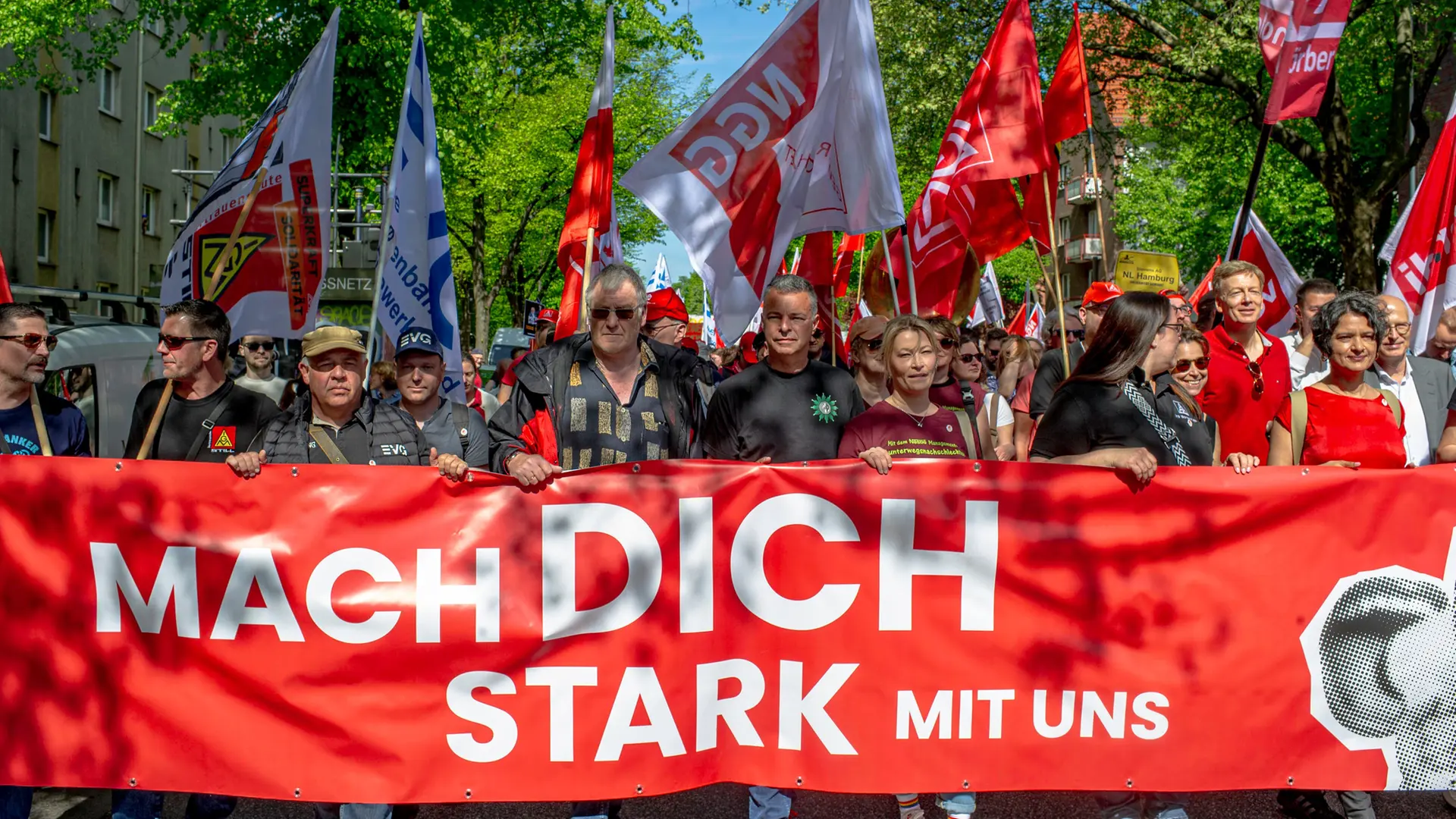
Hamburg braced for widespread demonstrations on Wednesday as unions, left-wing groups, and anarchist movements took to the streets on May Day, also known as the International Workers’ Day. The demonstrations, a long-standing tradition in the city, saw a significant turnout, with participants voicing concerns over labor rights, social inequality, and political issues. While police anticipated a large presence, a shift in strategy resulted in a reduced police presence compared to previous years, focusing instead on de-escalation and targeted intervention.
The day’s events began with a demonstration organized by the German Trade Union Confederation (DGB), starting at 10:30 AM at the Ottensen S-Bahn station and culminating in a rally at the Fischmarkt around noon. Under the slogan “Erst unsere Jobs, dann eure Profite” (“First our jobs, then your profits”), the DGB aimed to highlight the importance of job security and fair wages amidst ongoing labor disputes within the city. Notably, postal workers had already staged a strike on Thursday, April 30th, with further industrial action planned for Saturday, May 2nd. A strike deadline for Hamburg-Holstein public transport (VHH) also loomed on Sunday, May 3rd, raising the prospect of further disruptions to public transportation. NDR.de reported on these planned actions.
Diverse Demonstrations Reflect Broad Concerns
Beyond the DGB’s central demonstration, a multitude of other groups organized protests throughout the day. The “Wer hat, der gibt” (“He who has, gives”) alliance held a demonstration starting at 2:30 PM at Jungfernstieg, with the rallying cry “Geld ist da – Ran an die Reichen” (“Money is there – Go for the rich”). The route took protesters through affluent neighborhoods, including the Rothenbaumchaussee and Eppendorfer Baum, signaling a direct challenge to wealth inequality. Jan van Aken, co-leader of the Left Party (Die Linke), was scheduled to speak at the rally.
Simultaneously, various left-wing groups organized demonstrations in the Schanze and Ottensen districts. Authorities were particularly focused on two demonstrations organized by the far-left scene: the “Revolutionäre 1. Mai-Demo,” starting at 4:00 PM on Neue Große Bergstraße in Ottensen, and the “Anarchismus wagen – Dystopien bekämpfen” (“Dare Anarchism – Fight Dystopias”) demonstration in the Schanze later in the evening. Police were prepared for potential confrontations, given the history of unrest associated with these groups. t-online Hamburg provided an overview of the planned routes and focuses of these demonstrations.
A Shift in Policing Strategy
In a notable change from previous years, Hamburg police adopted a revised strategy for managing the May Day demonstrations. According to reports, the police opted for a less visible presence, prioritizing de-escalation and targeted intervention over large-scale deployments. This approach was reportedly a response to criticisms of heavy-handed policing in past years and a desire to foster a more peaceful environment. The Hamburger Abendblatt reported that this shift was a deliberate decision aimed at avoiding unnecessary escalation.

Despite the reduced police presence, authorities remained vigilant, particularly concerning the demonstrations organized by far-left groups. The police were prepared to respond swiftly to any instances of violence or property damage. The MOPO reported that police were anticipating a large number of demonstrators and were prepared for potential disruptions. MOPO detailed the police’s expectations for the day.
Broader Context: The History and Significance of May Day
May Day, or the International Workers’ Day, has a rich history rooted in the labor movement of the late 19th century. The day commemorates the Haymarket affair of 1886 in Chicago, where a peaceful labor demonstration turned violent after a bomb was thrown at police. The event led to the execution of several labor activists and became a symbol of the struggle for workers’ rights. Historian Knud Andresen, speaking to the TAZ, noted that the day serves as a barometer of the state of the workers’ movement, reflecting evolving concerns and social compositions over the decades. TAZ interviewed Andresen about the historical significance of May Day.
In Germany, May Day was initially suppressed under the Nazi regime but was revived after World War II. Today, it remains a significant day for labor unions and left-wing political groups to advocate for workers’ rights, social justice, and economic equality. The demonstrations in Hamburg, and across Germany, reflect a continuing commitment to these principles. The day also provides a platform for addressing contemporary issues such as precarious employment, wage stagnation, and the rising cost of living.
Additional Protests Highlight Diverse Concerns
In addition to the core labor-focused demonstrations, several other protests took place in Hamburg on May Day. A demonstration took place at noon on Mönckebergstraße protesting the human rights situation in Iran, calling for international pressure on the Iranian government. The protest concluded around 6:30 PM at the Gänsemarkt. A queer-feminist demonstration against capitalism and patriarchal structures took place on Thursday evening, May 1st, drawing approximately 950 participants, according to police estimates. The demonstration, under the slogan “Take Back the Night,” marched from Heiligengeistfeld towards Reeperbahn. Radio Hamburg reported on the diverse range of demonstrations.
The multifaceted nature of the May Day protests in Hamburg underscores the breadth of social and political concerns driving activism in the city. From labor rights and economic inequality to international human rights and gender equality, the demonstrations served as a powerful expression of collective demands for a more just and equitable society.
As the day concluded, authorities monitored the situation closely, prepared to respond to any further developments. The focus now shifts to assessing the impact of the demonstrations and addressing the underlying issues that motivated the protests. Further updates on any potential disruptions or police interventions are expected in the coming days.
Key Takeaways:
- Hamburg saw a significant turnout for May Day demonstrations, organized by unions, left-wing groups, and anarchists.
- The DGB led a major demonstration focusing on job security and fair wages, coinciding with ongoing labor disputes.
- Hamburg police adopted a revised strategy, prioritizing de-escalation and targeted intervention over large-scale deployments.
- A diverse range of protests addressed issues including human rights in Iran and queer-feminist concerns.
The events of May Day in Hamburg highlight the ongoing importance of social and political activism in addressing pressing issues facing the city and the wider world. Stay tuned to World Today Journal for further updates on this developing story.