
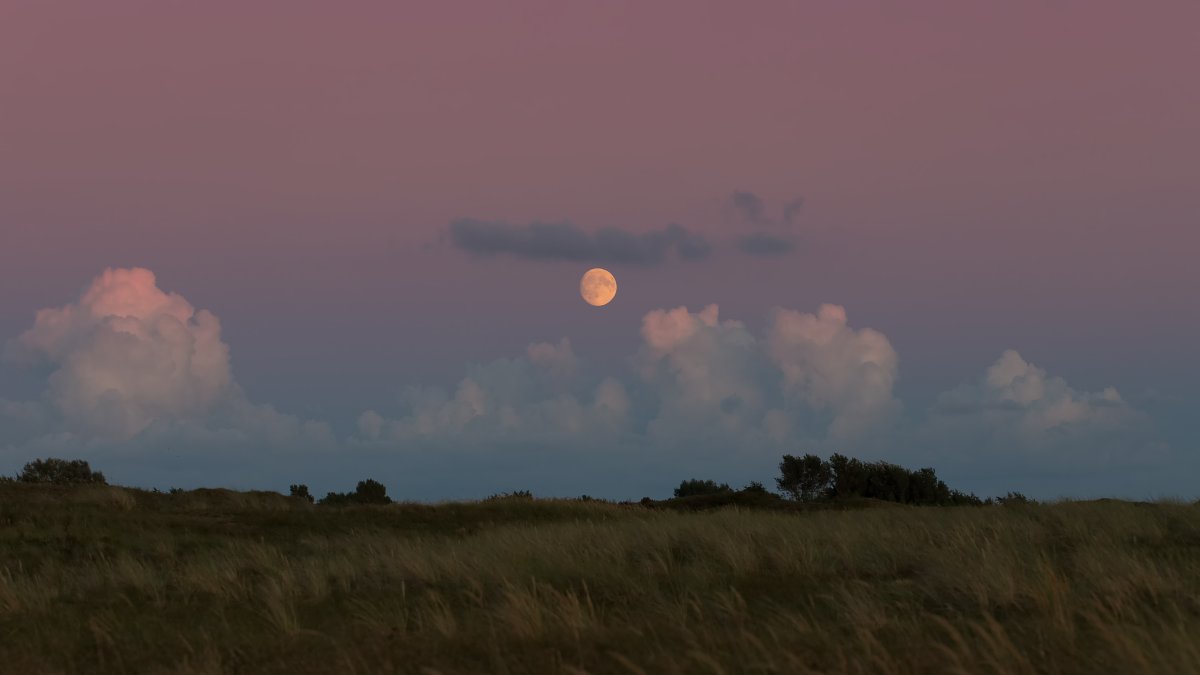
The night sky is offering a rare celestial double-feature this month, beginning today, Friday, May 1, 2026. Although full moons are a regular occurrence, the current lunar event—known as the Flower Moon—is distinguished by a combination of orbital mechanics and calendar timing that transforms a standard monthly cycle into a rarity for stargazers and astronomy enthusiasts worldwide.
This particular full moon is not only the first of two appearing in May, but it also qualifies as a micromoon
. This means that as the moon reaches its full phase, It’s positioned at its farthest point from Earth in its elliptical orbit, resulting in a lunar disk that appears slightly smaller and less luminous than the dramatic supermoons that often capture public attention.
For those tracking the lunar calendar, the rarity is compounded by the arrival of a second full moon later this month. The sequence begins today and concludes on May 31, creating a phenomenon known as a Blue Moon. This alignment of a micromoon and a monthly double-feature makes May 2026 a standout period for astronomical observation.
Understanding the Flower Moon
The term Flower Moon
is a traditional name rooted in the seasonal changes of the Northern Hemisphere. According to the Farmers Almanac, the name serves as a reference to the abundant flowers that bloom during May, describing them as Mother Nature’s coming attractions
.
This naming convention reflects the ecological transition of spring, particularly in North America, where hundreds of native flowers, bushes, and trees typically blossom during this window. While the name is poetic, the timing of the peak is precise. The Flower Moon is scheduled to reach its maximum fullness today, May 1, at 12:23 p.m. CT, according to data from Time and Date.
The Science of the Micromoon
While many are familiar with the “supermoon,” the micromoon is its opposite. To understand why this happens, one must look at the shape of the moon’s orbit. The moon does not travel around Earth in a perfect circle; instead, it follows an elliptical path.
This orbit creates two critical points: the perigee, which is the point nearest to Earth, and the apogee, the point farthest away. When a full moon coincides with the moon’s arrival at apogee, it is classified as a micromoon. As reported by EarthSky:
“The moon takes about a month to orbit Earth once… And the moon’s orbit around Earth isn’t a perfect circle. So the moon has a nearest point (perigee) and a farthest point (apogee) each month. When we have a full moon around the time of apogee, that’s a full micromoon.” EarthSky Editorial Team
Because of this increased distance, a micromoon may appear slightly smaller than an average full moon. While the difference is often subtle to the naked eye, it is significantly less imposing than a supermoon, which occurs at perigee.
The Arrival of the Blue Moon
The most rare aspect of May’s lunar schedule is the frequency of full moons. Typically, a calendar month sees only one full moon, as the lunar cycle lasts approximately 29.5 days. However, because May has 31 days, there is enough room for a second full moon to occur.
The second full moon of the month will take place on May 31, 2026. This second occurrence is termed a Blue Moon
. Despite the name, the moon does not actually change color; the term is a linguistic marker for a rare calendar event.
“Blue Moon is the name given to the second Full Moon in a single calendar month. It’s a relatively rare event, hence the phrase ‘once in a blue moon,’” NASA
According to NASA, this event occurs infrequently enough to have entered the global lexicon as a metaphor for something that happens very rarely.
May 2026 Lunar Quick-Reference
| Event | Date | Key Characteristic |
|---|---|---|
| Flower Moon | May 1, 2026 | Micromoon (Apogee) |
| Blue Moon | May 31, 2026 | Second full moon of the month |
Observation Tips for the Public
Viewing a micromoon does not require specialized equipment, though a pair of binoculars can help highlight the craters and lunar maria more clearly. Because the moon is at apogee, the light may seem slightly softer than during a supermoon event.
To obtain the best view of today’s Flower Moon, observers should look for the moon as it rises in the east during twilight. Because it peaks at 12:23 p.m. CT, the most visible “full” appearance for most global audiences will occur during the evening of May 1 and the early hours of May 2.
As we look toward the finish of the month, the Blue Moon on May 31 will provide a second opportunity for observation. This pairing of a micromoon and a Blue Moon within a single 31-day window is a reminder of the complex, overlapping cycles that govern our solar system.
The next major lunar milestone will be the Blue Moon on May 31, 2026. We invite our readers to share their photographs of the Flower Moon in the comments below.