Decoding the Maya: How Ancient Astronomers Predicted eclipses with Remarkable Accuracy
For centuries, the intricate calendars of the Maya civilization have fascinated researchers. Thes weren’t simply timekeeping devices; they were deeply interwoven with religious beliefs and, crucially, a complex understanding of astronomical events – particularly eclipses. Today, we’re gaining a clearer picture of how the Maya achieved such accurate predictions, thanks to new analysis of ancient texts.
The Legacy of the Daykeepers
The Maya maintained their complex calendars through dedicated specialists known as “daykeepers.” This tradition remarkably continues even today. It’s widely accepted that eclipses held significant importance in Maya culture,influencing rituals and being integrated into their worldview. Researchers now believe the famed eclipse tables found in surviving codices represent a culmination of centuries of observation and mathematical refinement.
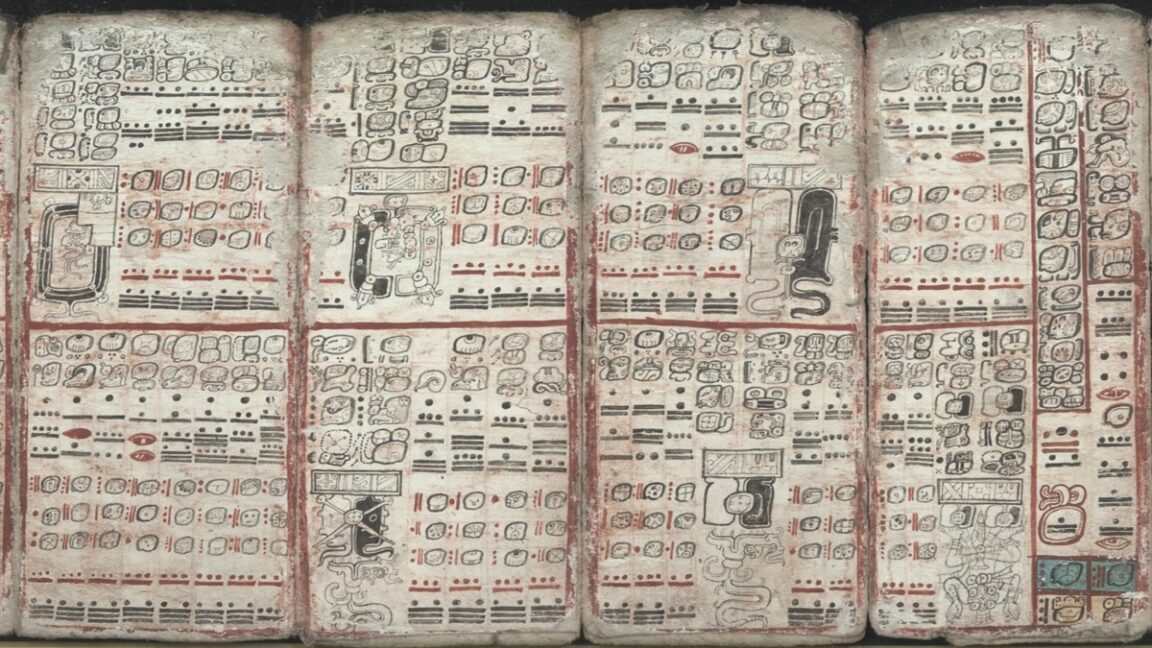
Unlocking the Dresden codex
A key to understanding this ancient knowledge lies within the Dresden Codex, one of the few remaining Maya books. Researchers recently focused on the codex’s eclipse tables, comparing predictions within to a historical database maintained by NASA. Their analysis centered on 145 solar eclipses visible across the Maya region between 350 and 1150 CE.
This meticulous work revealed a fascinating origin for the eclipse tables. They didn’t spring forth fully formed, but rather evolved from a broader table tracking lunar months.
The 405-Month Cycle: A Foundation for Prediction
The length of a 405-month lunar cycle – totaling 11,960 days – proved surprisingly significant. This number aligns perfectly with 46 repetitions of the 260-day Maya calendar (46 x 260 = 11,960). Essentially, Maya daykeepers discovered that 405 new moons consistently corresponded to 46 cycles of their sacred calendar.
This allowed them to accurately predict the dates of both full and new moons over extended periods. You can imagine the power this held for ritual planning and agricultural cycles.
Eclipses and the New Moon Connection
But how did lunar predictions translate into eclipse forecasting? Remember, a solar eclipse only occurs during a new moon. Therefore, if you can reliably predict new moons, you’ve already narrowed down the potential eclipse window to roughly one in seven new moons.
As Lowry explains,the Maya focused on perfecting lunar prediction models. This approach was remarkably efficient,as it didn’t require calculating the moon’s precise position relative to the ecliptic – a far more complex undertaking.
Refining Accuracy Over Time
Of course, even the most sophisticated system isn’t perfect. The Maya understood the need for occasional adjustments to their tables. Over time,slight discrepancies would accumulate,requiring recalibration.
It’s important to remember that “accuracy” is relative. While modern science strives for predictions down to the microsecond, the Maya aimed for accuracy to the day. This level of precision was incredibly effective for their purposes and demonstrates a profound understanding of cyclical patterns in the cosmos.
Here’s a quick recap of key takeaways:
* Lunar Cycles as a Base: The Maya built their eclipse predictions upon a foundation of accurate lunar cycle tracking.
* The 260-Day Calendar: This calendar played a crucial role in aligning lunar and eclipse events.
* Practical Prediction: They focused on predicting new moons,knowing eclipses would occur with relative frequency during those times.
* Iterative Refinement: The Maya continuously adjusted their tables to maintain accuracy over centuries.
Ultimately, the Maya’s success wasn’t about possessing advanced technology, but about meticulous observation, mathematical ingenuity, and a deep connection to the rhythms of the natural world. Their legacy continues to inspire awe and offers valuable insights into the power of ancient astronomical knowledge.
Related reading