
Starting next month, Medicare will cover weight-loss drugs for the first time in its history through a temporary demonstration program that experts warn could be difficult to end. The move, announced under the Trump administration, bypasses long-standing legal restrictions on obesity drug coverage by Medicare, raising questions about whether the policy will become permanent.
Medicare has long been prohibited by federal law from covering obesity treatments, including prescription weight-loss medications like semaglutide (brand name Wegovy) and tirzepatide (brand name Mounjaro). But beginning in July 2025, eligible Medicare beneficiaries—those enrolled in Medicare Part D or Advantage plans—will gain access to these drugs through a special federal program called Bridge, designed to test their effectiveness and cost impact over a two-year period.
Originally, the Biden administration had planned to launch a separate three-year initiative called BALANCE (Better Access to Lower Cost and Effective Medications for Obesity), which would have relied on private Medicare insurers to voluntarily cover the drugs. However, after insurers resisted participation, the federal government shifted strategy, extending the Bridge program—a transitional coverage model that began in January 2025—until the end of 2026. This extension, confirmed by the Centers for Medicare & Medicaid Services (CMS), effectively makes the policy a de facto long-term solution for millions of Americans.
With obesity rates among Medicare beneficiaries reaching 33% in 2023—higher than the national average—advocates say the program could improve health outcomes for older adults struggling with weight-related conditions like diabetes and heart disease. But critics warn that the temporary designation may be a smokescreen: once the drugs prove cost-effective, ending the program could become politically and administratively challenging.
Why it matters: The Bridge program is the first major step toward normalizing obesity drug coverage under Medicare, a shift that could reshape how the U.S. addresses chronic weight management in older adults. If successful, it may set a precedent for broader Medicare coverage—potentially affecting future healthcare policy for millions.
How the Bridge Program Works—and Why It Might Not End
The Bridge program, initially launched as a 12-month pilot in January 2025, was meant to serve as a temporary bridge while Medicare and private insurers worked out a permanent solution. But after insurers declined to participate in the BALANCE initiative—citing concerns over drug costs and limited evidence of long-term benefits—the federal government expanded Bridge’s scope and timeline.
Under the updated rules, Medicare Part D and Advantage plans are now required to cover two FDA-approved obesity drugs: semaglutide (Wegovy) and tirzepatide (Mounjaro), both of which have shown significant weight-loss results in clinical trials. The program will run through December 31, 2026, giving CMS time to evaluate whether the drugs improve health outcomes and reduce long-term healthcare costs.

However, the temporary label is already raising eyebrows. “Demonstration programs like this often become permanent once they show positive results,” said Kaiser Family Foundation (KFF) analyst Tricia Neuman. “The political will to end a program that’s working—and saving money—is usually low.”
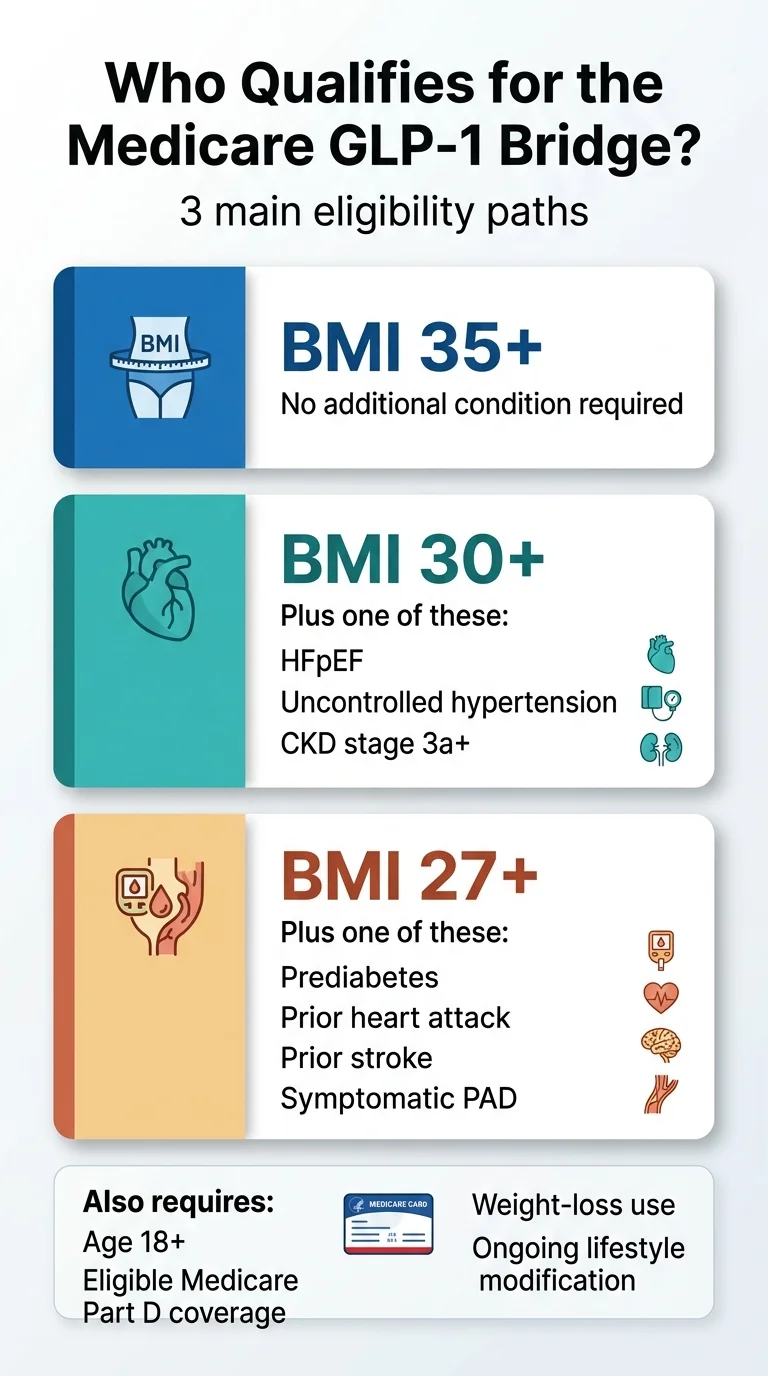
According to CMS data, the program could affect up to 15 million Medicare beneficiaries who meet the eligibility criteria: adults aged 65 and older with a body mass index (BMI) of 30 or higher (or 27 or higher with at least one weight-related condition). The cost to Medicare is estimated at $1.2 billion annually, based on current drug pricing and utilization rates.
“This is a significant shift in how Medicare views obesity treatment. For decades, weight management was seen as a personal responsibility, not a medical issue. That’s changing.”
—Dr. David Ludwig, endocrinologist and obesity researcher at Harvard Medical School
Legal Workarounds: How Medicare Is Bypassing Obesity Coverage Bans
Medicare’s prohibition on obesity drug coverage stems from the Social Security Act of 1965, which explicitly excludes “routine” weight-loss treatments. But the Bridge program operates under a legal loophole: it is classified as a demonstration project, a tool CMS uses to test new coverage models without requiring congressional approval.
Demonstration projects have a history of becoming permanent. For example, the Medicare Advantage program, initially a pilot in the 1990s, now covers 45% of all Medicare beneficiaries. Similarly, the Part D prescription drug benefit, launched in 2006 as a temporary fix, remains a cornerstone of Medicare.
Legal experts say the Bridge program’s structure makes it difficult to unwind. “Once CMS demonstrates that these drugs are cost-effective, the political pressure to maintain coverage will be enormous,” said Brookings Institution health policy analyst Sarah Liao. “Congress would have to explicitly repeal the law—or pass new legislation—to stop it.”
Adding to the complexity, the Inflation Reduction Act of 2022 already includes provisions to negotiate drug prices for Medicare, which could further entrench obesity medications in the benefit structure. If CMS determines that semaglutide or tirzepatide reduce hospitalizations or medication costs for diabetes, the financial case for permanent coverage strengthens.
Who Benefits—and Who Pays?
The Bridge program targets Medicare beneficiaries who have struggled to access obesity treatments due to high out-of-pocket costs. Before this change, patients typically paid $1,000–$1,500 per month for these drugs, with no Medicare reimbursement. Now, under Bridge, the cost-sharing burden shifts to Medicare, though beneficiaries will still face copays and deductibles depending on their plan.
A 2024 study in JAMA Network Open found that 60% of Medicare beneficiaries with obesity report delaying or skipping medications due to cost. The new coverage could improve adherence and outcomes for this group, particularly those with diabetes or hypertension, where weight loss has been shown to reduce complications.
However, the financial impact on Medicare’s budget remains uncertain. While the drugs may lower long-term costs by reducing hospitalizations, the upfront expense could strain the program. “We’re essentially conducting a real-world experiment with billions of dollars at stake,” said University of Pennsylvania health economist Austin Frakt. “If the drugs don’t deliver on their promises, we could see pushback.”
Key Takeaways
- Temporary program, potential permanent impact: The Bridge program, set to run until 2026, could become a lasting Medicare benefit if it proves cost-effective.
- Legal loophole: CMS is using a demonstration project to bypass long-standing bans on obesity drug coverage.
- Who’s eligible: Medicare Part D and Advantage enrollees with BMI ≥30 (or ≥27 with weight-related conditions).
- Cost concerns: Annual program costs could reach $1.2 billion, with uncertain long-term savings.
- Political hurdles: Ending the program would require new legislation, making reversal unlikely if results are positive.
- Broader implications: Success could pave the way for obesity treatments to be included in standard Medicare benefits.
What Happens Next? The Timeline and Uncertainties
The next critical phase begins in July 2025, when the Bridge program fully launches. CMS will monitor several key metrics over the next two years:
- Weight loss outcomes among participants
- Changes in diabetes and cardiovascular risk factors
- Hospitalization and emergency department visit rates
- Overall program costs compared to projected savings
Initial data is expected in late 2025, with a full evaluation report due to Congress by June 2027. If the results are favorable, CMS could propose making the coverage permanent as early as 2028. However, political shifts—such as a change in administration or congressional priorities—could alter the timeline.
For now, beneficiaries should check with their Medicare plan providers for specific enrollment details, as coverage rules may vary by insurer. The official Medicare website will post updates as the program rolls out.
Expert Reactions: A Divided Outlook
Reactions to the Bridge program reflect deep divisions over obesity treatment in Medicare. Supporters, including public health advocates and endocrinologists, argue that the move is long overdue. “Obesity is a chronic disease, not a lifestyle choice,” said Dr. Fatima Cody Stanford, obesity medicine physician and associate professor at Harvard Medical School. “Treating it as such could save lives and money.”

Critics, however, express concerns about cost, equity, and the potential for overprescription. “We don’t yet know if these drugs are safe or effective for older adults over the long term,” warned Dr. David Ludwig. “Rushing coverage without robust data could lead to unintended consequences.”
A middle-ground perspective comes from America’s Health Insurance Plans (AHIP), which represents Medicare Advantage insurers. While supportive of obesity treatment, AHIP has called for clearer guidelines on patient selection and monitoring to prevent misuse. “This is a step forward, but we need safeguards to ensure these drugs are used appropriately,” said an AHIP spokesperson.
What This Means for Patients—and Future Policy
For Medicare beneficiaries, the Bridge program offers a rare opportunity to access cutting-edge obesity treatments without financial barriers. But questions remain about access, affordability, and long-term sustainability. Here’s what patients should know:
- Check eligibility: Confirm with your Medicare plan whether you qualify based on BMI or weight-related conditions.
- Understand costs: Even with coverage, copays and deductibles may apply—review your plan’s formulary.
- Monitor outcomes: The program’s success depends on real-world data; CMS will track results closely.
- Advocate for permanence: If you benefit, consider sharing your experience with policymakers to support long-term coverage.
On the policy front, the Bridge program could accelerate broader changes in how Medicare addresses obesity. Already, 17 states have introduced legislation to expand obesity treatment coverage, and private insurers are increasingly covering these drugs. If Medicare’s experiment succeeds, it may trigger a domino effect, pressuring other payers to follow suit.
Yet challenges remain. The American Medical Association (AMA) has urged CMS to include comprehensive behavioral support alongside drug therapy to ensure holistic care. Without lifestyle interventions, critics argue, the drugs alone may not deliver sustained results.
| Program | Duration | Covered Drugs | Eligibility | Cost to Medicare | Legal Basis |
|---|---|---|---|---|---|
| Bridge | January 2025–December 2026 | Semaglutide (Wegovy), Tirzepatide (Mounjaro) | Medicare Part D/Advantage enrollees with BMI ≥30 (or ≥27 with conditions) | Estimated $1.2B annually | Demonstration project (temporary authority) |
| BALANCE (original plan) | Proposed 3-year pilot (cancelled) | Same as Bridge | Same as Bridge | Unspecified (voluntary insurer participation) | Private insurer agreement (not enacted) |
| Current Medicare Policy | Ongoing | None (obesity drugs excluded) | N/A | $0 | Social Security Act of 1965 |
The next major checkpoint is June 2027, when CMS is required to submit a full evaluation of the Bridge program to Congress. This report will determine whether obesity drug coverage becomes a permanent part of Medicare—or if the experiment ends.
Have you or a loved one been affected by Medicare’s obesity drug coverage changes? Share your experience in the comments below, or contact Medicare directly for updates on eligibility and enrollment.
For more on Medicare policy, explore our Medicare coverage or obesity treatment updates.
- How to Use an Inversion Table for Neck Pain: A Step-by-Step Guide
- The Secret World of Femcels: Understanding Involuntary Celibacy Among Women
- Sorren Expands Northern Nevada Presence with Two Acquisitions (news-usa.today)
- Ariana Grande Body and Weight Debate: Health, Privacy, and Celebrity (archynewsy.com)