
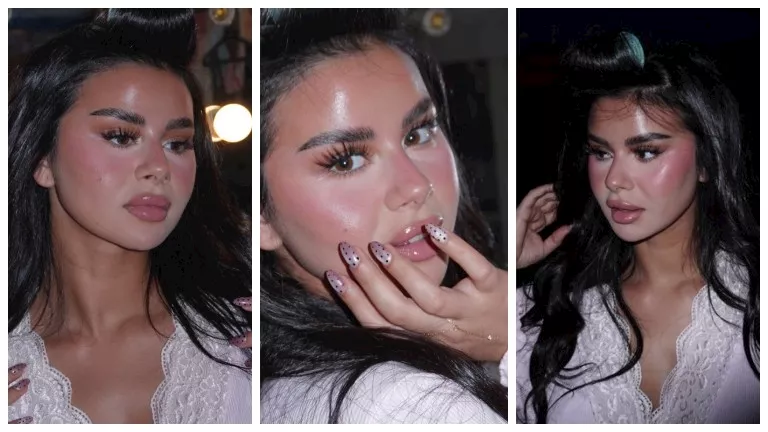
In the fast-paced world of digital celebrity, a single image can ignite a thousand conversations. For Menna Arafa, one of Egypt’s most recognizable faces since childhood, her recent birthday celebration became less about the milestone of turning 27 and more about the polarizing nature of public perception. A new series of promotional photographs, intended to mark her transition into a new year of life and career, instead sparked a heated debate across social media platforms regarding beauty standards, artistic expression, and the relentless scrutiny faced by women in the Middle Eastern spotlight.
The controversy centered on a specific aesthetic choice in the photo session, leading many followers to question the changes in her appearance. Comments ranging from admiration to confusion flooded her profiles, with some users explicitly asking why she had altered her look. This reaction is not an isolated incident for Arafa, but rather a symptom of the complex relationship between Egyptian stars and a public that has watched them grow up in real-time. For a performer who entered the industry as a child, the transition to adulthood is not merely a personal journey but a public negotiation.
As a journalist who has spent over a decade analyzing the intersection of performance and public image, I see this not as a simple case of “celebrity gossip,” but as a study in the evolution of the child star. Menna Arafa represents a specific generation of Egyptian talent that bridged the gap between traditional television stardom and the era of the influencer. Her trajectory offers a window into how the Egyptian entertainment industry manages its young prodigies and how those prodigies, in turn, attempt to reclaim their identities as adults.
The dialogue surrounding Arafa’s latest images highlights a recurring theme in contemporary celebrity culture: the “perfection trap.” When a star is known for a specific look—particularly one established during a period of perceived “innocence” as a child actor—any deviation from that image is often viewed by the public as a mistake or a loss of authenticity. In Arafa’s case, the birthday session was meant to signal maturity and sophistication, yet it triggered a protective, and sometimes critical, response from a fanbase that still views her through the lens of her early roles.
The Birthday Session That Ignited a Digital Debate
The images in question were released to coincide with Arafa’s 27th birthday, showcasing a bold, modern aesthetic. While the production value of the shoot was high, the focus of the conversation quickly shifted from the art to the artist’s face. The phrase “Why did you do this to your face?” became a recurring sentiment among critics, reflecting a broader societal tendency to police the physical transformations of female celebrities.
This reaction underscores the volatility of social media engagement. For every critical comment, there were supporters praising her bravery and her right to evolve her style. The tension between these two camps reveals a deeper cultural divide in Egypt regarding the boundaries of beauty and the expectations placed on public figures. The “controversy” is rarely about the makeup or the lighting; it is about the perceived defiance of a predetermined image.

For Arafa, navigating this feedback requires a thick skin and a strategic approach to public relations. In an era where Instagram and TikTok dictate the narrative, the distance between the star and the audience has vanished. The immediate, unfiltered nature of the feedback loop means that an actress cannot simply release a project; she must manage the emotional response of millions of people who feel a sense of “ownership” over her image because they have followed her since she was a young girl.
From Prodigy to Public Figure: The Evolution of Menna Arafa
To understand why a photo session can cause such a stir, one must look at the foundation of Menna Arafa’s career. Arafa did not simply enter the acting world; she was absorbed by it at an age when most children are barely beginning school. Her early work in Egyptian cinema and television established her as a child prodigy, capable of delivering emotional depth and professional precision that rivaled adult actors.
This early success provided her with a level of visibility that is rare for most performers. However, the “child star” label is a double-edged sword. While it ensures a loyal initial fanbase, it also creates a psychological anchor. The public often struggles to reconcile the image of the precocious child with the reality of the adult woman. This phenomenon is seen globally—from the United States to South Korea—but it takes on a specific cultural dimension in Egypt, where traditional values regarding femininity and modesty often clash with the demands of modern stardom.
Throughout her teenage years and into her twenties, Arafa has consistently pushed the boundaries of her public persona. Whether through her choice of roles or her social media presence, she has signaled a desire to be seen as an independent artist rather than a legacy act. Her career trajectory, as documented on platforms like IMDb, shows a steady progression through various genres, attempting to diversify her portfolio and move away from the “daughter” or “sister” roles that defined her youth.
Navigating the Complexities of the Modern Egyptian Spotlight
The scrutiny Menna Arafa faces is indicative of the broader challenges facing female artists in the MENA region. The transition from a “sweet” child image to a “bold” adult image is often fraught with risk. In many cases, the public interprets a change in style as a change in character or a rejection of cultural norms. This makes the act of simply changing a hairstyle or experimenting with makeup a political statement, whether the artist intends it to be or not.

the rise of the “influencer-actor” hybrid has changed the stakes. Arafa is not just an actress who appears in films; she is a brand. Her Instagram account, @mennaaarafaofficial, serves as a direct line of communication with her audience, bypassing the traditional filters of press releases and interviews. While this allows for greater authenticity, it also exposes her to a level of raw, unmediated criticism that can be overwhelming.
The “controversy” over her birthday photos is, a clash between two different versions of Menna Arafa: the one the public remembers and the one she is currently becoming. The struggle to bridge this gap is where most of the drama resides. When the audience asks “Why did you do this?”, they are often asking “Why are you changing?” The answer, of course, is that growth is the only alternative to stagnation.
The Broader Phenomenon of the Child Star Transition
The experience of Menna Arafa is a microcosm of a global pattern. The “Child Star Syndrome” is well-documented, involving the struggle to establish a self-identity separate from a professional persona created during childhood. When the professional persona is based on a specific look or a specific “type” of character, the physical transition to adulthood becomes a point of public contention.

In the Egyptian context, this is amplified by the speed of digital communication. In previous decades, a child star’s transition was managed through carefully timed movie roles and magazine covers. Today, it happens in real-time via Instagram Stories and live streams. There is no “gap” for the audience to adjust; the transition is an open book, and every page is subject to instant critique.
However, there is a positive side to this evolution. By leaning into the controversy and continuing to experiment with her image, Arafa is effectively training her audience to accept her as an adult. Each “controversial” photo session is a step toward breaking the old mold. By refusing to remain the child the public remembers, she is carving out a space for herself as a contemporary woman and a versatile artist.
Career Evolution: Menna Arafa’s Journey
| Phase | Public Perception | Key Characteristics | Primary Challenge |
|---|---|---|---|
| Child Stardom | The “Prodigy” | Innocence, precocious talent, family-friendly | Establishing professional boundaries |
| Adolescence | The “Growing Star” | Transitioning roles, increasing visibility | Managing the “innocence” expectation |
| Early Adulthood | The “Polarizing Figure” | Bold style, social media presence, independence | Overcoming the child-star archetype |
| Current Era (27+) | The “Modern Artist” | Experimental aesthetics, brand autonomy | Navigating digital scrutiny and beauty standards |
As we look forward, the conversation around Menna Arafa will likely continue to fluctuate between praise and criticism. This is the price of visibility in the digital age. However, the real story is not the makeup or the photos, but the resilience of an artist who has spent her entire life in the public eye and is still finding the courage to redefine herself on her own terms.
The next checkpoint for Arafa will likely be her upcoming projects for the next television season, where the public will see if her visual evolution is matched by a shift in the types of roles she accepts. Whether she chooses to embrace the “bold” persona or return to a more traditional image, she has already succeeded in one major area: ensuring that the world is watching.
What do you think about the pressure placed on child stars to maintain a certain image as they grow up? Does the public have a right to “critique” the evolution of a celebrity’s look, or is this simply a form of digital harassment? We invite you to share your thoughts in the comments below and share this analysis with others interested in the intersection of culture and celebrity.