
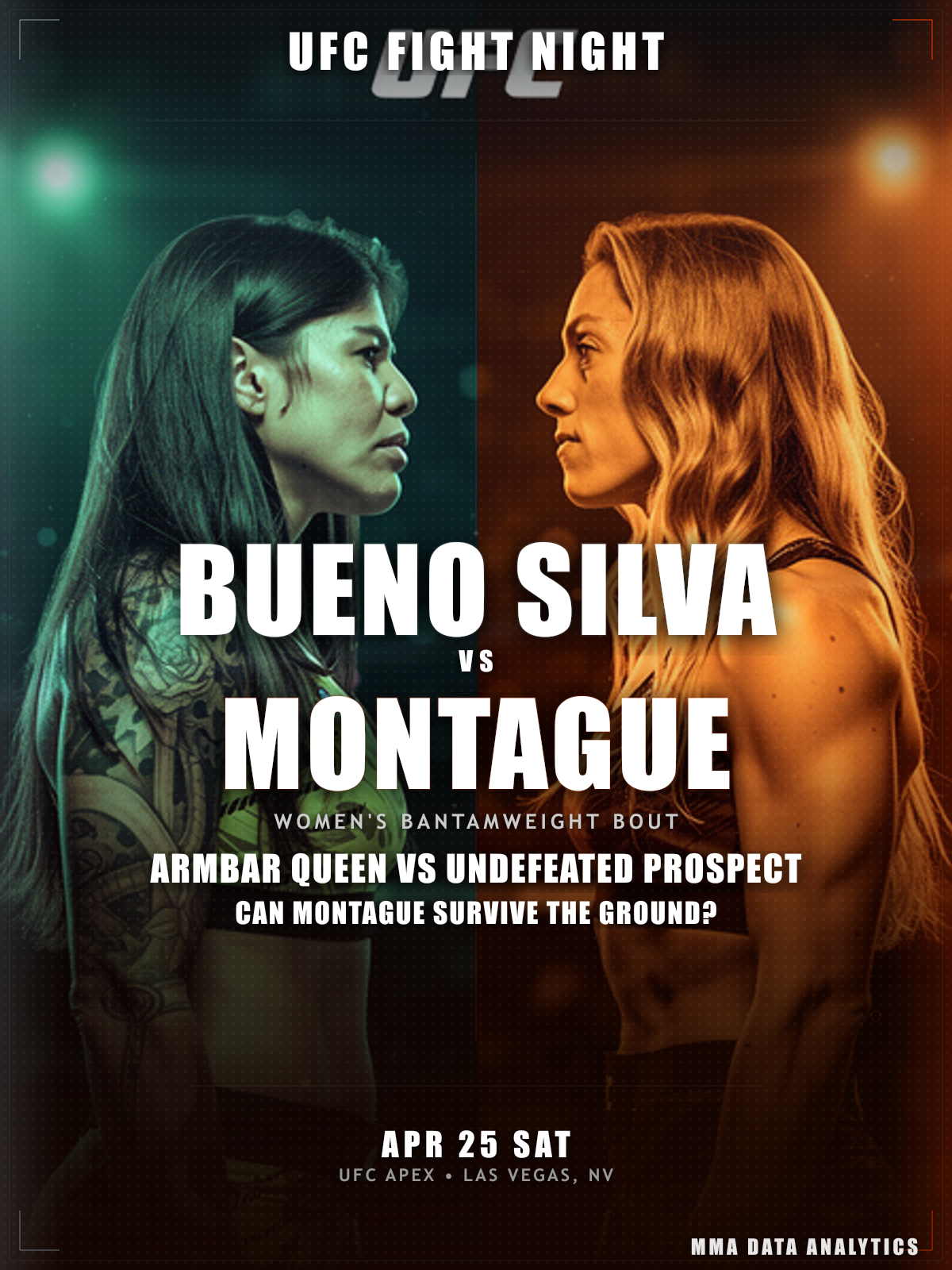
Michelle Montague has emerged as a rising force in the UFC women’s bantamweight division, capturing attention with her decisive victory over former title challenger Mayra Bueno Silva at UFC Vegas 116. The New Zealand-born athlete, competing under the moniker “The Kraken,” demonstrated the relentless drive that has defined her journey from regional circuits to the sport’s premier stage. Her performance not only secured a significant win but reignited discussions about her potential to climb the division’s rankings.
The bout, held on December 11, 2021, at the UFC Apex facility in Las Vegas, Nevada, marked a pivotal moment in Montague’s professional career. Facing Bueno Silva—a fighter who had previously challenged for the UFC women’s bantamweight title—Montague displayed superior striking accuracy and defensive awareness throughout the three-round contest. Judges scored the fight unanimously in her favor, with all three officials awarding her the decision by identical 29-28 margins.
Montague’s path to this victory reflects a trajectory built on consistent improvement and adaptability. Prior to joining the UFC roster, she compiled an impressive record in regional promotions across Oceania and Europe, notably capturing the Eternal MMA bantamweight championship. Her technical foundation in Muay Thai and Brazilian Jiu-Jitsu has evolved into a well-rounded skill set that allows her to dictate the pace of fights, whether standing or on the ground.
Breaking Down the Victory Over Mayra Bueno Silva
The tactical approach Montague employed against Bueno Silva centered on controlling distance and exploiting openings in her opponent’s defense. Early in the fight, she established her jab as a measuring tool, preventing Bueno Silva from closing the range effectively. This striking discipline forced the Brazilian veteran to commit to combinations that Montague could counter with precision straights and leg kicks.
Midway through the second round, Montague began mixing in body shots that visibly slowed Bueno Silva’s movement. This strategic shift created opportunities for her to land clean combinations to the head, particularly in the final minute of each round. While Bueno Silva demonstrated her trademark resilience and aggression, Montague’s ability to reset after exchanges and maintain composure under pressure proved decisive.
Statistical analysis from the bout reveals Montague landed 42 significant strikes compared to Bueno Silva’s 31, with a striking accuracy rate of 48% versus 35%. She also defended 80% of takedown attempts, neutralizing one of Bueno Silva’s primary paths to victory. These metrics underscored Montague’s effectiveness in implementing her game plan while limiting her opponent’s offensive output.
Rankings Implications and Divisional Context
Following the win, Montague positioned herself within striking distance of the UFC women’s bantamweight top 15. At the time of the victory, the division was led by champion Amanda Nunes, with contenders such as Julianna Peña, Holly Holm, and Ketlen Vieira occupying the upper echelons. Montague’s win over a ranked opponent like Bueno Silva—who was sitting at #9 in the official UFC rankings—provided a clear pathway for her own ascent.
The bantamweight division has experienced considerable flux in recent years, with injuries, suspensions, and shifting competitive dynamics creating openings for emerging talent. Montague’s performance against a veteran of Bueno Silva’s caliber signaled to matchmakers that she possesses the tools to compete at a higher level. Her next steps will likely depend on how the division evolves, particularly regarding title contention and the return of injured fighters.
What distinguishes Montague from many prospects is her mental approach to competition. In post-fight interviews, she has consistently emphasized preparation over outcome, describing her mindset as “far too motivated to fail”—a phrase that has turn into synonymous with her public persona. This philosophy extends beyond fight week, influencing her training regimen, recovery protocols, and long-term career planning.
Background and Fighting Philosophy
Born in Auckland, New Zealand, Montague began her martial arts journey in her teenage years, initially drawn to striking disciplines before gravitating toward mixed martial arts as a teenager. Her early career saw her compete in promotions such as Hex Fight Series in Australia and Shamrock FC in the United States, where she developed the resilience needed to navigate the sport’s physical and psychological demands.
Her fighting style reflects a blend of traditional Muay Thai techniques—particularly her use of teeps (push kicks) to manage distance—and modern MMA footwork that allows her to cut angles effectively. On the ground, she demonstrates patience in seeking improvements rather than rushing submissions, a trait that has prevented her from being caught in dangerous positions against higher-ranked grapplers.
Outside the cage, Montague has spoken openly about the challenges of being an international athlete competing far from home. She has credited her support network—including coaches, training partners, and family—for helping her maintain focus amid the pressures of professional sports. Her commitment to continuous learning is evident in her willingness to adapt her technique based on feedback from coaches and performance reviews.
The Road Ahead in UFC Competition
As of late 2021, Montague’s immediate future in the UFC hinged on how the bantamweight division’s landscape developed. With several high-profile matchups scheduled for early 2022—including potential title eliminators and veteran comebacks—the timing of her next fight would be critical. A victory over another ranked opponent could have propelled her into direct contention territory, while a loss might have required a recalibration of her trajectory.
The UFC’s matchmaking philosophy often rewards fighters who demonstrate both skill and marketability, and Montague’s combination of technical growth and compelling personal narrative has made her a candidate for increased visibility. Whether through main card placements, promotional features, or stylistically advantageous matchups, her progression will depend on sustaining the form shown against Bueno Silva while continuing to evolve her overall game.
For fans and analysts tracking the women’s bantamweight division, Montague represents a case study in how methodical improvement can yield results in one of MMA’s most competitive weight classes. Her journey underscores the importance of resilience in overcoming setbacks—she had previously faced adversity in her career, including a loss that prompted significant reassessment of her approach—and how those experiences can forge a more complete athlete.
As the division continues to evolve with new entrants and shifting hierarchies, Montague’s placement will ultimately be determined by her ability to deliver consistent performances against top-tier opposition. The win over Bueno Silva served not as an endpoint but as validation of a process that prioritizes long-term development over short-term accolades—a mindset that aligns with her enduring mantra of being “far too motivated to fail.”
To stay updated on Michelle Montague’s career and the latest developments in the UFC women’s bantamweight division, follow official UFC channels and reputable MMA news outlets for verified fight announcements, results, and athlete insights.