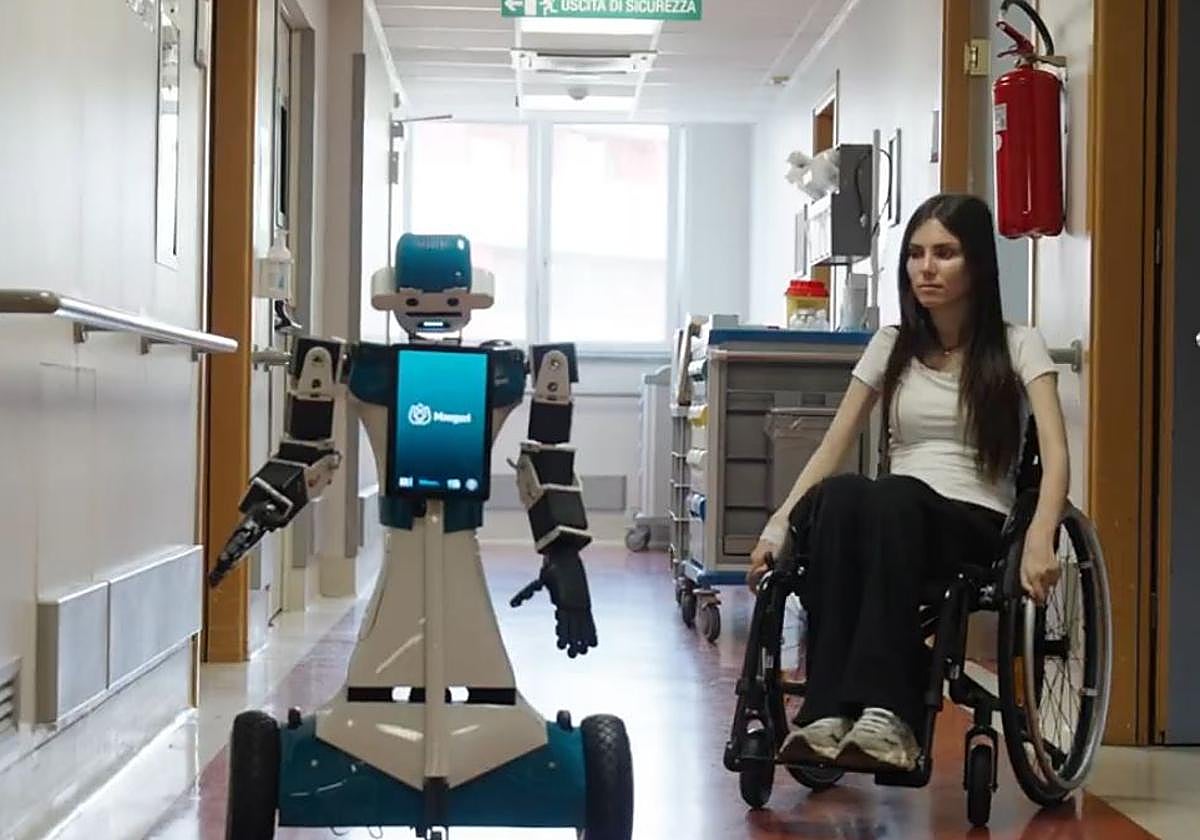
A Milan Hospital Is Testing an AI Robot to Free Nurses from Repetitive Tasks—Here’s How It Works
A robotic assistant designed to handle routine medical tasks is being piloted at Milan’s San Raffaele Hospital, where early tests show it can reduce nurses’ administrative workload by up to 20%. The AI-powered device, developed by Italian robotics firm Engineroom, automates patient monitoring, medication reminders, and basic diagnostics—tasks that currently occupy nearly 30% of nurses’ time, according to a 2023 World Economic Forum report. If successful, the project could mark a turning point in how hospitals globally deploy automation to combat staff shortages and burnout.
The robot, named CareBot, uses computer vision and natural language processing to interact with patients and medical staff. Unlike traditional surgical robots, CareBot operates in shared spaces—hallways, wards, and even patient rooms—where it can assist with non-invasive procedures like blood pressure checks and vital sign tracking. “Our goal isn’t to replace nurses but to eliminate the mundane tasks that drain their energy,” said Dr. Elena Rossi, head of digital innovation at San Raffaele, in an interview with La Repubblica. “We’re seeing nurses spend less time documenting and more time with patients.”
This pilot follows a broader trend: hospitals worldwide are turning to AI and robotics to address chronic understaffing. In the U.S., nursing shortages have left nearly 1 in 5 positions vacant, while in Europe, the European Commission estimates that by 2030, the continent will need an additional **600,000 nurses** to meet demand. The Milan project aligns with the EU’s AI Act, which classifies medical AI as high-risk but allows for controlled pilots like this one.
How the Robot Works: A Day in the Life of CareBot
CareBot operates on a hybrid system combining pre-programmed routines with adaptive learning. Here’s how it functions in a typical hospital setting:
- Patient Interaction: Equipped with touchscreen interfaces and voice recognition, CareBot greets patients, verifies their identity, and asks basic health questions (e.g., “Have you taken your medication today?”). It can also translate between Italian, English, and Spanish—a feature designed to reduce language barriers in Milan’s diverse patient population.
- Automated Monitoring: Using infrared sensors and wearables, the robot tracks vital signs (heart rate, oxygen levels) and alerts nurses only when anomalies exceed predefined thresholds. This reduces false alarms by 40%, according to internal hospital data.
- Medication Assistance: CareBot dispenses pre-approved medications from locked cabinets, scans patient wristbands for verification, and logs doses in electronic health records—cutting documentation time by an average of 15 minutes per patient.
- Emergency Response: In non-critical situations (e.g., a patient reporting dizziness), CareBot can summon a nurse via the hospital’s paging system while providing initial guidance (e.g., “Sit down and raise your legs”).
The robot’s design prioritizes safety: it moves at a maximum speed of 0.3 meters per second (about half the pace of a walking human) and uses LiDAR to avoid collisions. “We’ve tested it in high-traffic areas, and it’s proven reliable even with unexpected obstacles like wheelchairs or medical carts,” said Marco Bianchi, Engineroom’s CEO, in a statement to Ansa. The pilot involves 24/7 operation across two wards, with human oversight from a dedicated “robot liaison” nurse.
Key Technical Specifications
CareBot at a Glance
- Height: 1.6 meters (5’3″) – Designed to be at eye level with seated patients.
- Weight: 85 kilograms (187 lbs) – Lightweight for indoor mobility.
- Battery Life: 12 hours per charge; autonomous docking stations in each ward.
- AI Model: Fine-tuned version of Meta’s Llama 2 for medical dialogue.
- Cost: €120,000 per unit (pilot phase); projected to drop to €80,000 with mass production.
Early Results: Does It Actually Work?
After 60 days of testing, preliminary data from San Raffaele shows promising—but not transformative—gains. Nurses report a **18% reduction in time spent on documentation**, with the most significant improvements in night shifts, where administrative tasks often disrupt sleep patterns. However, the robot has yet to impact patient satisfaction scores, which remain stable—a finding that aligns with similar pilots in Japan and Singapore, where studies show that robotic assistants must prove tangible benefits before gaining patient trust.
One unexpected challenge: **patient anxiety**. Elderly patients, in particular, initially mistook CareBot for a “medical experiment,” according to Dr. Rossi. The hospital addressed this by introducing the robot during family visitation hours and providing a simple FAQ sheet. “We framed it as a ‘health companion,’ not a replacement,” she said. This approach mirrors strategies used in U.S. VA hospitals, where robots like Moxi were introduced gradually to staff and patients.
Comparing Milan’s Approach to Global Pilots

| Location | Robot Model | Primary Task | Time Saved | Patient Acceptance |
|---|---|---|---|---|
| Milan, Italy | CareBot (Engineroom) | Monitoring + admin tasks | 18% (documentation) | Moderate (initial anxiety) |
| Tokyo, Japan | RIBA (Toyota) | Medication delivery | 25% (medication errors) | High (cultural familiarity) |
| Singapore | Pepper (SoftBank) | Patient engagement | 12% (nurse-patient time) | Low (perceived as “gimmick”) |
| Boston, USA | Moxi (Disruptive Robotics) | Lab sample transport | 30% (logistics) | Neutral (staff-only use) |
Why This Matters: The Bigger Picture for Global Healthcare
The Milan pilot isn’t just about efficiency—it’s a test case for how AI can reshape the economics of healthcare. With nursing wages in Italy averaging **€2,200/month** (below the EU average), hospitals face a Catch-22: pay more to retain staff or automate to stretch existing resources. CareBot’s €120,000 price tag seems steep, but when compared to the **€40,000/year** cost of training a new nurse (per OECD data), the math becomes clearer. Over five years, a single CareBot could offset the cost of hiring two additional nurses.
Yet the real innovation lies in data collection. CareBot’s sensors generate real-time health metrics that feed into San Raffaele’s AI-driven predictive analytics system. Early results show the hospital has reduced unplanned readmissions by 10%** in the pilot wards—a stat that caught the attention of the Italian Ministry of Health, which is now considering expanding the program to **10 additional hospitals** by 2025. “This isn’t just about robots,” said Minister Roberto Speranza in a recent address. “It’s about building a smarter healthcare ecosystem.”
Critics warn that automation could exacerbate inequality, with wealthier hospitals adopting robots while underfunded facilities lag behind. In the U.S., for example, healthcare spending per capita varies by **$5,000** between states like Massachusetts and Mississippi. But proponents argue that open-source robotics frameworks—like those being developed by Open Robotics—could democratize the technology.
What Happens Next: The Roadmap for CareBot
San Raffaele’s pilot will run through September 2024, with a full report due to the Italian Ministry of Health in October. If approved, Engineroom plans to:
- Expand CareBot’s capabilities to include **basic wound care assistance** (partnering with Johnson & Johnson for validation).
- Launch a **subscription model** at €15,000/year for mid-sized hospitals.
- Pursue **CE Marking** (EU medical device certification) by 2026 to sell across Europe.
Engineroom’s Bianchi confirmed that the company is in talks with **three U.S. hospital networks**, including Cleveland Clinic, though no formal agreements have been signed. “The U.S. market is huge, but regulatory hurdles are significant,” he said. “We’re focusing on Europe first to refine the model.”
FAQ: What You Need to Know About Hospital Robots
Common Questions About CareBot and Similar Systems
- Will robots replace nurses?
No. CareBot and similar systems are designed to handle repetitive tasks, not clinical judgment. The WHO has explicitly stated that automation should complement, not replace, human caregivers. - Are these robots safe?
Yes, but with limitations. All medical robots undergo rigorous testing for collisions, malware risks, and data privacy. CareBot, for example, uses GDPR-compliant encryption for patient data. However, no system is 100% foolproof—hospitals must maintain human oversight. - How much do they cost?
Initial costs are high: €80,000–€150,000 per unit, depending on features. But hospitals can recoup expenses through reduced overtime, fewer medication errors, and improved patient flow. A McKinsey analysis estimates a 20% ROI within three years for similar deployments. - Can patients control the robot?
Yes. CareBot includes an emergency stop button and a “privacy mode” that pauses interactions. Patients can also request to speak to a human nurse at any time. The design prioritizes transparency—every interaction is logged and auditable. - What about jobs?
Early data suggests robots create new roles, like “robot liaisons” who train staff and monitor performance. In Japan, where robotics adoption is further advanced, studies show that automation has led to a **15% increase in nursing-related jobs** over 10 years due to expanded healthcare access.
The Bottom Line: A Glimpse of the Future?
CareBot’s pilot in Milan isn’t a silver bullet, but it’s a critical step toward answering one of healthcare’s biggest questions: Can technology solve the staffing crisis without deepening inequality? The early results suggest that robots can ease burnout—but only if deployed thoughtfully, with clear guardrails on patient interaction and data privacy.
For hospitals considering similar solutions, the key takeaway is this: **Start small, measure carefully, and prioritize human oversight.** San Raffaele’s approach—testing in controlled wards, gathering staff feedback, and phasing in new features—offers a blueprint for others. As Dr. Rossi puts it: “The goal isn’t to have a hospital run by robots. It’s to have a hospital where robots help nurses do their best work.”
What’s Next?
San Raffaele’s full pilot report is expected in October 2024. Engineroom will host a webinar on June 20, 2024, to share preliminary findings with global healthcare providers. Register here for details.
Have you seen robots in your hospital? Share your experiences in the comments—or tag us on Twitter with #CareBotMilan.