
Astronomers at Durham University have linked a cataclysmic head-on collision between the Milky Way and a dwarf galaxy known as the Gaia-Sausage-Enceladus to a dramatic “disc flip” that occurred approximately 10 billion years ago. This ancient impact fundamentally reshaped the galaxy, potentially reorienting its disc by more than 90 degrees.
The discovery, presented this week at the Royal Astronomical Society’s National Astronomy Meeting in Birmingham, offers a potential explanation for one of the most enduring mysteries regarding our galaxy: why the sparse stellar halo
of stars surrounding the Milky Way rotates at such a sluggish pace compared to the rest of the galactic structure.
Simulating the Gaia-Sausage-Enceladus Collision
Researchers utilized the Auriga suite of cosmological simulations to analyze the evolution of 25 Milky Way-like galaxies over billions of years. According to IFLScience, the team identified two primary factors that result in a slowly rotating stellar halo: the presence of substructures mirroring the Gaia-Sausage-Enceladus merger and the occurrence of a disc flip
in the galaxy’s past history.
The Gaia-Sausage-Enceladus dwarf galaxy, which contained gas, dark matter, and stars totaling more than 10 billion times the mass of the sun, collided with the Milky Way between 8 billion and 11 billion years ago. As Theguardian reported, the Milky Way tore the interloper to shreds,
absorbing its stars and leaving behind a distinctive pattern of motion that astronomers first identified in 2018 using data from the European Space Agency’s Gaia mission.
Kirill Batrakov, the lead researcher at Durham University, told IFLScience that the main question they were trying to answer was to identify the factors that define the magnitude of the rotation of stellar halos in Milky Way-like galaxies.
Defining the Galactic Disc Flip
The concept of a disc flip describes a scenario where a galaxy’s orientation changes by more than 90 degrees. While the process is dramatic, it is not instantaneous. Batrakov noted that such a transition is a relatively gradual tilt, It probably takes at least a few hundred million years,
he told Theguardian.
This reorientation has significant implications for our understanding of the galaxy’s history. As The Independent noted, the flip means that the majority of the Milky Way’s stars—including the Sun—have moved on trajectories that differ significantly from their current paths. The galaxy’s stable
spot may not have been quite as steady throughout the Solar System’s entire existence.
Mapping the Milky Way’s Archaeological Record
The study of these stellar movements serves as a form of galactic archaeology. By analyzing the orbits of stars that were not born in the Milky Way, researchers can reconstruct the violent events that shaped the galaxy. These migrant stars, characterized by their unusual orbits and lower concentrations of heavier elements, act as fossils of the merger.
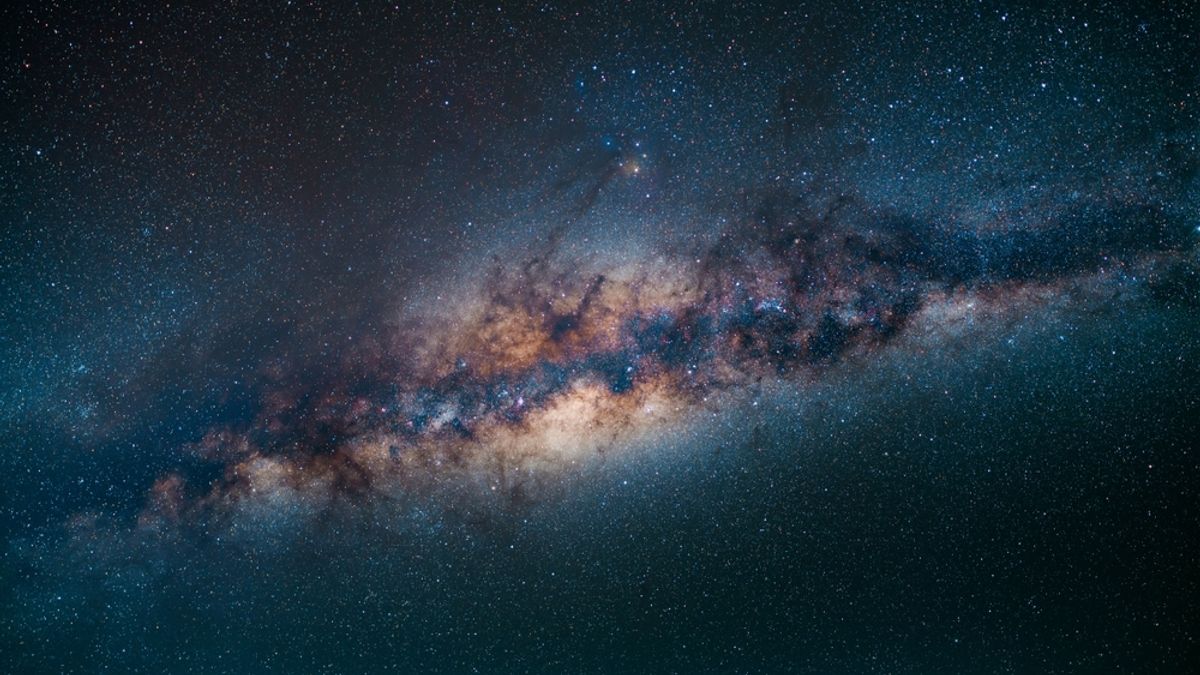
The researchers emphasize that this complex history is accessible through present-day observations, providing a new chapter in the story of how our galaxy evolved.
“Finding that its disc flipped adds a new chapter to that story, one we must account for when placing the Milky Way in a broader context of other galaxies. What excites me the most is that this complex history can be reconstructed just from present-day observations.”
Kirill Batrakov, lead researcher at Durham University
Future Galactic Upheavals
While the Gaia-Sausage-Enceladus event was the most significant in the early history of the Milky Way, the galaxy remains subject to external influences. A smaller merger is currently underway with the Sagittarius dwarf galaxy, though its impact is expected to be minimal compared to the ancient collision.