
Astronomers have uncovered evidence that the Milky Way experienced a catastrophic head-on collision with a dwarf galaxy known as the Gaia Sausage approximately 10 billion years ago. This massive impact likely caused our galaxy’s disc to flip by more than 90 degrees, fundamentally reshaping its structure and stellar orbits.
The discovery, presented this week at the Royal Astronomical Society’s National Astronomy Meeting in Birmingham, offers a new explanation for a long-standing mystery in galactic evolution: why the stars in the Milky Way’s halo rotate at a significantly slower speed than those in the main disc. Researchers from Durham University utilized advanced supercomputer simulations to model the history of galaxies similar to our own, revealing that such a dramatic reorientation is a likely consequence of a major, direct galactic hit.
The Gaia Sausage Collision and Galactic Evolution
The dwarf galaxy, formally recognized as Gaia-Sausage-Enceladus but frequently referred to as the Gaia Sausage, collided with the Milky Way about 10 to 11 billion years ago. The Milky Way absorbed the interloper, scattering its stars and gas, and effectively ripped the dwarf to shreds
in the process.
This collision left behind a distinct signature in the motion of stars. Data from the European Space Agency’s Gaia mission previously identified that many stars in the stellar halo move in long, narrow, radial orbits.
Simulating the Disc Flip
To understand how this merger influenced the galaxy’s physical orientation, the team at Durham University analyzed 25 Milky Way-like galaxies using the Auriga suite of cosmological simulations. Lead researcher Kirill Batrakov noted that the simulations were instrumental in reconstructing the complex history of our galaxy from present-day observations.
“Finding that its disc flipped adds a new chapter to that story, one we must account for when placing the Milky Way in a broader context of other galaxies. What excites me the most is that this complex history can be reconstructed just from present-day observations.”
Kirill Batrakov, lead researcher at Durham University
The simulations revealed that the slow rotation of the stellar halo—moving at roughly 25 kilometers per second—is a natural byproduct of a disc flip occurring during such a collision. While stars in the Milky Way’s disc travel at approximately 220 kilometers per second, the halo’s slower pace had previously puzzled scientists.
Implications for the Solar System’s Stability
The findings suggest that the environment of the early Milky Way was far more volatile than previously assumed. Because the disc flip changed the trajectories of most stars within the galaxy, researchers believe that even the Sun may have occupied a very different path before the collision occurred.
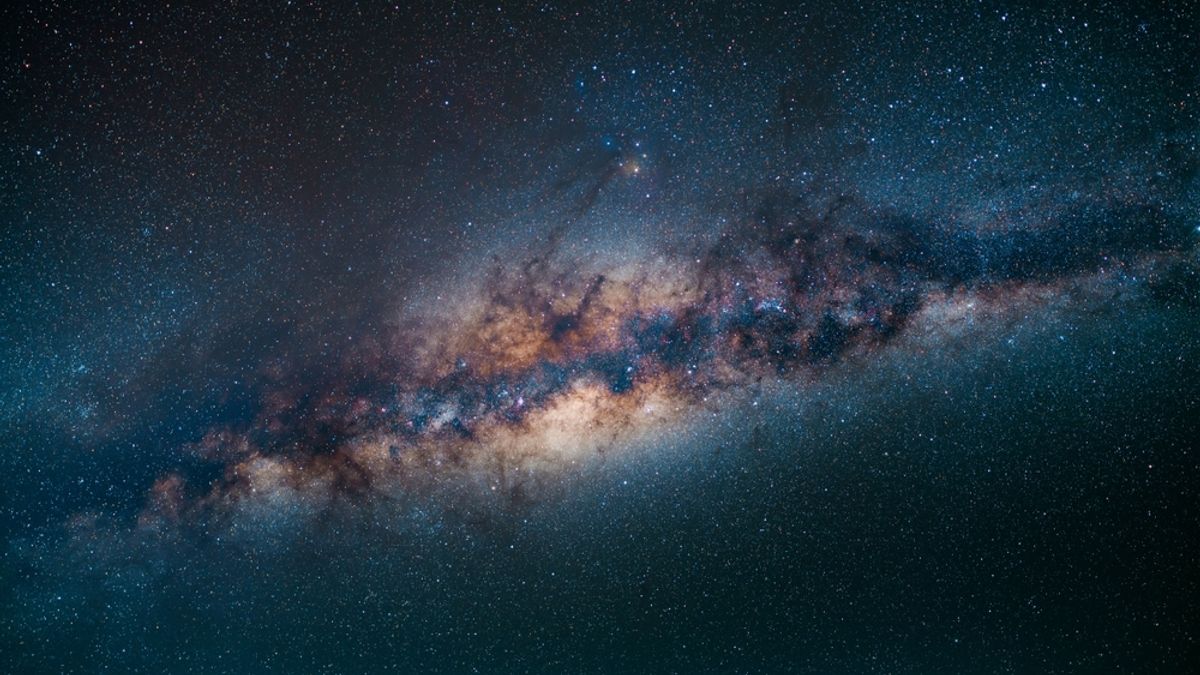
“A disc flip also means most of the Milky Way’s stars once moved on very different trajectories than they do today – possibly even our own Sun, meaning our ‘stable’ spot in the galaxy might not have been so stable for the Solar System’s whole lifetime.”
Kirill Batrakov, lead researcher at Durham University, via The Independent
While the galaxy has since stabilized, it continues to interact with other entities, such as the Sagittarius dwarf galaxy, though these current mergers are expected to have a significantly smaller impact than the Gaia Sausage encounter.
Future Galactic Interactions
Looking ahead, the Milky Way remains on course for further transformations.
The work of the Durham team, alongside broader efforts in galactic archaeology—such as those recognized by the 2026 Kavli Prize in Astrophysics—continues to refine our understanding of dark matter and galactic growth.
Related reading