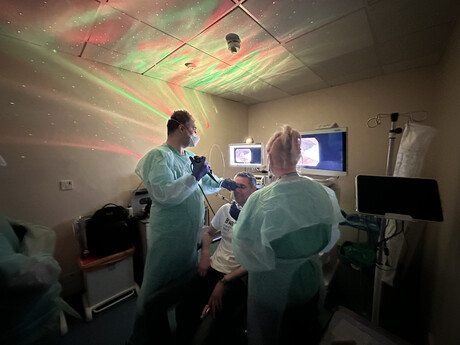
Mindfulness Offers a Calmer, More Effective Approach to Endoscopy
For many patients, the prospect of an endoscopy – a procedure to examine the digestive tract – evokes anxiety. Traditional methods often rely on sedation or general anesthesia, carrying inherent risks and logistical challenges. However, a growing body of research suggests a promising alternative: incorporating mindfulness techniques into the procedure. A recent study conducted in the UK demonstrates that mindful endoscopy not only enhances patient satisfaction but also potentially improves diagnostic accuracy and streamlines healthcare delivery. This innovative approach, combining advanced endoscopic technology with practices focused on breathwork, relaxation, and positive imagery, is gaining traction as a way to make this essential diagnostic tool more accessible and patient-centered.
The core principle behind mindful endoscopy is empowering patients to manage their physiological responses – specifically, the gag reflex and associated discomfort – through focused attention and acceptance. Researchers have found that this can allow for more thorough examinations in awake patients, potentially leading to earlier and more accurate cancer detection. The technique is particularly relevant given recent reports highlighting challenges in early cancer diagnosis within the National Health Service (NHS) in the United Kingdom. Improving early detection rates is a critical public health priority, and mindful endoscopy offers a potentially valuable tool in achieving this goal.
The study, published in the British Journal of Nursing, involved 231 patients undergoing endoscopy procedures with the support of a dedicated Mindful Endoscopy team. Remarkably, 92% of patients reported being “satisfied or very satisfied” with their experience – a significantly higher rate than previously reported for both sedated and conventionally awake endoscopy patients. This suggests that mindfulness can substantially improve the patient experience, reducing anxiety and discomfort associated with the procedure.
The Benefits of a Calm Approach: Improved Diagnostics and Efficiency
Traditionally, full examinations of the upper digestive tract – including the mouth, throat, voice box, esophagus, and stomach – have been challenging to perform on awake patients due to the natural gag reflex. This often necessitates sedation or general anesthesia, which carries risks such as respiratory depression and cardiovascular complications. These procedures require dedicated operating theatre space and specialized staffing, contributing to longer waiting lists and increased healthcare costs. Professor Reza Nouraei, Professor of Laryngology and Clinical Informatics at the University of Southampton and a consultant ENT Surgeon at the Loxley Centre for Airway, Voice and Swallowing at Queen’s Medical Centre, Nottingham, explains that mindful endoscopy circumvents these challenges.
“A patient with a hoarse voice, throat problem or difficulty swallowing can walk into the clinic, have a more thorough examination in less than 10 minutes than is possible in many cases under general anaesthesia, and walk out reassured,” Professor Nouraei stated. He emphasizes the “one-stop” nature of the approach, allowing for immediate diagnosis and, when necessary, biopsy collection, accelerating the path to treatment. This streamlined process has the potential to significantly reduce waiting times and free up valuable resources within the healthcare system.
The Mindful Endoscopy team at Queen’s Medical Centre in Nottingham developed a specific protocol involving a range of mindfulness practices. These techniques, including guided breathing exercises, relaxation techniques, positive imagery, and clear communication, aim to give patients a sense of control and regulate their emotional responses. According to Professor Nouraei, mindfulness has specific physiological effects, such as lowering heart rate and blood pressure, and can even help to dissipate the urge to cough or gag before it fully develops. The study revealed 12 cancer diagnoses – representing 5% of the patients examined – a rate considered typical for endoscopy screenings. Importantly, no cancers were missed at an average follow-up of 12 months.
Addressing the Challenges of Early Cancer Detection
The development of mindful endoscopy was partly driven by concerns about delayed cancer diagnoses. Researchers from the University of Southampton and Nottingham University Hospitals NHS Trust recognized that traditional approaches, although effective, could miss early-stage cancers hidden in the folds of the throat, particularly in patients without obvious symptoms. This represents a significant concern, as early detection is crucial for improving treatment outcomes and survival rates. A 2024 NHS investigation highlighted that, aside from lung cancer, the NHS has made limited progress in improving early cancer detection rates, underscoring the urgent demand for innovative diagnostic strategies. Nottingham University Hospitals NHS Trust is at the forefront of this innovation.
The ability to perform thorough examinations in an outpatient setting, without the need for sedation, has the potential to expand access to screening and diagnostic services, particularly in community diagnostic centres. This aligns with efforts to bring healthcare closer to home and reduce the burden on hospitals. The researchers believe that mindful endoscopy could be readily implemented in these settings, increasing capacity and reducing waiting times for patients.
Perioperative Mindfulness: Expanding the Scope of Application
The success of the Mindful Endoscopy team has led to the exploration of “perioperative mindfulness” – the application of mindfulness techniques throughout the entire surgical pathway, from pre-operative preparation to post-operative recovery. For the past 18 months, the team in Nottingham has been using this approach to support up to 22 patients with airway and voice problems during a single operating list. This has resulted in a significant increase in efficiency, allowing them to treat more patients per day compared to traditional methods requiring general anesthesia – increasing from six to seven patients to as many as 22.
Professor Nouraei believes that perioperative mindfulness has the potential to transform healthcare delivery, not only improving early cancer detection but also freeing up operating theatres and reducing waiting lists for a wide range of procedures. “We hope that this approach could be applied in different clinical settings, and across different procedures,” he stated. The team’s operate demonstrates the versatility of mindfulness as a tool for enhancing patient care and optimizing healthcare resource allocation.
Key Takeaways
- Enhanced Patient Experience: Mindfulness significantly increases patient satisfaction during endoscopy procedures, reducing anxiety and discomfort.
- Improved Diagnostic Accuracy: The technique allows for more thorough examinations in awake patients, potentially leading to earlier and more accurate cancer detection.
- Increased Efficiency: Mindful endoscopy can streamline healthcare delivery by reducing the need for sedation, freeing up operating theatre space, and shortening waiting lists.
- Potential for Wider Application: Perioperative mindfulness shows promise for improving outcomes and efficiency across a range of surgical procedures.
The research team is continuing to investigate the long-term benefits of mindful endoscopy and exploring its application to other diagnostic and therapeutic procedures. Further studies are planned to assess the cost-effectiveness of the approach and to identify the patient populations who are most likely to benefit. The next step involves disseminating these findings to healthcare professionals and implementing training programs to facilitate the widespread adoption of mindful endoscopy practices. Readers interested in learning more about mindfulness and its applications in healthcare are encouraged to share their thoughts and experiences in the comments below.
Related reading