
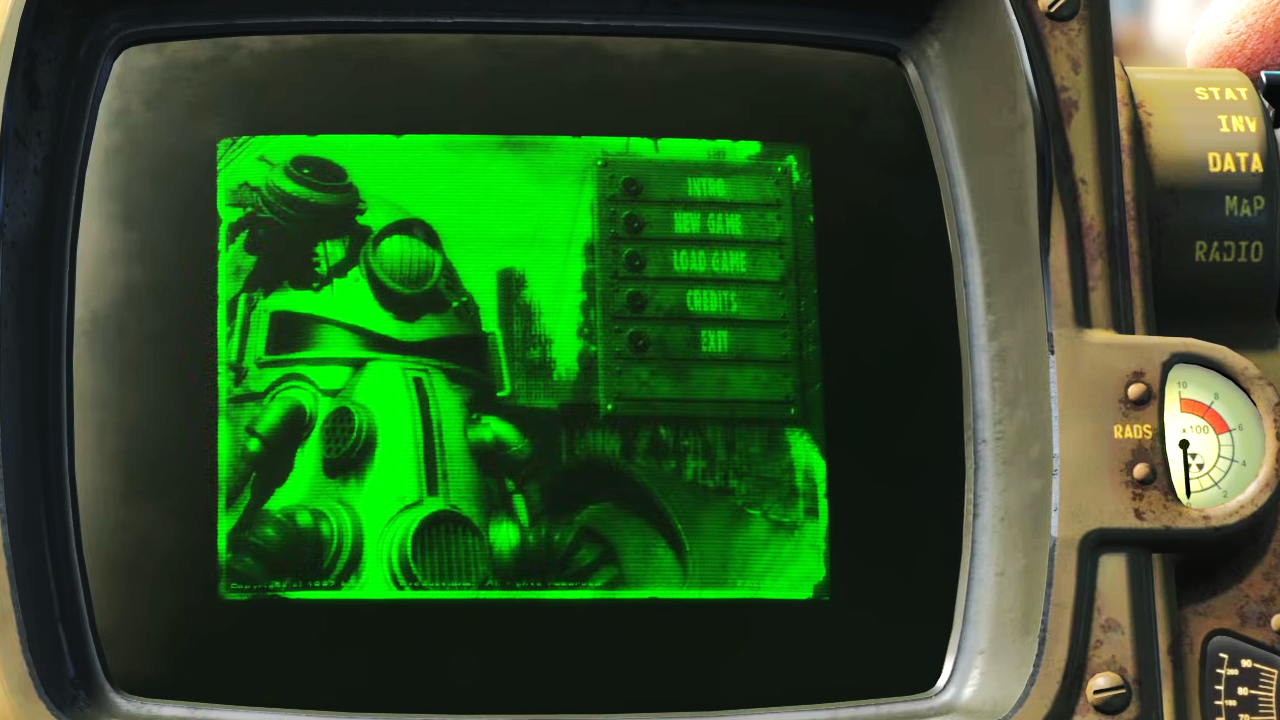
In the sprawling, radioactive wastes of the Commonwealth, the Pip-Boy is an essential tool for survival, managing everything from inventory to map data. However, for the community of dedicated modders who push the boundaries of what is possible within Bethesda’s engines, the wrist-mounted device has become something more: a fully functional gaming console.
Following a series of high-profile technical feats, modder RPGKing117 has revealed a new project that allows players to run the original Fallout 1 directly on the Pip-Boy and other in-game computer terminals within Fallout 4. This “game-within-a-game” achievement transforms the monochrome screens of the wasteland into portals to the series’ 1997 origins, allowing players to experience the isometric classic without ever leaving the 3D environment of the later sequel.
The project arrives on the heels of another ambitious release by RPGKing117, who recently achieved similar success by integrating The Elder Scrolls III: Morrowind into Fallout 4. While the Fallout 1 mod has not yet seen a full public release, a demonstration video has already circulated within the modding community, showcasing the original RPG running smoothly on the vacuum-tube displays of the Pip-Boy.
For many fans, What we have is more than just a technical curiosity. It represents the “frontier of absurdity” that defines the modern PC modding scene—a culture where the goal is often to see if a piece of software can be ported to the most unlikely hardware, whether that hardware is a real-world toaster or a fictional piece of in-game equipment.
The Technical Architecture: How a Game Lives Inside a Game
Achieving a functional “game-within-a-game” requires more than just a simple visual overlay. To make Fallout 1 playable on a Pip-Boy, RPGKing117 had to bridge the gap between two entirely different game engines and eras of software development. While the full technical breakdown is expected upon the project’s release on GitHub, the foundation likely mirrors the architecture used in the Morrowind project.
The core of this integration relies on the Fallout 4 Script Extender (F4SE). F4SE is a critical tool for advanced modders, as it expands the capabilities of the base game’s scripting language, allowing for complex interactions that the original developers did not envision. In this case, the Script Extender allows the player to launch an external application—the source port of the original game—from within the Fallout 4 environment while simultaneously passing control inputs (keyboard and mouse) through to both games.
However, simply running the game in the background isn’t enough; the visual output must be rendered onto the 3D model of the Pip-Boy screen. This is achieved through a process involving the “framebuffer.” The framebuffer is the region of memory that holds the data the GPU sends to the monitor. By using a custom version of a source port, the modder can stream this framebuffer data directly onto the in-game textures of the Pip-Boy or terminal screens in real-time.
For the Morrowind version of this mod, RPGKing117 utilized OpenMW, an open-source engine recreation of Morrowind. For the Fallout 1 project, it is widely believed that the modder utilized Alex Batalov’s Community Edition. Batalov’s work is a modern source port for the original Fallout games, designed to improve compatibility with modern operating systems and provide a cleaner codebase for other developers to build upon.
A Track Record of Modding ‘Blasphemy’
The Fallout 1 integration is the latest in a string of provocative and technically impressive releases from RPGKing117. The modding community often refers to these projects as “blasphemy” in a playful sense, as they frequently blend game mechanics and universes in ways that defy official design logic.
Before tackling the Pip-Boy projects, RPGKing117 gained attention for introducing Skyrim-style quest markers into Morrowind. For purists, Morrowind is celebrated for its lack of hand-holding, requiring players to rely on handwritten journal entries to find their way. Adding a glowing arrow that points directly to an objective is, by definition, a violation of the original game’s philosophy—yet the mod was praised for its utility and technical execution.
The subsequent leap to the Morrowind-in-Fallout 4 mod set a new precedent. By combining the OpenMW source port with the framebuffer streaming technique, RPGKing117 proved that complex, open-world RPGs could be rendered as interactive elements within another game’s world. The Fallout 1 project is the natural evolution of this logic, returning the series to its roots by literally placing the first game inside its descendant.
The Impact on the Modding Community
The “Doom on everything” phenomenon—where developers attempt to run the 1993 classic Doom on everything from pregnancy tests to digital thermostats—has long been the gold standard for technical eccentricity. However, RPGKing117’s work signals a shift toward more complex, narrative-driven classics. Porting a full-scale RPG like Fallout 1 or Morrowind requires managing much larger datasets and more complex input systems than a fast-paced shooter.
This trend highlights the growing importance of source ports. Without projects like OpenMW or Batalov’s Community Edition, these “absurd” mods would be nearly impossible. Source ports rewrite the original game’s engine in a modern language, allowing current hardware to interact with old code more efficiently. This not only enables “meta-gaming” experiments like the Pip-Boy mod but also ensures that these classic titles remain playable as operating systems evolve.
For the average player, the appeal lies in the immersion. The idea of sitting down at a terminal in a ruined vault and actually playing the game that started the franchise adds a layer of diegetic storytelling to the experience. It turns the Pip-Boy from a menu system into a piece of believable, multipurpose technology.
How to Access These Mods
Currently, the Fallout 1 Pip-Boy mod is in the demonstration phase. While the video proof is available, the files have not yet been pushed to a public repository. Based on previous releases, the mod is expected to be hosted on Nexus Mods and GitHub, providing both the compiled mod for users and the source code for other developers to study.
Players wishing to attempt similar setups should be aware that these mods typically require several dependencies to function:
- Fallout 4 Script Extender (F4SE): The essential foundation for any advanced Fallout 4 mod.
- A compatible source port: Such as OpenMW for Morrowind or the Community Edition for Fallout 1.
- The original game files: Most source ports require the original legal assets (textures, sounds, and maps) from the retail version of the game to function.
As the modding community awaits the official release of the Fallout 1 project, the conversation has already shifted toward what might come next. With the technical groundwork for framebuffer streaming now established, the possibility of other classics—perhaps The Elder Scrolls II: Daggerfall or even Fallout 2—appearing on the Pip-Boy is no longer a matter of “if,” but “when.”
The next confirmed checkpoint for this project is the public release of the source code and installation files on RPGKing117’s GitHub and Nexus pages. We will continue to monitor these repositories for the official launch date.
Do you think “game-within-a-game” mods enhance immersion, or are they just technical stunts? Let us know in the comments below and share this story with your fellow wasteland survivors.