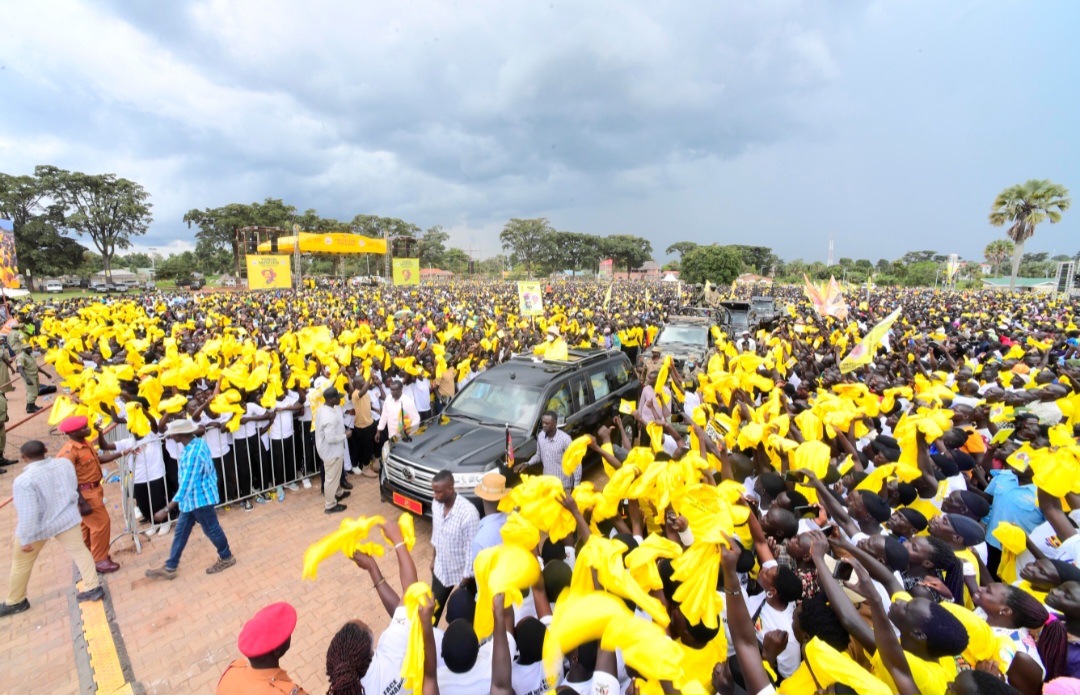
NRM Rally in Gulu Highlights Economic Progress and Regional Integration as key to Uganda’s Future
Gulu, Uganda – A recent rally in Gulu City underscored the ruling national Resistance Movement (NRM)’s commitment to sustained economic growth, regional integration, and improved social services in Northern Uganda. President Yoweri Museveni addressed a large gathering of supporters, outlining the party’s achievements and vision for propelling Uganda towards high middle-income status. The event, themed “Protecting the Gains, Making a Qualitative Leap into High Middle-Income Status,” showcased tangible progress in Gulu and the broader Acholi sub-region, demonstrating the impact of government initiatives on local communities.
A Thriving Private Sector & The Power of Regional Markets
President Museveni emphasized the crucial role of the private sector in Uganda’s economic advancement. He highlighted a significant statistic: “The private sector alone are now employing 1.3 million people, almost three times the number working for the government.” This underscores a strategic shift towards fostering a vibrant, self-sustaining economy driven by entrepreneurship and innovation.
Crucially, the President stressed the importance of regional integration as a cornerstone of economic stability and growth. He illustrated this point with a compelling example: Uganda’s maize production exceeding domestic consumption by a ample margin - 5 million tonnes produced versus 1 million tonnes consumed. “If we did not have the East African market, the maize industry would collapse,” he explained. This highlights how access to regional markets is not merely beneficial,but essential for the viability of key Ugandan industries,including milk,bananas,beer,and cement. The NRM’s continued emphasis on regional integration is therefore presented as a pragmatic strategy for economic resilience.
Gulu’s Conversion: A Local Success Story
The rally wasn’t just a platform for national policy pronouncements; it was a festivity of local achievements. gulu City NRM Chairperson, gifter Aber, delivered a powerful address detailing the positive changes witnessed in the region under NRM leadership.Her remarks painted a picture of a community experiencing tangible improvements in education, healthcare, infrastructure, and economic possibility.
Ms. Aber specifically highlighted:
* Empowerment of Women: Acknowledging the President’s commitment to providing opportunities for women in politics and leadership.
* Global Education: Celebrating the positive impact of the free education policy.
* Strengthened Party Structures: Recognizing the support provided to party organization at all levels.
* Improved Higher education Access: The establishment of Gulu University, a landmark achievement for higher education in Northern uganda.
* Specialized Healthcare: The opening of the Gulu Cancer Institute, eliminating the need for patients to travel long distances to Kampala for specialized treatment.
* Vocational Skills Development: The Presidential Skilling Hub, equipping young people with practical skills for employment.
* Modernized Trade: The construction of a modern market, revitalizing local commerce.
* Enhanced Public Services: Expansion of health centers and government schools.
Financial Inclusion & Targeted Development Programs
The impact of key government programs was also prominently featured. The Parish Development Model (PDM) is demonstrably reaching households in Gulu, with Shs 14.4 billion disbursed to 14,143 households in the district and Shs 9.8 billion benefiting 9,792 households in Gulu City.
Furthermore, the Emyooga SACCOs initiative is fostering entrepreneurship at the grassroots level. Across Gulu District and City, 54 SACCOs are supporting 41,576 members with Shs 2.1 billion in government funding, facilitating savings and business ventures. These figures demonstrate a concerted effort to empower communities financially and promote self-reliance.
Investing in Human Capital & Infrastructure
significant investments in education and healthcare are laying the foundation for long-term development. Gulu now boasts 47 government primary schools and 5 government secondary schools in the district, and 41 primary and 7 secondary schools in the city, all offering Universal Secondary education and post-ordinary level training.
Healthcare infrastructure has also seen substantial upgrades. Gulu Regional Referral Hospital is now equipped with critical services like an ICU,CT scan,X-ray,ultrasound,functional oxygen plants,and ambulances. Ongoing upgrades to district health centers are further expanding access to quality healthcare for local communities.
Enduring Development & Future Outlook
Ms. Aber concluded by emphasizing progress in environmental sustainability,with 87% of villages in Gulu District now having access to safe water and the implementation of small-scale
Keep reading