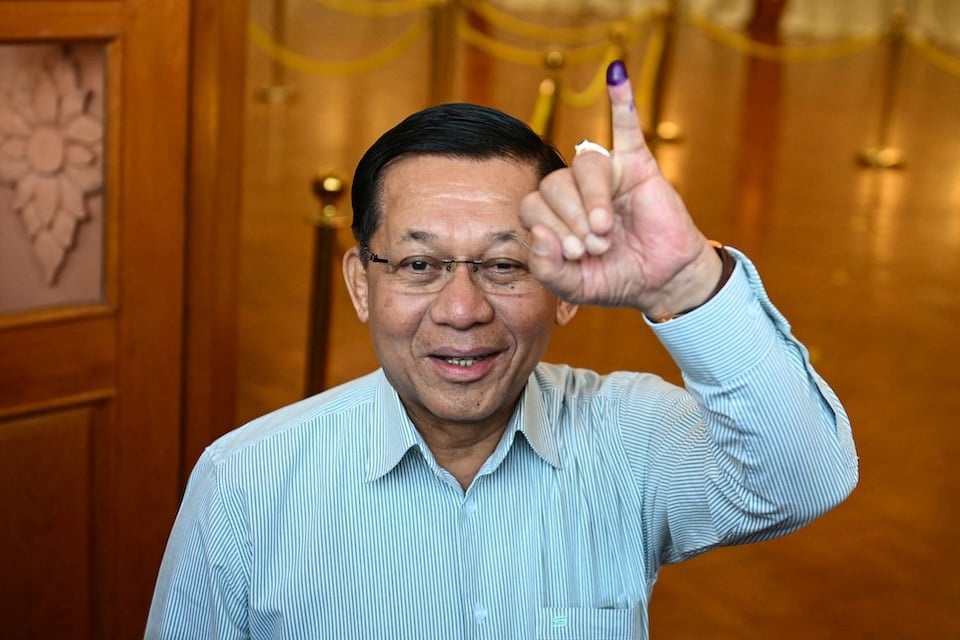
Naypyidaw, Myanmar – In a move widely condemned by international observers, Myanmar’s former junta leader, Min Aung Hlaing, has been elected president by a parliament dominated by his allies, five years after orchestrating a military coup that plunged the nation into turmoil. The election, held on Friday, April 3, 2026, formalizes his grip on power and casts further doubt on the prospect of a return to civilian rule.
The 69-year-old general secured 429 out of 584 votes cast by members of parliament, according to Aung Lin Dwe, the speaker of the combined upper and lower house as reported by Al Jazeera. This outcome was largely preordained, following December and January elections that were widely dismissed as a sham designed to legitimize military rule. Min Aung Hlaing had already stepped down as commander-in-chief of the armed forces, a constitutional requirement for assuming the presidency.
A Coup and a Promise Broken
Min Aung Hlaing seized power on February 1, 2021, ousting the democratically elected government of Aung San Suu Kyi and her National League for Democracy (NLD) party. At the time, he pledged to hold elections and restore civilian rule within a year. Still, that promise has now been fulfilled in a manner that critics argue fundamentally undermines the principles of democracy. The coup triggered widespread protests across Myanmar, which were met with brutal repression by the military, leading to a civil war that continues to rage today.
The parliamentary vote represents the culmination of a carefully orchestrated process designed to consolidate the military’s control. The Union Solidarity and Development Party (USDP), the military’s proxy party, won over 80 percent of the seats contested in the recent election according to reports. The constitution guarantees the armed forces a quarter of the parliamentary seats, ensuring a built-in majority for the military and its allies. This arrangement effectively transforms the parliament into a rubber stamp for the junta’s decisions.
A Civilian Façade?
While Min Aung Hlaing’s transition to the presidency is presented as a move towards civilian rule, many observers believe We see merely a cosmetic change. The BBC reports that this is “civilian rule in name only” . The newly elected parliament is composed almost entirely of loyalists, and the military continues to wield significant power through its guaranteed parliamentary seats and the appointment of hardliners to key positions. General Ye Win Oo, described as a hardliner with a reputation for brutality, has been appointed as the new commander-in-chief of the armed forces, replacing Min Aung Hlaing.
Min Aung Hlaing has established a new consultative council that will hold paramount authority over both civilian and military affairs, further cementing his control even as he relinquishes his military uniform. This council is designed to ensure that his influence remains undiminished, effectively bypassing any potential checks and balances from the civilian government.
Impact on the Ongoing Civil War
The elevation of Min Aung Hlaing to the presidency is unlikely to have a positive impact on the ongoing civil war in Myanmar. The conflict, which erupted in response to the 2021 coup, has pitted the military against a diverse array of armed resistance groups, including ethnic armed organizations and People’s Defence Forces (PDFs) formed by pro-democracy activists. The war has resulted in widespread displacement, human rights abuses, and a humanitarian crisis.

For many in Myanmar, particularly young activists like Kyaw Win (an alias), Min Aung Hlaing’s ascent to the presidency signifies the complete loss of hope for meaningful change. Kyaw Win, a student who was arrested and tortured for participating in a protest against the coup in 2022, represents the countless individuals who have suffered under military rule as detailed by the BBC. The continued grip of the military on power is expected to exacerbate the conflict and prolong the suffering of the Myanmar people.
International Condemnation
The international community has largely condemned Min Aung Hlaing’s election as president and the broader political process that led to it. Western governments have consistently criticized the military junta’s human rights abuses and called for a return to democracy. The recent elections have been widely dismissed as lacking legitimacy and failing to meet international standards.
The United States, the European Union, and other countries have imposed sanctions on Myanmar’s military leaders and entities linked to the regime. However, these sanctions have had limited impact on the junta’s behavior, and the military continues to consolidate its power. The international community faces a difficult challenge in finding effective ways to pressure the military to restore democracy and finish the violence.
What Happens Next?
The formation of a new government under President Min Aung Hlaing is expected in the coming weeks. This government will likely be dominated by military appointees and loyalists, further marginalizing pro-democracy voices. The civil war is expected to continue, and the humanitarian situation is likely to worsen. The BBC notes that for many in Myanmar, little will change despite the change in leadership .
The next key development to watch will be the composition of the new cabinet and the policies that the government adopts. The international community will be closely monitoring the situation in Myanmar and assessing whether there is any indication that the military is willing to engage in meaningful dialogue with pro-democracy forces. The future of Myanmar remains uncertain, but the election of Min Aung Hlaing as president has undoubtedly set the country on a dangerous path.
Key Takeaways:
- Min Aung Hlaing has been elected president of Myanmar by a parliament dominated by his allies.
- The election follows a 2021 military coup and is widely seen as a sham to legitimize military rule.
- The move is unlikely to lead to a resolution of the ongoing civil war or an improvement in the human rights situation.
- The international community has condemned the election and called for a return to democracy.
The situation in Myanmar remains fluid and deeply concerning. We will continue to provide updates as events unfold. Share your thoughts and perspectives in the comments below.
Keep reading