In a discovery that challenges long-held assumptions about the stability of the Earth’s crust, geologists have captured the first direct observation of a subduction zone actively breaking apart. Located off the coast of Vancouver Island in the Cascadia region, this geological phenomenon reveals a tectonic plate that is not merely sinking into the mantle, but is actively tearing.
The findings, detailed in a study led by Brandon Shuck, an assistant professor at Louisiana State University, were published in Science Advances
. By utilizing advanced seismic imaging and earthquake data, researchers identified a process where the oceanic crust is fragmenting, potentially creating microplates and altering the seismic risk profile for the Pacific Northwest. This tectonic plate rupture in the Northwest Pacific provides a rare, real-time glimpse into how the planet’s surface evolves and reconfigures itself over millions of years.
For residents of the Cascadia region, the news is a complex mixture of scientific breakthrough and renewed caution. Whereas the tearing of the plate is a natural process, the way these fractures develop can influence the magnitude and frequency of earthquakes. The research suggests that the plate is behaving less like a solid slab and more like a fragmented sheet, which may change how stress is distributed along the megathrust fault.
The Mechanics of a Breaking Planet
To understand the significance of this discovery, one must first understand the traditional model of subduction. In a standard subduction zone, one tectonic plate slides beneath another, diving deep into the Earth’s interior. Still, the research conducted by Shuck and his team indicates that in the northeast Pacific, this process is not uniform. Instead, they observed a strain-partitioned sliver
and a nascent megathrust at an incipient subduction zone reported in Science Advances.
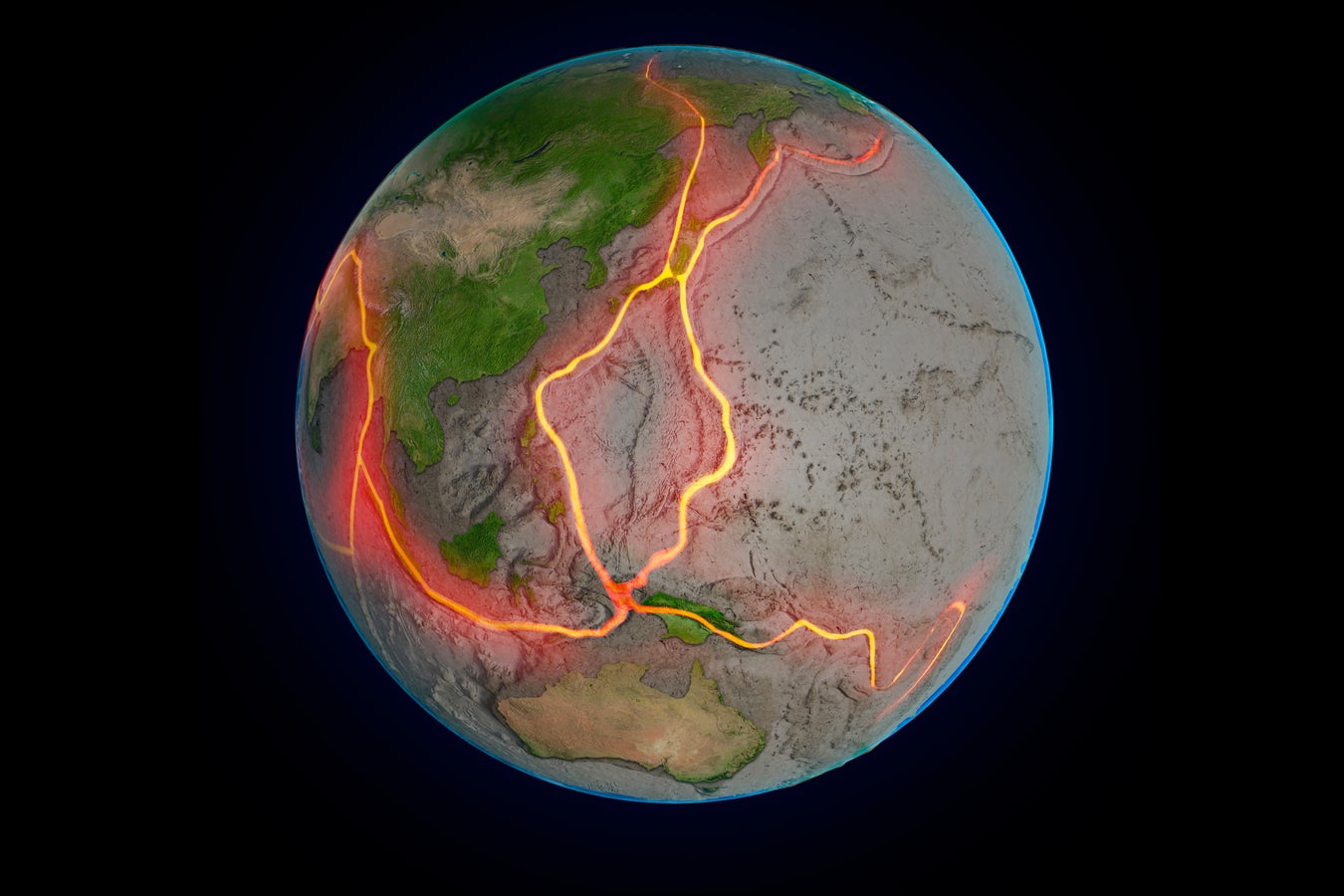
The “tearing” described by scientists occurs when the subducting plate cannot withstand the mechanical stress of its descent or the friction of the overriding plate. This results in the plate splitting, which can lead to the formation of smaller, independent tectonic fragments known as microplates. This fragmentation is a critical stage in the lifecycle of a subduction zone, often signaling the beginning of the end for that specific zone’s activity or the birth of a latest tectonic configuration.
The imaging techniques used in the study allowed scientists to observe the internal structure of the plate with unprecedented clarity. They found that the plate was not a monolithic block but was instead segmented. This segmentation means that the “grip” between the two plates is not consistent, creating “patches” of high and low friction. In the world of seismology, these patches are where the most dangerous energy builds up before being released in a massive earthquake.
Impact on Seismic Risk in the Cascadia Region
The Cascadia Subduction Zone (CSZ) is already known as a high-risk area, capable of producing “megathrust” earthquakes—events with a magnitude of 9.0 or higher—and devastating tsunamis. The discovery that the plate is actively fracturing adds a new layer of complexity to these risk assessments.
When a plate tears, it can create “rupture segments.” According to the research, the morphology of the subducting plate is directly linked to how earthquake ruptures are segmented as detailed in Science Advances. If the plate is broken into smaller pieces, it may limit the size of a single earthquake as the rupture cannot easily jump across a tear in the plate. Conversely, these tears can also create new points of instability that could trigger unexpected seismic events.
Geologists are particularly interested in how this tearing affects the “locking” of the fault. A locked fault is one where the plates are stuck together, accumulating elastic energy. When the lock finally breaks, the energy is released as an earthquake. The fracturing of the plate may change where these locks occur and how much energy they can store, making traditional predictive models less reliable.
What This Means for the Pacific Northwest
- Microplate Formation: The fragmentation process can lead to the creation of small plates that move independently, potentially causing smaller but more frequent earthquakes.
- Rupture Segmentation: The “tears” may act as barriers, potentially preventing a single earthquake from spanning the entire length of the Cascadia zone, though this remains a subject of active study.
- Tsunami Potential: The way the seafloor is displaced during a rupture—which is influenced by the plate’s structural integrity—determines the size and power of the resulting tsunami.
A Global Perspective on Tectonic Evolution
While the focus of the current study is on the waters off Canada and the U.S. Pacific Northwest, the implications are global. The ability to observe a subduction zone in the act of breaking apart provides a blueprint for understanding other “dying” or “nascent” subduction zones around the world.
Historically, scientists have had to infer the tearing of plates by looking at the “scars” left in the rock record—ancient volcanic chains or distorted sediment layers. The use of deep seismic imaging allows researchers to move from historical inference to direct observation. This shift is comparable to moving from studying fossils to watching a living organism evolve in real-time.
The research highlights that the Earth’s crust is far more dynamic than previously thought. The description of plates tearing like wet paper
underscores the fragility of the lithosphere when subjected to the immense forces of mantle convection and plate collision. This discovery suggests that the “reconfiguration” of the planet is not a slow, steady crawl, but a series of episodic, violent breaks, and shifts.
Key Takeaways for the Public
- Observation: Scientists have for the first time directly observed a tectonic plate breaking apart in the northeast Pacific.
- Location: The activity is centered off the coast of Vancouver Island in the Cascadia region.
- The Cause: The plate is experiencing mechanical failure (tearing) rather than just sinking.
- The Risk: This fragmentation may alter how earthquakes rupture and how stress is distributed, requiring a revision of seismic risk models.
- The Significance: This provides a new understanding of how microplates form and how subduction zones evolve.
Looking Ahead: The Next Steps in Monitoring
The scientific community is now tasked with determining whether this tearing is a localized event or part of a larger trend affecting the entire Cascadia Subduction Zone. The next phase of research will likely involve the deployment of more dense networks of ocean-bottom seismometers to track the movement of these newly identified fragments in real-time.
Government agencies and regional planners in British Columbia, Washington, and Oregon are expected to integrate these findings into their long-term hazard maps. While there is no immediate “deadline” for a seismic event, the refined understanding of plate segmentation will inform the engineering of infrastructure and the development of early warning systems.
As the Earth continues to shift beneath the Pacific, the goal for geologists is to move from observation to prediction. The discovery of the “breaking” plate is a critical step toward that goal, providing the missing piece of the puzzle regarding how the planet’s most dangerous faults actually function.
We want to hear from you. Does the prospect of a shifting tectonic landscape change how you view coastal development and safety? Share your thoughts in the comments below or share this article with your community to start the conversation.
Keep reading