
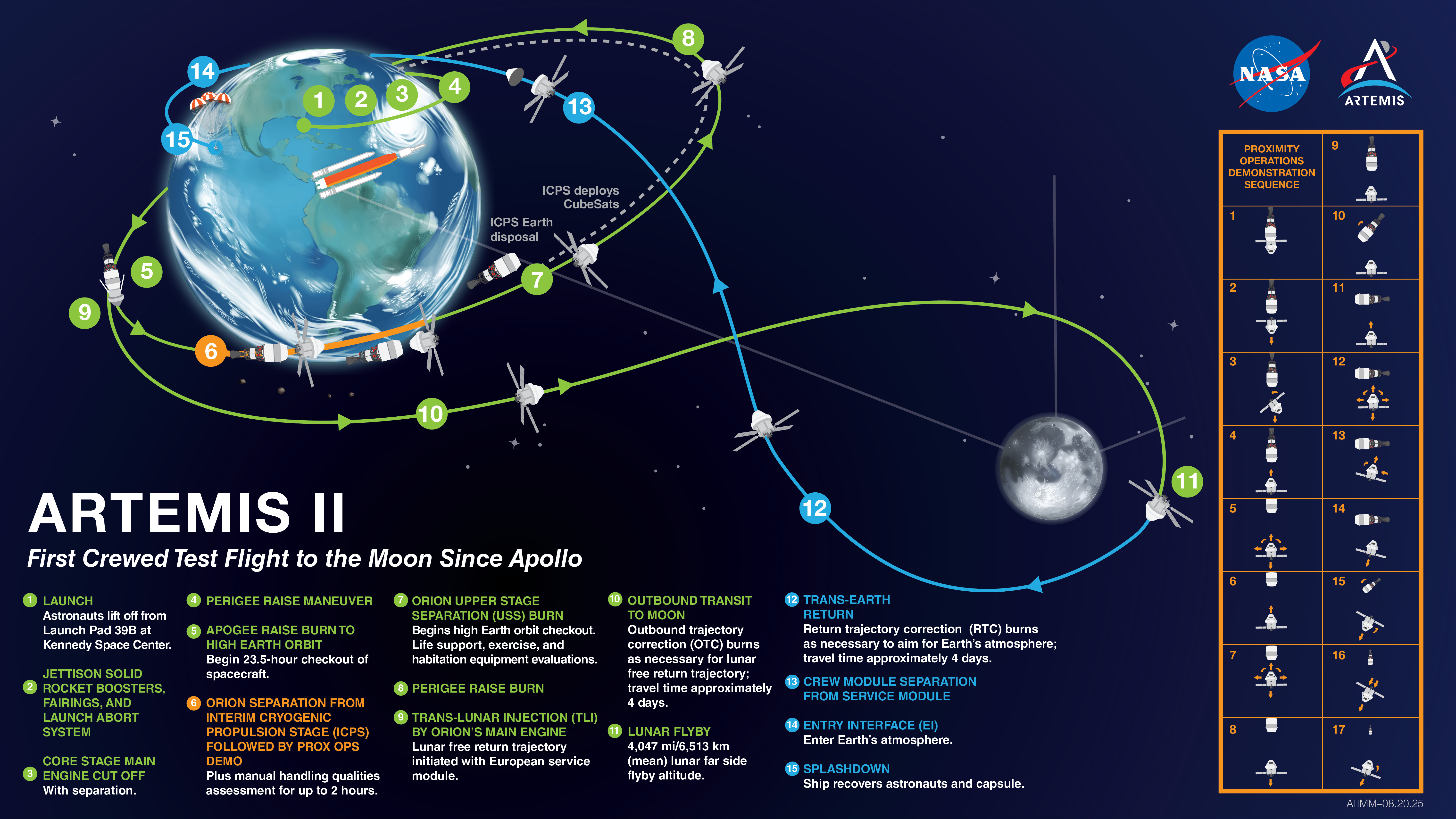
The horizon of human space exploration has expanded once again. After a historic journey that took them beyond the lunar far side, the crew of NASA’s Artemis II mission has returned to Earth, marking the first time in 50 years that humans have ventured back toward the Moon.
The mission, which served as a critical test of NASA’s deep space capabilities, concluded with a successful splashdown on April 10, 2026 NASA Artemis II Mission. The crew has since returned to Houston to reunite with their families and participate in post-flight briefings, providing the first firsthand accounts of the mission’s performance and the psychological experience of venturing into deep space.
Spanning a total duration of 9 days, 1 hour, and 32 minutes, the Artemis II lunar flyby was designed not to land on the lunar surface, but to rigorously test the systems required to sustain human life and ensure safe navigation in the void between Earth and the Moon NASA Artemis II Mission. By successfully completing this loop, NASA has cleared a primary hurdle in its long-term strategy to establish a sustainable human presence on the Moon and eventually send crews to Mars.
The Technical Backbone: Orion and the SLS
The success of the Artemis II mission relied on the synergy between two massive pieces of engineering: the Space Launch System (SLS) rocket and the Orion spacecraft. The SLS, NASA’s new heavy-lift rocket, provided the necessary departure energy, payload mass, and volume to propel the crew out of Earth’s orbit NASA Artemis II Mission.

Once in transit, the Orion spacecraft served as the primary exploration vehicle. Developed specifically for deep space, Orion is designed to carry and sustain astronauts throughout the lunar journey and protect them during the high-velocity re-entry into Earth’s atmosphere NASA Artemis II Mission. The mission’s timeline began with a launch on April 1, 2026, and culminated in the April 10 splashdown off the coast of California NASA Artemis II Mission.
Capturing the ‘Earthset’: Perspectives from the Lunar Far Side
Beyond the technical milestones, Artemis II delivered a profound visual record of our place in the solar system. As the crew journeyed around the far side of the Moon, they captured a series of extraordinary images, most notably a phenomenon known as an “Earthset.”
On April 6, 2026, at 6:41 p.m. Eastern Daylight Time, the Orion spacecraft passed behind the Moon’s far side, allowing the astronauts to photograph the Earth as it appeared to sink below the lunar horizon NASA Earth Observatory. This image, which echoes the iconic “Earthrise” photos from the Apollo 8 mission in 1968, showed a partially lit crescent Earth with visible blue water and white clouds over the Oceania region NASA Earth Observatory.
The seven-hour flyby of the lunar far side was a period of intense activity for the crew. In addition to the Earthset, the astronauts captured images of a total solar eclipse, the light from neighboring planets, and the stark contrast of the terminator line—the boundary where lunar day meets night NASA Earth Observatory. These images provide not only artistic value but critical data on the lunar surface’s overlapping craters and basins.
What Which means for the Future of Exploration
The primary objective of the Artemis II lunar flyby was to pave the way for future lunar surface missions. By testing the Orion spacecraft’s life-support systems and the SLS’s launch capabilities with a human crew on board, NASA has validated the architecture needed for the next phase of the Artemis program.
The mission’s success transforms the theoretical capabilities of the Artemis hardware into proven operational reality. The data gathered during the 10-day journey will be used to refine safety protocols and system efficiencies for the upcoming missions that intend to land astronauts on the lunar surface. This progression is a fundamental step in the broader goal of using the Moon as a proving ground for the eventual human exploration of Mars NASA Artemis II Mission.
Key Mission Milestones
| Event/Metric | Detail |
|---|---|
| Launch Date | April 1, 2026 NASA |
| Splashdown Date | April 10, 2026 NASA |
| Total Duration | 9 Days, 1 Hour, 32 Minutes NASA |
| Key Visual Event | Earthset captured April 6, 2026 NASA |
| Primary Hardware | SLS Rocket & Orion Spacecraft NASA |
As NASA processes the remaining imagery and telemetry from the flight, the focus now shifts toward the analysis of the crew’s health and the spacecraft’s performance during the high-stress phases of the mission, such as the final burn before splashdown and the re-entry process NASA Artemis II Mission.
The next confirmed checkpoint for the program is the NASA-hosted post-flight news conference, where the Artemis II crew will provide detailed insights into their journey and the systems they tested NASA Artemis II Mission.
Do you think the return to the Moon is the most important step toward reaching Mars? Share your thoughts in the comments below.