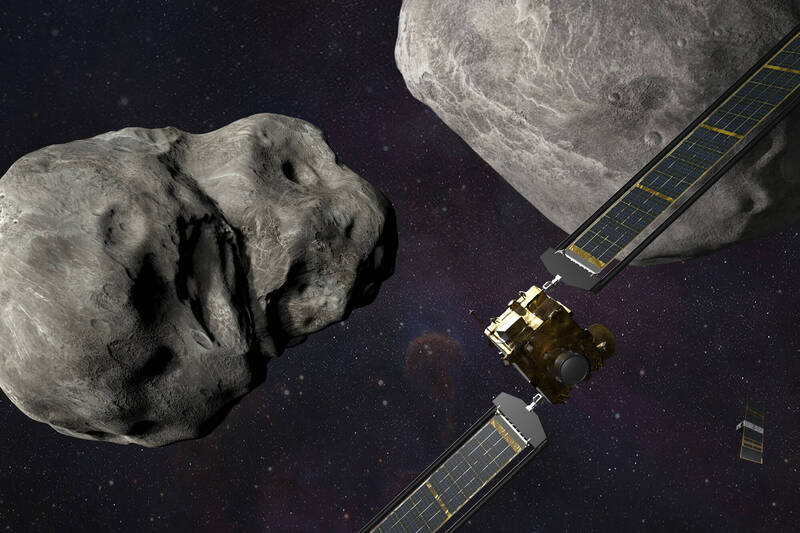
In a landmark achievement for planetary defense, NASA’s Double Asteroid Redirection Test (DART) mission has not only successfully altered the orbit of its target asteroid, Dimorphos, but has also measurably shifted the orbit of the entire binary asteroid system around the Sun. The findings, published recently in the journal Science Advances, demonstrate the viability of “kinetic impact” as a method for potentially mitigating future asteroid threats to Earth.
The DART mission, completed in September 2022, intentionally collided a spacecraft with Dimorphos, a smaller moon orbiting the larger asteroid Didymos. The initial results confirmed a change in Dimorphos’ orbital period. However, new research reveals a far more significant outcome: the entire Didymos-Dimorphos system now follows a slightly altered path around the Sun. This marks the first time humanity has demonstrably influenced the orbit of a celestial body.
Understanding the DART Mission and its Objectives
The DART mission was conceived as a test of a potential method for deflecting asteroids that might pose a future impact risk to Earth. Rather than destroying an asteroid – a potentially messy and unpredictable outcome – the goal was to subtly alter its trajectory through a precisely calculated collision. The Didymos-Dimorphos system was chosen as an ideal testing ground because it doesn’t currently pose a threat to our planet, and the change in orbit would be measurable. Didymos is approximately 775 meters (2,543 feet) in diameter, while Dimorphos is significantly smaller, at roughly 160 meters (525 feet) across.
As explained by NASA, the two asteroids orbit each other around a common “barycenter” – a point representing the center of mass of the system. It’s the movement of this barycenter that dictates the overall orbital path around the Sun. The DART impact altered the momentum of the system, resulting in a measurable change to this orbital path.
Measurable Changes to the Asteroid System’s Orbit
The research, led by planetary defense scientist Rahil Mardia from the University of Illinois, details the subtle but significant changes observed after the impact. According to a report in the Wall Street Journal, the system’s orbital period around the Sun has changed by approximately 0.15 seconds, and its velocity has shifted by about 11.7 micrometers per second. While seemingly minuscule, these changes accumulate over time, resulting in a noticeable shift in the system’s position.
“This is the first time humanity has created a measurable impact on the orbit of a celestial body around the Sun,” NASA stated in a press release. The success of the DART mission provides crucial data for refining models and strategies for planetary defense. The ability to predict and calculate the effects of a kinetic impact is paramount to effectively mitigating any future asteroid threats.
How the Impact Was Measured and Analyzed
Measuring the impact’s effect required meticulous observation and analysis. Prior to the collision, the orbital characteristics of the Didymos-Dimorphos system were carefully documented. Following the impact, astronomers used ground-based telescopes and data from the Hubble Space Telescope to track the system’s new orbital path. The subtle changes were then analyzed using sophisticated modeling techniques.
The DART spacecraft also deployed a small Italian-made satellite called LICIACube (Light Italian CubeSat for Imaging of Asteroids) prior to impact. LICIACube captured images and data during the collision, providing valuable insights into the impact process and the resulting debris field. This data is still being analyzed by scientists.
Beyond Dimorphos: Implications for Planetary Defense
The success of the DART mission has significant implications for the future of planetary defense. While no known asteroids currently pose an immediate threat to Earth, the possibility of a future impact remains a concern. Larger asteroids, while less frequent, could cause catastrophic damage. The DART mission demonstrates that kinetic impact is a viable technique for altering the trajectory of a potentially hazardous asteroid.
The initial results from DART showed the impact altered Dimorphos’ orbital period by 32 minutes, shortening it from 11 hours and 55 minutes to 11 hours and 23 minutes – a change exceeding initial expectations by 10 minutes. Scientists had predicted a minimum orbital period reduction of 10 minutes for the mission to be considered a success, and even a change of 73 seconds would have been deemed positive.
What is a Kinetic Impactor?
A kinetic impactor is a spacecraft designed to alter the trajectory of an asteroid by colliding with it. The force of the impact transfers momentum to the asteroid, causing a slight change in its velocity and direction. This seemingly small change, accumulated over time, can be enough to steer the asteroid away from a collision course with Earth. The DART mission was the first full-scale demonstration of this technology.
Future Missions and Continued Research
NASA is planning future missions to further refine our understanding of asteroid composition and behavior. The Hera mission, led by the European Space Agency (ESA), is scheduled to launch in 2024 and will arrive at the Didymos system in late 2026. Hera will conduct a detailed post-impact analysis of Dimorphos and Didymos, providing valuable data to improve planetary defense strategies.
Researchers will continue to monitor the Didymos-Dimorphos system to track the long-term effects of the DART impact. This ongoing observation will help refine models and improve our ability to predict the outcome of future kinetic impact missions. The data gathered from DART and Hera will be crucial for developing a comprehensive planetary defense system capable of protecting Earth from potential asteroid threats.
The DART mission represents a pivotal moment in humanity’s efforts to safeguard our planet. By demonstrating the feasibility of altering an asteroid’s orbit, NASA has taken a significant step towards developing a robust and effective planetary defense strategy. The success of this mission offers a beacon of hope, assuring us that we are not powerless in the face of potential cosmic dangers.
The next major milestone in this field will be the arrival of the ESA’s Hera mission at the Didymos system in 2026, promising even more detailed insights into the aftermath of the DART impact. Stay tuned to World Today Journal for continued coverage of this evolving story.
What are your thoughts on the DART mission and the future of planetary defense? Share your comments below!