
NASA’s Europa Clipper Mission: The Search for Life Beneath Jupiter’s Icy Moon
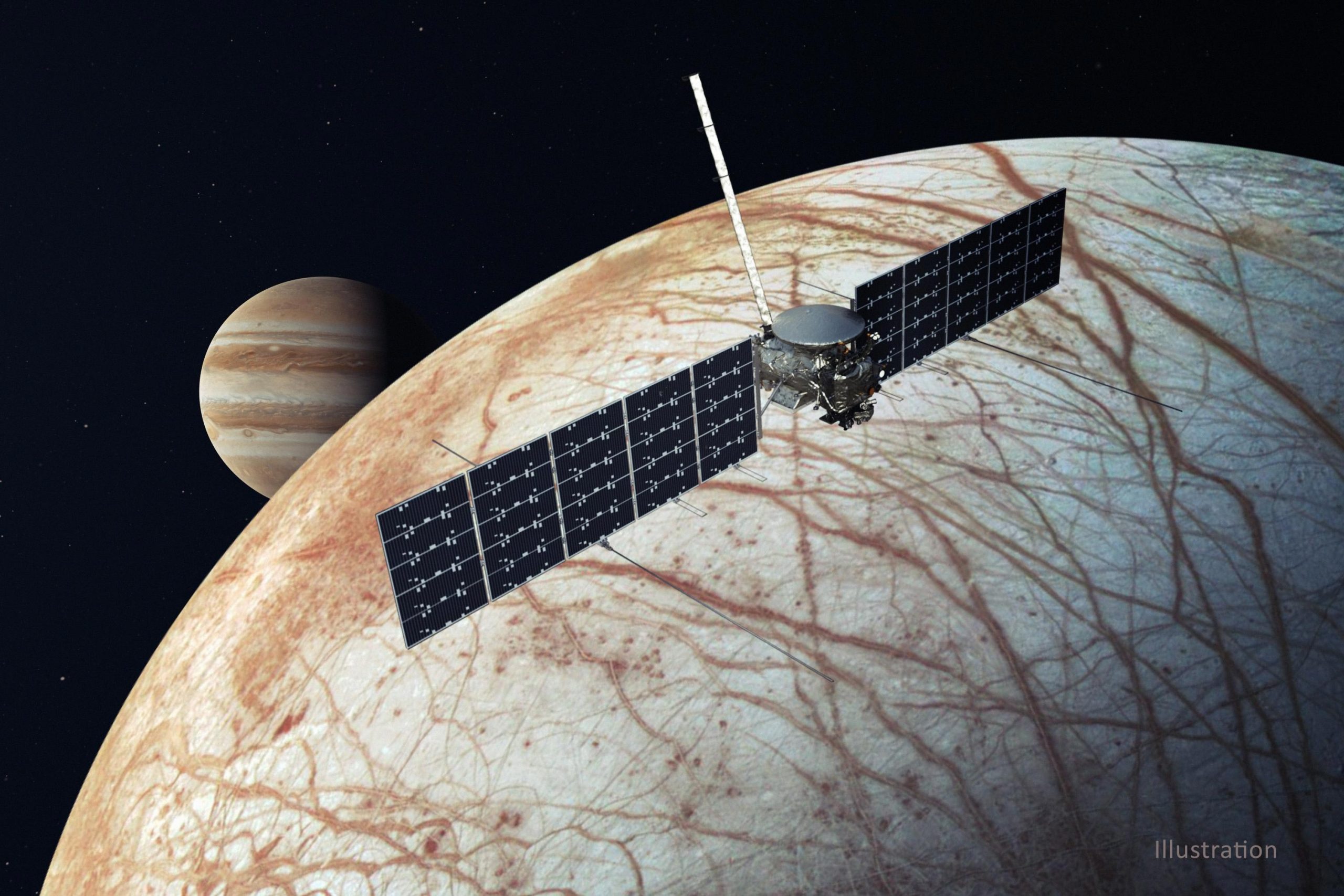
NASA’s Europa Clipper mission, set to launch in October 2024, will explore Jupiter’s moon Europa—a world with a hidden ocean beneath its icy crust—using advanced instruments to search for signs of habitability and potential extraterrestrial life. The $4.25 billion mission, the most ambitious in NASA’s planetary science program, marks a pivotal step in understanding whether life exists beyond Earth.
Europa, one of Jupiter’s four Galilean moons, has long captivated scientists due to its subsurface ocean, which contains more than twice the volume of Earth’s oceans. New data from NASA’s Hubble Space Telescope and the Galileo mission suggests the presence of water vapor plumes erupting from its surface, raising the possibility of liquid water interacting with the moon’s rocky interior—an environment that could support microbial life.
Europa Clipper will carry nine scientific instruments, including high-resolution cameras, ice-penetrating radar, and spectrometers, to analyze the moon’s composition, geology, and potential habitability. The mission’s findings could redefine our understanding of life in the universe.
Key Takeaways
- Launch Date: October 2024 (delayed from 2023 due to technical challenges)
- Budget: $4.25 billion, funded by NASA’s Planetary Science Division
- Mission Duration: 3.5 years, including a five-year journey to Jupiter
- Scientific Goals: Determine Europa’s habitability, study its ocean, and search for biosignatures
- Instruments: Nine advanced tools, including radar, spectrometers, and high-resolution cameras
- Orbit: Europa Clipper will perform 49 close flybys, coming as close as 16 miles (25 km) to the moon’s surface
Why Europa? The Case for a Subsurface Ocean
Europa’s subsurface ocean is one of the most promising locations in the solar system for finding extraterrestrial life. According to NASA’s 2012 findings, Europa’s icy shell is estimated to be 10 to 15 miles (15 to 25 km) thick, with a global ocean beneath it. This ocean is kept liquid by tidal heating—gravitational forces from Jupiter and its other moons flexing and warming Europa’s interior.

In 2013, NASA’s Hubble Space Telescope detected water vapor plumes erupting from Europa’s surface, suggesting that liquid water may be reaching the moon’s exterior. These findings were later supported by studies published in Nature Astronomy, which analyzed data from the Galileo mission and confirmed the presence of persistent water vapor activity.
“If there’s life in that ocean, it would almost certainly be microbial,” said Robert Pappalardo, Europa Clipper project scientist at NASA’s Jet Propulsion Laboratory (JPL). “But even if we don’t find life, understanding Europa’s ocean and its potential habitability will tell us a lot about how life might arise on other worlds.”
Mission Timeline: From Launch to Jupiter’s Orbit
Europa Clipper’s journey will be a marathon, not a sprint. After launching from NASA’s Kennedy Space Center in Florida, the spacecraft will take five years to reach Jupiter, arriving in April 2030. Once there, it will enter an elliptical orbit around Jupiter, allowing it to perform 49 close flybys of Europa over the course of 3.5 years.
The mission’s trajectory is carefully planned to minimize radiation exposure—Jupiter’s magnetic field is one of the most intense in the solar system, posing risks to sensitive electronics. Europa Clipper will use Jupiter’s gravity to slingshot itself into a stable orbit, ensuring it can conduct its science without being damaged.
“The trajectory is designed to be as efficient as possible,” said Jordan Evans, Europa Clipper project manager at JPL. “We’re balancing fuel efficiency with the need to get close enough to Europa to gather the best data.”
Nine Instruments, One Goal: Finding Habitability
Europa Clipper’s payload includes nine cutting-edge instruments, each designed to answer a specific question about Europa’s potential to host life. Here’s how they work:
- Europa Imaging System (EIS): A high-resolution camera suite to map Europa’s surface in detail, identifying features like ridges, cracks, and potential plume sites.
- Thermal Emission Imaging System (THEMIS): Measures Europa’s surface temperatures to detect recent geological activity, such as water eruptions.
- Mapping Imaging Spectrometer for Europa (MISE): Analyzes Europa’s surface composition, searching for organic molecules and salts that could indicate past or present habitability.
- Radar for Europa Assessment and Sounding: Ocean to Near-surface (REASON): A radar instrument that will penetrate Europa’s icy shell to measure its thickness and search for subsurface lakes or oceans.
- Plasma Instrument for Magnetic Sounding (PIMS): Studies Jupiter’s magnetic field interactions with Europa to determine the depth and salinity of its ocean.
- Interior Characterization of Europa using Magnetometry (ICEMAG): Measures Europa’s magnetic field to study its ocean’s conductivity and composition.
- Ultraviolet Spectrograph/Europa (UVS): Observes Europa’s atmosphere and surface to detect water vapor and other gases.
- SUrface Dust Mass Analyzer (SUDA): Analyzes dust particles ejected from Europa’s surface, searching for signs of organic material.
- Europa Clipper Magnetometer (ECM): Measures Jupiter’s magnetic field and its interactions with Europa to study the moon’s interior structure.
“Each instrument was selected because it answers a critical question about Europa’s habitability,” said Dr. Curt Niebur, Europa program scientist at NASA Headquarters. “We’re not just looking for water—we’re looking for the ingredients of life.”
What Happens Next? The Road to Launch and Beyond
Europa Clipper’s development has faced delays, with its original launch date pushed back from 2023 to October 2024 due to technical challenges, including issues with the spacecraft’s propulsion system and software testing. NASA has since resolved these issues, and the mission is on track for its new launch window.
Once in orbit around Jupiter, Europa Clipper will begin its science phase in 2031, with the first close flyby expected in April 2032. The mission’s data will be transmitted back to Earth, where scientists will analyze it for signs of habitability, including:
- The presence of liquid water beneath Europa’s icy shell
- Evidence of organic molecules or chemical energy sources
- Geological activity that could sustain life
- Signs of water vapor plumes or other atmospheric activity
“This mission is about more than just finding water,” said Dr. Kevin Hand, a planetary scientist at JPL. “It’s about understanding whether the conditions for life exist beyond Earth—and if they do, what that means for the possibility of life elsewhere in the universe.”
Beyond Europa: What This Means for the Search for Extraterrestrial Life
Europa Clipper is not just a mission to Jupiter’s moon—it’s a stepping stone in humanity’s search for life beyond Earth. If the mission confirms that Europa’s ocean is habitable, it could pave the way for future missions, including a landed probe to directly sample its surface or even a robotic submarine to explore its subsurface seas.
“Finding life on Europa would be one of the most profound discoveries in human history,” said Dr. Thomas Zurbuchen, former associate administrator for NASA’s Science Mission Directorate. “But even if we don’t find life, understanding Europa’s ocean will tell us whether such environments are common in the universe—and that’s a question that has fascinated scientists for decades.”
Europa is not the only ocean world in our solar system. Saturn’s moon Enceladus also harbors a subsurface ocean, and NASA’s Cassini mission detected water vapor plumes there as well. Future missions, such as the Enceladus Orbilander concept, could further explore these icy moons.
What’s Next for Europa Clipper?
The next major milestone for Europa Clipper is its launch in October 2024, followed by a five-year journey to Jupiter. The first science data is expected to arrive on Earth in 2032, with the full mission lasting until 2034.
NASA will provide regular updates on the mission’s progress, including live coverage of the launch and key milestones. For the latest news, visit:
Have questions about Europa, the search for extraterrestrial life, or NASA’s planetary missions? Share your thoughts in the comments below—or let us know what you’d like to see explored next in the world of space science.
Keep reading