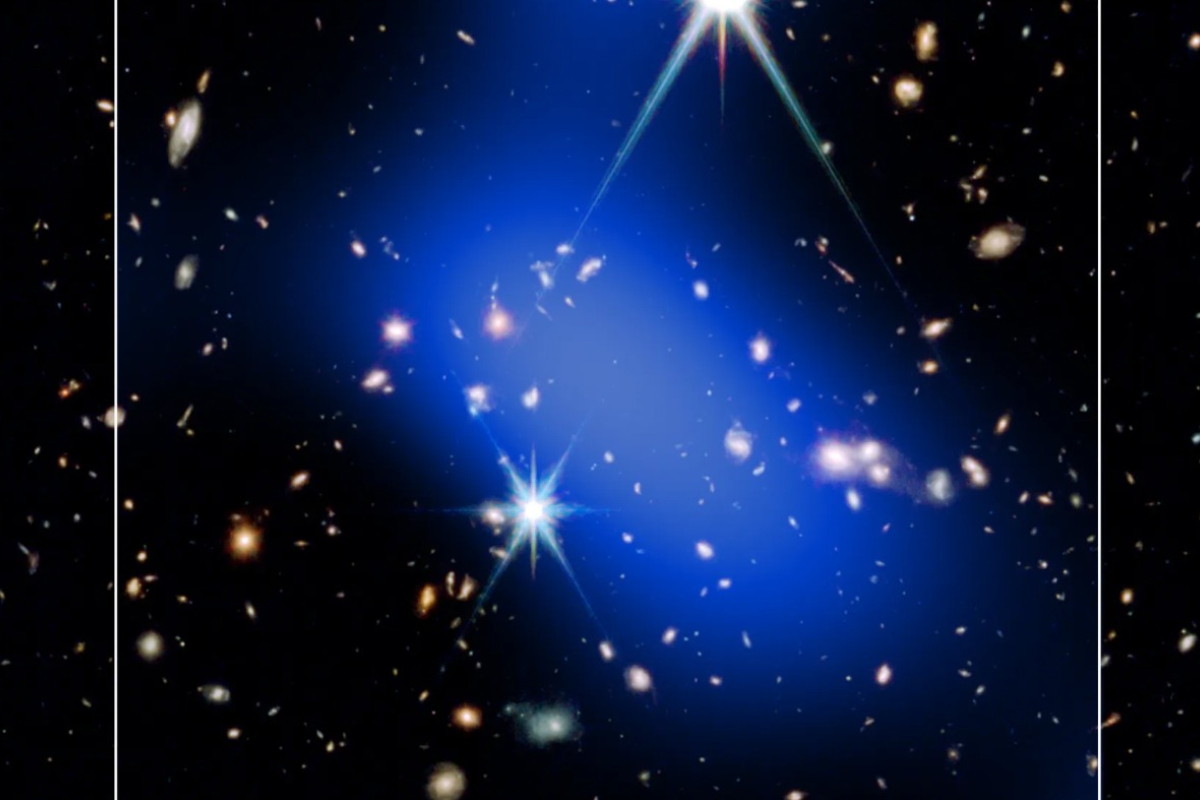
The universe continues to reveal its secrets, and a recent discovery is challenging established timelines for the formation of large-scale structures. Astronomers, utilizing the combined power of NASA’s Chandra X-ray Observatory and the James Webb Space Telescope, have identified a remarkably massive protocluster of galaxies – designated JADES-ID1 – that existed just one billion years after the Big Bang. This finding suggests that the universe may have matured far more rapidly than previously thought, prompting a reevaluation of cosmological models.
This early protocluster, a precursor to the massive galaxy clusters we observe today, is particularly intriguing due to its unexpectedly early appearance. The discovery, detailed in recent research, centers around JADES-ID1, located within the JWST Advanced Deep Extragalactic Survey (JADES) field. Its estimated mass is a staggering 20 trillion times that of our Sun, making it an exceptionally dense region for such an early epoch in cosmic history. The sheer scale of JADES-ID1 raises fundamental questions about the processes that drove structure formation in the nascent universe.
Understanding the formation of these early structures is crucial to unraveling the evolution of the cosmos. Galaxy clusters aren’t simply collections of galaxies; they are embedded within vast halos of superheated gas and dark matter. As galaxies form and merge within these clusters, the gas is heated to millions of degrees, emitting X-rays that can be detected by telescopes like Chandra. The presence of this hot gas, coupled with the gravitational pull binding the galaxies together, confirms JADES-ID1’s status as a protocluster. This detection is a key piece of evidence supporting the theory that these structures were already beginning to assemble in the early universe.
A Cosmic Puzzle: The Rapid Growth of JADES-ID1
The discovery of JADES-ID1 presents a significant puzzle for cosmologists. Current models struggle to explain how such a massive structure could have formed so quickly after the Big Bang. The prevailing theory suggests that gravity needed time to amplify initial density fluctuations in the early universe, gradually pulling matter together to form galaxies and, eventually, clusters. However, JADES-ID1 appears to have bypassed this gradual process, achieving a substantial mass within a remarkably short timeframe. “Before, astronomers found extremely massive galaxies and black holes very soon after the Big Bang, and now we’re finding that galaxy clusters can also grow quickly,” explained Qiong Li of Manchester University, a lead researcher on the project.
Further investigation revealed that JADES-ID1 isn’t alone. Li and her colleague, Christopher Conselice, have identified five other candidate protoclusters within the JADES field. However, JADES-ID1 stands out as the only one exhibiting the telltale signs of hot gas within its galaxies and possessing sufficient mass to generate detectable X-ray emissions. This unique characteristic reinforces its classification as a genuine protocluster and highlights the exceptional nature of its early formation. The Chandra X-ray Observatory played a critical role in detecting this crucial X-ray signature, confirming the presence of the hot gas and solidifying the protocluster’s identity. NASA’s Chandra X-ray Observatory detects X-ray emissions from very hot regions of the universe.
The Role of Chandra and Webb in Unveiling the Early Universe
The discovery of JADES-ID1 underscores the synergistic power of combining observations from different telescopes. The James Webb Space Telescope, with its unparalleled infrared vision, was instrumental in identifying the galaxies within the protocluster and measuring their distances. Its ability to peer through cosmic dust and detect the faint light from extremely distant objects allowed astronomers to pinpoint JADES-ID1 at a record-breaking distance. Meanwhile, the Chandra X-ray Observatory provided the crucial X-ray data, revealing the presence of the hot gas that confirms the protocluster’s existence.
The Chandra telescope, launched in 1999, is specifically designed to detect X-ray emissions from high-energy phenomena in the universe, such as exploded stars, galaxy clusters, and matter around black holes. Its high resolution and sensitivity allow it to resolve fine details in these X-ray sources, providing valuable insights into the physical processes at play. The James Webb Space Telescope, the successor to the Hubble Space Telescope, operates primarily in the infrared spectrum, enabling it to observe objects that are too distant or obscured by dust for visible-light telescopes to detect. Together, these two telescopes provide a comprehensive view of the universe, complementing each other’s strengths and revealing previously hidden details.
Implications for Cosmological Models
The rapid formation of JADES-ID1 has significant implications for our understanding of the universe’s evolution. It suggests that the processes governing structure formation may be more efficient than previously assumed, or that there may be additional mechanisms at play that accelerate the growth of these structures. “The challenge for us now is to understand how this protocluster was able to form so quickly,” Conselice stated. This discovery could necessitate revisions to existing cosmological models, potentially incorporating recent physics or refining our understanding of the initial conditions of the universe.
The standard cosmological model, known as Lambda-CDM, posits that the universe is composed primarily of dark energy (Lambda) and cold dark matter (CDM). This model successfully explains many observed features of the universe, such as the cosmic microwave background and the large-scale distribution of galaxies. However, it also has limitations, and the discovery of JADES-ID1 highlights one of those challenges. The model may need to be adjusted to account for the possibility of more rapid structure formation in certain regions of the early universe.
the discovery suggests that the early universe may have been more heterogeneous than previously thought, with some regions experiencing accelerated growth while others evolved more slowly. This could have implications for the distribution of galaxies and other structures we observe today. Understanding these variations in growth rates is crucial for building a complete and accurate picture of the universe’s evolution.
What’s Next in the Search for Early Structures?
Astronomers are continuing to analyze data from the JADES survey and other deep-field observations to identify additional protoclusters and further refine our understanding of early structure formation. Future observations with the James Webb Space Telescope and Chandra X-ray Observatory will be crucial for characterizing these structures in greater detail and testing the predictions of cosmological models. The team plans to conduct follow-up observations of JADES-ID1 to measure the velocities of the galaxies within the protocluster and map the distribution of dark matter. These measurements will provide further insights into the dynamics of the protocluster and its formation history.
The ongoing research into early structure formation is not only shedding light on the origins of the universe but also providing valuable clues about the nature of dark matter and dark energy, the mysterious components that make up the vast majority of the cosmos. By unraveling the secrets of the early universe, One can gain a deeper understanding of our place in the cosmos and the fundamental laws that govern its evolution.
The next major step in this research will involve analyzing data from future observing runs with both the James Webb Space Telescope and the Chandra X-ray Observatory, scheduled for late 2026 and early 2027 respectively. These observations will provide a more comprehensive view of the JADES field and allow astronomers to identify additional protoclusters and study their properties in greater detail. Readers interested in following these developments can identify updates on the NASA websites dedicated to both telescopes.
This discovery is a testament to the power of collaborative research and the ingenuity of modern astronomical instruments. As we continue to explore the universe, we can expect to uncover even more surprises and challenge our existing understanding of the cosmos. Share your thoughts on this groundbreaking discovery in the comments below, and don’t forget to share this article with your network!
Keep reading