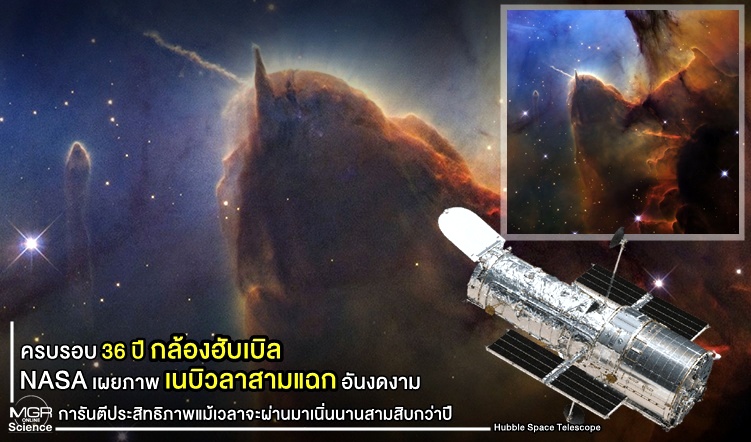
On April 24, 2026, NASA released a stunning new image of the Trifid Nebula to mark the 36th anniversary of the Hubble Space Telescope’s launch into orbit. The image, captured in visible light, showcases the nebula’s intricate structure of gas and dust, revealing ongoing star formation in a region located approximately 5,000 light-years from Earth in the constellation Sagittarius.
The Trifid Nebula, officially designated Messier 20 or NGC 6514, is a rare cosmic object that combines an emission nebula, a reflection nebula, and a dark nebula within a single field of view. Its name derives from the three-lobed appearance of its dark dust lanes, which divide the glowing gas into three distinct sections when viewed from Earth. This latest Hubble observation highlights how the nebula has evolved over nearly three decades, offering astronomers valuable insights into the dynamic processes of stellar birth and interstellar medium interaction.
According to NASA’s official announcement, the image was taken using Hubble’s Wide Field Camera 3 (WFC3), which has been instrumental in capturing high-resolution views of celestial objects since its installation during the 2009 servicing mission. The data collected not only serves a public outreach purpose but also supports ongoing scientific research into how massive stars influence their surroundings through radiation and stellar winds.
“This image celebrates Hubble’s enduring legacy as a tool for discovery,” said a NASA spokesperson in the release. “Even after more than three decades in space, the telescope continues to deliver transformative views of the universe that deepen our understanding of cosmic origins.” The statement emphasized that Hubble remains a cornerstone of NASA’s astrophysics mission, complementing newer observatories like the James Webb Space Telescope.
The Hubble Space Telescope was launched aboard the Space Shuttle Discovery on April 24, 1990, beginning what has become one of the most productive scientific endeavors in history. Over its operational lifetime, Hubble has made over 1.5 million observations, contributing to breakthroughs in cosmology, exoplanet characterization, and galaxy evolution. Its ability to observe in ultraviolet, visible, and near-infrared wavelengths has allowed scientists to study phenomena ranging from the atmospheres of distant planets to the light from galaxies formed shortly after the Big Bang.
Despite the deployment of more advanced telescopes, Hubble continues to operate effectively due to periodic servicing missions and ongoing software updates. Engineers at NASA’s Goddard Space Flight Center and the Space Telescope Science Institute in Baltimore monitor the spacecraft’s systems daily, ensuring stable pointing and instrument performance. As of 2024, all major subsystems remain functional, with no indication of imminent failure.
The Trifid Nebula itself is a vibrant stellar nursery, illuminated by a young, massive star at its center that emits intense ultraviolet radiation. This radiation ionizes the surrounding hydrogen gas, causing it to glow in characteristic red hues—visible in the emission nebula component. Meanwhile, dust particles reflect starlight from nearby stars, producing the blue reflection nebula seen in the upper regions of the image. The dark lanes, composed of dense interstellar dust, absorb background light and create the trifurcated pattern that gives the nebula its name.
Scientists note that comparing current Hubble images with those taken in the 1990s reveals subtle changes in the nebula’s structure, such as the movement of dust clouds and the emergence of new stellar sources. These temporal comparisons are critical for understanding how star-forming regions evolve over time, particularly under the influence of energetic feedback from newborn stars.
Hubble’s longevity has also enabled long-term monitoring campaigns that would be impossible with shorter-lived missions. For example, repeated observations of variable stars, planetary atmospheres, and transient events like comet impacts have provided unique datasets that improve predictive models across multiple disciplines in space science.
In addition to its scientific contributions, Hubble has played a significant role in inspiring public interest in astronomy. Its iconic images—such as the Pillars of Creation, the Hubble Deep Field, and now the Trifid Nebula—have become cultural touchstones, appearing in educational materials, documentaries, and art installations worldwide. NASA regularly shares these images through its website and social media channels, making cutting-edge science accessible to global audiences.
As the telescope enters its fourth decade of operation, NASA has confirmed that no final decommissioning date has been set. Instead, the agency continues to evaluate Hubble’s performance on a case-by-case basis, prioritizing scientific output and operational safety. Any future decisions regarding end-of-life procedures will be made in coordination with international partners and based on technical assessments.
For those wishing to explore the latest Hubble imagery or learn more about ongoing missions, NASA’s official Hubble Site (hubblesite.org) provides access to a searchable archive of images, videos, and scientific findings. The site also features educational resources for students and educators, including lesson plans and interactive tools aligned with STEM curricula.
While the James Webb Space Telescope has begun unveiling its own infrared perspectives on the universe, Hubble’s unique capabilities in ultraviolet and visible light ensure its continued relevance. Together, the two observatories represent a powerful synergy in modern astrophysics, each filling observational gaps that the other cannot.
As astronomers prepare for the next generation of space telescopes, including the planned Nancy Grace Roman Space Telescope, Hubble remains a vital bridge between past discoveries and future exploration. Its 36-year journey underscores the value of long-term investment in scientific infrastructure and the enduring human desire to understand our place in the cosmos.
The next major milestone for Hubble will be the continuation of its current observation cycle, scheduled to run through 2026, with proposals for Cycle 35 already under review by the Space Telescope Science Institute. Researchers interested in submitting observations can uncover guidelines and deadlines on the official Hubble website.
If you found this overview of Hubble’s latest achievement informative, consider sharing it with others who appreciate science and exploration. Join the conversation by leaving a comment below—we welcome thoughtful reflections on how space science continues to shape our view of the universe.