
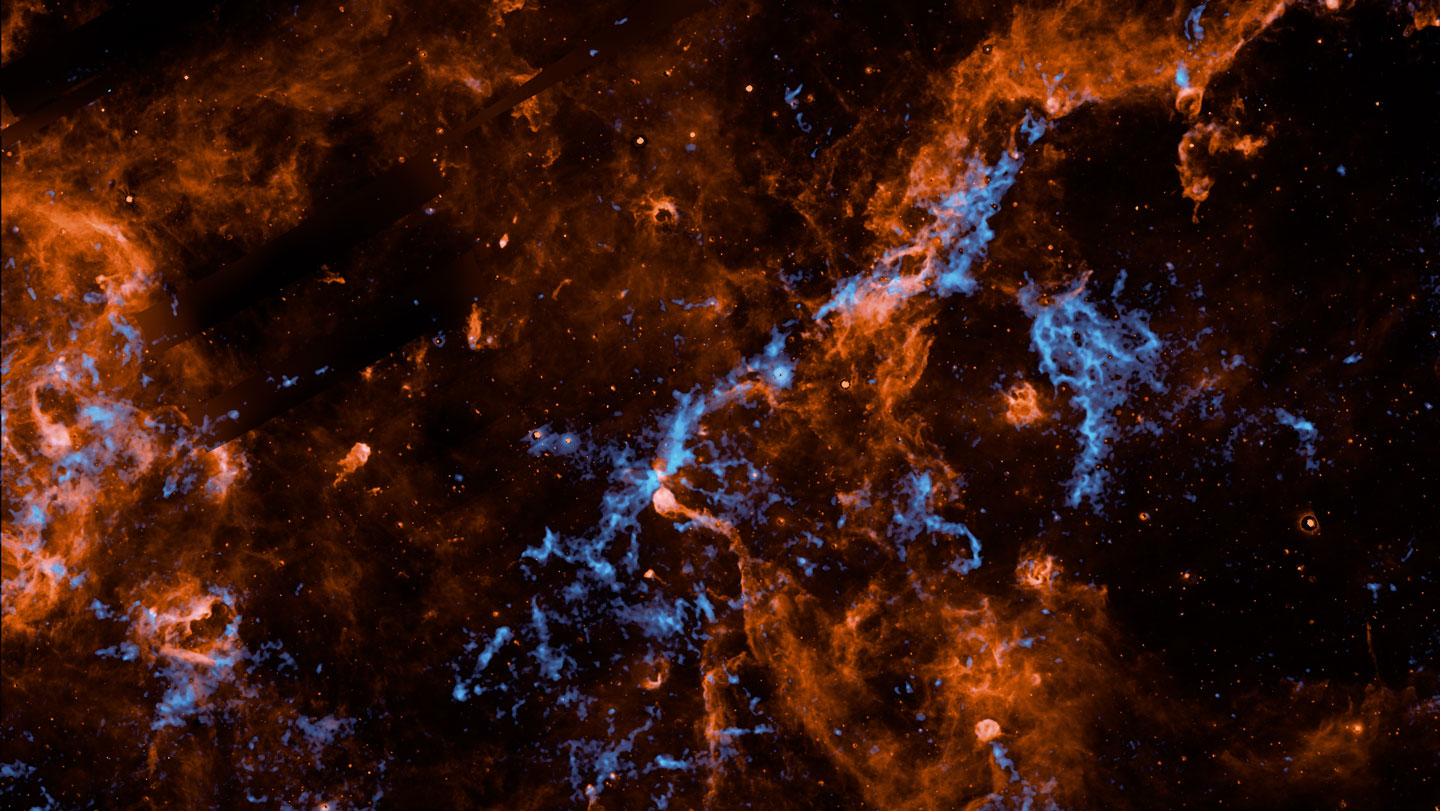
In a significant development for astrobiology and planetary science, astronomers have confirmed the widespread presence of water ice in stellar nurseries across the Milky Way, offering new insights into how oceans may form on nascent worlds. Using data from NASA’s SPHEREx space observatory, researchers have mapped frozen water molecules threaded through dense interstellar clouds where stars and planetary systems are born.
The findings, detailed in a study published in The Astrophysical Journal on April 15, 2026, reveal that water ice is not merely scattered but forms extensive, interconnected structures in regions like Cygnus X—one of the galaxy’s most active star-forming complexes. These icy reservoirs, shielded by surrounding dust from harsh ultraviolet radiation emitted by young stars, may serve as a primordial source of water for developing planets.
According to the research team led by Joseph Hora of the Harvard-Smithsonian Center for Astrophysics, SPHEREx’s unique capability to observe the sky in 102 infrared wavelengths enabled the first large-scale, high-fidelity mapping of interstellar ice distribution. The observations show that ice accumulates on the surfaces of microscopic silicate and carbon-based dust grains—particles no larger than those found in candle smoke—within molecular clouds where gas and dust collapse under gravity to form new stars.
“When we look along the galactic plane, where most of our galaxy’s stars, gas, and dust are concentrated, scattered background light shines through entire clouds, and SPHEREx can see the distribution of ice within them in incredible detail,” Hora explained in a statement accompanying the study’s release. The data confirm a long-standing hypothesis: that interstellar ice forms on dust grain surfaces and is preserved in the densest, most shielded regions of these clouds.
The study further notes that the spatial distribution of water ice closely aligns with the densest filaments of interstellar dust, suggesting a protective role for these grains. Without this shielding, the intense radiation from newborn stars would sublimate the ice, preventing its accumulation. Instead, in sheltered zones, the ice persists and may eventually be incorporated into protoplanetary disks around forming stars.
This process has profound implications for understanding the origin of Earth’s oceans. Scientists have long theorized that much of the water on our planet—and potentially on other worlds—originated as ice in interstellar space before being incorporated into the solar system during its formation 4.6 billion years ago. The SPHEREx observations provide empirical support for this idea by demonstrating that such ice is not rare but widespread across vast stellar nurseries.
“If there’s a lot of this ice nearby, that provides a likely answer to how these newly forming worlds could acquire their own oceans,” said Gary Melnick, an astronomer at the Harvard-Smithsonian Center for Astrophysics and co-author of the study. His remarks, published alongside the research in The Astrophysical Journal, emphasize that the abundance of interstellar ice increases the likelihood that water is a common ingredient in planetary systems throughout the galaxy.
The research builds on earlier detections by missions such as the James Webb Space Telescope and the retired Spitzer Space Telescope, which identified water, carbon dioxide, carbon monoxide, and other icy molecules in localized regions. However, SPHEREx is the first mission specifically designed to conduct a full-sky spectral survey in the infrared, allowing it to trace ice across unprecedented scales—more than 600 light-years in extent in the regions studied.
By observing in narrow infrared bands, SPHEREx can distinguish the spectral signatures of different molecular ices, enabling scientists to map not just where ice exists but also its composition and physical state. This level of detail was unattainable with previous observatories, which lacked both the spectral resolution and wide-field capability to study ice distribution on galactic scales.
The findings come at a time when interest in the cosmic origins of water is growing, particularly in the context of exoplanet research and the search for habitable worlds. Understanding how water is distributed and preserved in interstellar environments helps scientists model the conditions under which rocky planets might accumulate volatile compounds essential for life.
As SPHEREx continues its all-sky survey, astronomers expect to build a more complete three-dimensional map of ice distribution throughout the Milky Way. Future analyses will focus on comparing ice abundances in different galactic environments—such as quiet versus turbulent star-forming regions—to determine how local conditions affect the survival and distribution of water and other volatiles.
For now, the study affirms a poetic yet scientifically grounded notion: the water in Earth’s oceans may have begun its journey not in rivers or rain, but as faint glimmers of ice on dust grains drifting in the dark, fertile clouds where stars are born.